
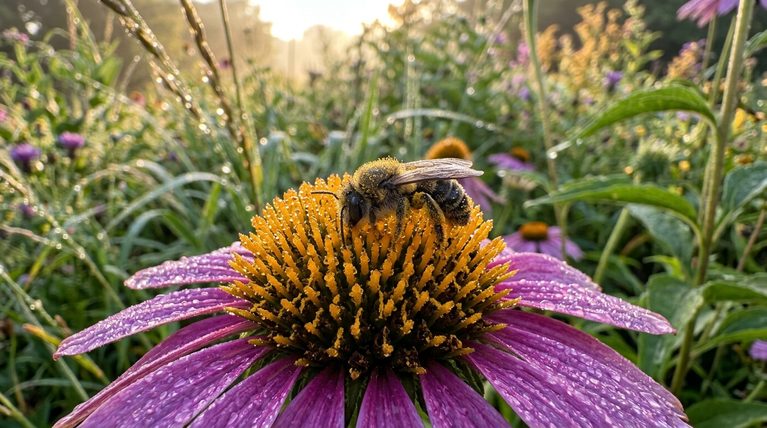
If you have ever found a bee motionless inside a flower, covered in pollen, not responding to gentle movement, it was almost certainly asleep.
This behavior, captured in a now-famous series of photographs by wildlife photographer Joe Neely, went viral because it is genuinely charming. Two globe mallow bees, curled together inside a bright orange flower, completely still.
But there is real science behind this image. Understanding why and how bees sleep in flowers reveals something important about pollinator biology — and tells gardeners exactly what to plant to support them.
Do Bees Actually Sleep?
Yes, in a meaningful physiological sense. Bees exhibit a sleep-like state during which their nervous system activity slows, their antennae droop, and they become significantly less responsive to stimuli.
Brandon Hopkins, a bee researcher at Washington State University, explains that you cannot identify sleeping bees by looking for closed eyes — bees have no eyelids. Instead, researchers identify sleep by watching for the cessation of antenna movement, which bee antennae do almost continuously when awake.
Honey bee sleep was studied extensively in 2008 by researchers at the Free University of Berlin, who documented that sleep-deprived honey bees made more navigation errors and performed the waggle dance less precisely — exactly the kind of cognitive impairment you see in sleep-deprived mammals. Sleep is not optional for bee health.
Which Bees Sleep in Flowers — and Why?
Not all bees sleep this way. The behavior is primarily associated with two groups:
1. Solitary Male Bees (Most Common)
In the United States, approximately 98% of bee species are solitary — meaning they don’t live in hives or nests with thousands of other bees. They are not social insects.
Male solitary bees have one primary biological purpose: to find and mate with females. They don’t build nests, don’t collect food for young, and don’t maintain a home base.
With no hive or burrow to return to at night, male solitary bees simply find a sheltered spot to sleep — often inside a flower. Flowers offer warmth (flowers retain solar heat after sunset), protection from wind and predators, and a convenient breakfast waiting when morning arrives.
The most photographed example is the globe mallow bee (Diadasia diminuta), native to the southwestern United States. This species is closely associated with Globe Mallow (Sphaeralcea), a wildflower with bowl-shaped orange blooms that seems tailor-made for this purpose.
2. Bumblebee Drones
In social bee species like bumblebees, male drones (the non-working males) are expelled from the colony when they reach maturity. After that, they spend their days foraging and attempting to mate, and sleep wherever they end up when the temperature drops — often clinging to flower heads or petals.
You will most often see bumblebee drones sleeping on late summer flowers — specifically on composite flowers like coneflowers, black-eyed Susans, and zinnias, where they can grip the petals with their legs or mandibles while resting.
The Ecology of Flower-Sleeping Bees
Beyond the visual appeal, flower-sleeping bees have measurable ecological value:
Enhanced Pollination
When a bee spends the night inside a flower, it typically returns to flowers of the same species the next morning — a behavior called flower constancy. This is beneficial for plants because effective pollination requires pollen transfer between flowers of the same species. A bee that rested in a globe mallow all night is covered in globe mallow pollen and will carry it directly to the next globe mallow it visits.
The longer a bee spends in close contact with a flower, the more pollen it inadvertently transfers. Flower-sleeping bees may contribute disproportionately to pollination relative to their numbers.
Native Plant Support
Many flower-sleeping solitary bee species are specialist pollinators — they have evolved specifically to collect pollen from one or a small number of plant genera. The globe mallow bee pollinates primarily globe mallow. Supporting these niche relationships helps maintain native plant populations that commercial honeybees may not effectively serve.
How to Attract and Support Sleeping Bees in Your Garden
If you want to spot sleeping bees in your garden, or better yet, provide reliable habitat for them, here is what works:
Plant the Right Flowers
Flowers that are most commonly used as sleeping spots share common characteristics: they are bowl-shaped or tubular, large enough to shelter a bee’s body, and positioned close to the ground or horizontally to provide stability.
- Globe Mallow (Sphaeralcea): Native to the western US; the primary sleeping flower for globe mallow bees. Available as seed from native plant nurseries.
- Blanket Flower (Gaillardia): Large, daisy-like composite flowers with a flat central disc where bees can cling overnight.
- Coreopsis (Tickseed): Similar structure to blanket flower; early morning garden checks often reveal bees still sleeping on them.
- Cosmos: Lightweight, open petals that bees can sleep inside or perch on. Easy to grow from seed.
- Zinnias: Composite blooms with accessible pollen and a flat resting surface. One of the best all-round pollinator plants.
- Squash and pumpkin flowers: Male squash flowers open widely and close at night — squash bees (Peponapis pruinosa) are often found sleeping inside them in the morning. Grow any cucurbit to attract squash bees.
- Poppy flowers: The papery, cup-shaped blooms make ideal shelters. Both garden poppies (Papaver) and California poppies (Eschscholzia) attract sleeping bees.
Provide Bare Ground for Nesting
Most flower-sleeping bees are solitary species that nest in the ground. USDA Forest Service records show that globe mallow bee nests are most commonly found in partially compacted soil along unpaved paths and road margins.
To support nesting near your garden: leave patches of bare or sparsely vegetated soil in sunny spots, avoid heavy mulching of all surfaces (mulch can block ground-nesting sites), and minimize soil disturbance in areas where bees appear active.
Stop Using Pesticides — Even “Natural” Ones
Sleeping bees are extraordinarily vulnerable to pesticide exposure. A bee that has retreated inside a flower overnight has maximized contact with any residue on petals or pollen. Even pyrethrin-based “organic” pesticides are highly toxic to bees.
If you apply any pesticide in a garden with flowering plants, apply it only in the evening after all foraging has stopped, and avoid flowers entirely if possible.
When to Look
Early morning — between 6 and 8 AM before temperatures warm significantly — is the best time to observe sleeping bees in flowers. Check bowl-shaped flowers first. Move slowly and avoid casting shadows over the flower, which can rouse them.
Late evening, 30 minutes after sunset, is the second-best observation window when bees are just settling in for the night.
✅ Tip Male solitary bees cannot sting. They lack the stinger anatomy of females. The sleeping bees you find in flowers are almost certainly male — you can gently observe them (without touching) at close range without any risk of being stung. Photograph sleeping bees with a macro lens in low-angle morning light. The combination of pollen coating and the stillness of sleep produces extraordinary images — and you will understand exactly why Neely’s photographs went viral. |
Frequently Asked Questions
Why do bees sleep inside flowers rather than somewhere else?
For male solitary bees without a nest to return to, flowers provide three things overnight: warmth (flowers retain heat), physical shelter from wind, and concealment from predators. The same flower that attracted them for nectar during the day becomes a convenient bedroom as temperatures drop.
Is it safe to disturb a sleeping bee?
It is best not to. Disturbing a sleeping bee forces it to expend energy relocating — energy that is limited, particularly late in the season for male bees with short adult lifespans. Observe from a few inches away without touching or shaking the plant.
How long do bees sleep?
Research on honey bees suggests they sleep 5 to 8 hours in 24 hours, broken into shorter episodes of 15 to 30 seconds to a few minutes, often in total darkness or low light inside the hive. Solitary bees are less studied, but likely follow similar patterns of rest during nighttime hours.
What is the globe mallow bee?
Diadasia diminuta is a small, solitary native bee found in the western United States. It is a specialist pollinator of Globe Mallow (Sphaeralcea) and related plants. Both sexes forage for pollen and nectar from Globe Mallow, but males are the ones most commonly photographed sleeping inside the flowers. Females build nests in compacted soil near the plants they visit.
Do honeybees sleep in flowers?
Rarely. Worker honeybees typically return to the hive to sleep, where they are surrounded by colony members and protected. However, forager bees sometimes get caught away from the hive at nightfall and will find shelter on or in nearby flowers. Honey bee drones, similar to bumblebee drones, may also sleep outside the hive.
The Bottom Line
Bees sleeping in flowers are not a curiosity — they are a reminder that even the most familiar-seeming garden behaviors contain depths we rarely think about.
Solitary bees, which make up the vast majority of bee diversity in North America, are often overlooked in favor of the more familiar honeybee. They are quieter, smaller, and less conspicuous — until you find one peacefully asleep in your morning garden.
Plant the right flowers. Leave some bare ground. Put away the pesticides. And check your cosmos and blanket flowers at first light. You might find a perfect, pollen-covered guest still resting from the night before.
