
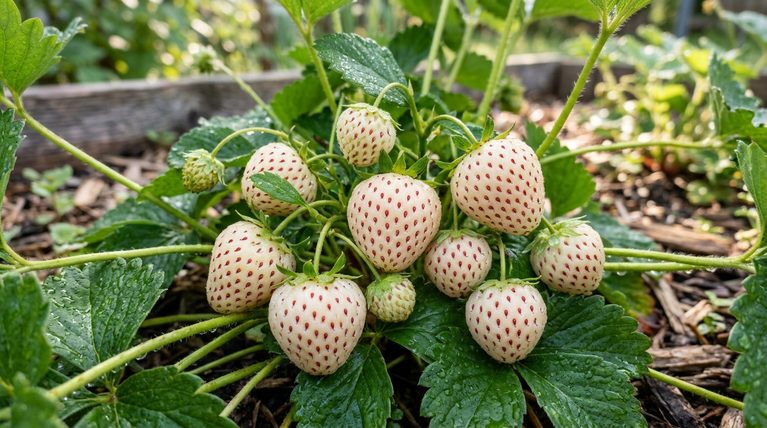
They look like an unripe strawberry. They smell faintly of pineapple. And when you bite into one, you realize you are eating something genuinely new.
The pineberry is one of the most surprising fruits you can grow in a home garden, a pale, almost ghostly white strawberry with bright red seeds and a flavor that defies easy description. Sweet, tart, aromatic, with tropical notes that remind most people of pineapple, though the comparison is never quite exact.
Here is everything you need to know: what pineberries actually are, why they taste the way they do, how to grow them successfully, and what to do with them in the kitchen.
What Is a Pineberry?
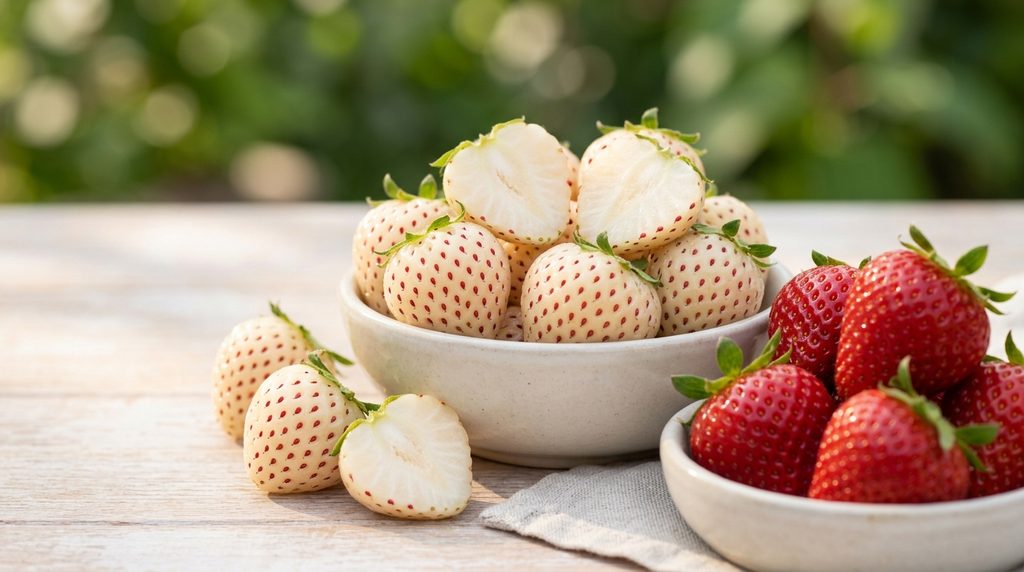
A pineberry is a type of white strawberry, botanically Fragaria x ananassa, produced by crossing two wild strawberry species: Fragaria chiloensis (the Chilean beach strawberry, native to South America) and Fragaria virginiana (the Virginia wild strawberry, native to North America).
Despite the name, pineberries are not a cross between strawberries and pineapples. They contain no pineapple genetics whatsoever. The name refers to the flavor, not the parentage.
White strawberries have existed in Chile and Japan for centuries, indigenous Chileans cultivated pale Fragaria chiloensis long before European contact. The specific modern pineberry, marketed as a novelty fruit, was first introduced commercially in UK supermarkets in 2010 and reached US markets around 2012, introduced by Burpee in partnership with plant breeders.
Wikipedia notes the pineberry measures between 15 and 23 mm, slightly smaller than a typical garden strawberry. The fruit is creamy white to pale pink when fully ripe, with prominent red achenes (seeds) on the surface. Fully ripe pineberries feel soft to the touch and pull easily from the stem.
What Does a Pineberry Taste Like?
This is the question everyone asks, and the honest answer is: it depends.
Most people describe the flavor as a mild, sweet strawberry with tropical overtones — fruity notes reminiscent of pineapple, sometimes with hints of citrus or vanilla. The texture is similar to a standard garden strawberry, though slightly softer and generally less acidic.
The Guardian, when tasting pineberries at their UK debut in 2010, was famously unimpressed — one editor described them as tasting like water with sweetener. Commercial pineberry varieties in large-scale production often sacrifice flavor intensity for yield and shelf life.
Home-grown pineberries from specialty varieties like Natural Albino, White D, or White Carolina tend to deliver a more pronounced and complex flavor than commercially packaged ones. The best pineberries are eaten within 1 to 2 days of harvest, fresh from the plant — not from a supermarket punnet that has been refrigerated for days.
Are Pineberries Nutritious?
Pineberries share the same general nutritional profile as garden strawberries:
- Vitamin C: A significant source supporting immune function and collagen production
- Antioxidants: Quercetin, anthocyanins, and ellagic acid protect cells from oxidative damage
- Dietary fiber: Supports digestive health and stable blood sugar
- Low calorie: Approximately 30 to 40 calories per 100 grams — comparable to red strawberries
- Manganese: Supports bone density and metabolic function
Pineberries are less acidic than most red strawberries, which can make them a more comfortable option for people with acid reflux or sensitivity to acidic foods.
How to Grow Pineberries
The good news for home gardeners is that growing pineberries is nearly identical to growing standard strawberries. If you have successfully grown strawberries before, you can grow pineberries.
Pollination: The Critical Requirement
Pineberries are only partially self-fertile. Most varieties produce significantly more and larger fruit when planted near a red strawberry variety for cross-pollination.
The recommended ratio is 1 red strawberry plant for every 3 to 5 pineberry plants. The red strawberry provides the pollen — the resulting pineberry fruit remains white regardless of which red variety you use. Good companion red varieties include Sonata, Earliglow, or any standard June-bearing garden strawberry.
Best Varieties to Grow
- Natural Albino: The classic pineberry variety; good flavor but smaller fruit and lower yield. Needs cross-pollinator.
- White D: Slightly larger fruit than Natural Albino; everbearing, producing fruit multiple times per season. A popular choice for home gardens.
- White Carolina: Burpee’s commercial variety; everbearing; labeled as self-pollinating but performs better with a companion.
- White Pine: Hardy with characteristic pineapple flavor; somewhat lower yield but excellent for cooler climates.
Growing Conditions
- Sun: Full sun, minimum 6 hours of direct light daily. More sun equals more flavor.
- Soil: Loamy, well-draining, slightly acidic (pH 5.5 to 6.5). Amend clay soils with compost and perlite.
- Planting: Set crowns at soil level — never bury the crown or leave it fully exposed. 12 inches between plants, 18 to 24 inches between rows.
- Watering: 1 to 1.5 inches per week. Soaker hose or drip irrigation keeps foliage dry and reduces fungal disease risk.
- Mulch: Straw, pine needles, or shredded bark suppress weeds, retain moisture, and keep fruit off the soil.
- Fertilizer: Apply a balanced fertilizer (10-10-10) at planting and again after first harvest. Avoid high-nitrogen products that push leafy growth at the expense of fruit.
When Is a Pineberry Ripe?
Unlike red strawberries, you cannot judge pineberry ripeness by color alone. The fruit is white even before it is ripe.
A fully ripe pineberry: feels soft to gentle pressure, releases easily from the stem without pulling, and smells distinctly fruity and aromatic. The seeds (achenes) turn from white to a deeper red as the fruit matures.
Harvest time: late spring through early summer for June-bearing varieties; multiple flushes from late spring through fall for everbearing types.
Where to Buy Pineberry Plants
Pineberry seeds are not widely available because most varieties are hybrids that do not grow true from seed. Purchase bare-root plants or potted starts from:
- Burpee.com (White Carolina variety)
- Stark Brothers Nurseries (White Pineberry variety)
- Etsy specialty plant sellers (search “pineberry plant”)
- Local specialty nurseries and farmers markets in spring
Expect to pay $5 to $15 per plant depending on variety and source.
Pineberries in the Kitchen
Use pineberries anywhere you would use fresh strawberries — they substitute directly in most recipes:
- Fresh eating: Their best use; eat within 1 to 2 days of harvest for peak flavor
- Fruit salads: The white color creates a striking visual contrast against dark berries and tropical fruits
- Pineberry jam: Works beautifully; the jam turns a soft peachy-pink. Add a squeeze of lemon juice to brighten the flavor.
- Pavlovas and cream desserts: The muted color of pineberries looks elegant against white cream and meringue
- Cocktails and mocktails: Muddle with mint and lime for a sophisticated berry drink
- Chefs’ pairings: Pineberries pair particularly well with apples, vanilla, ginger, soft cheeses, and white fish — flavor combinations that emphasize their tropical aromatic quality
Storage
Pineberries are more perishable than red strawberries. Their pale color makes it easy to miss early signs of overripening.
- Refrigerator: Store unwashed in a single layer in an open container. Use within 2 to 3 days.
- Freezer: Freeze on a sheet pan, then transfer to a bag once solid. Frozen pineberries work well in smoothies and cooked preparations, though texture degrades.
- Do not wash until ready to use: Moisture accelerates decay.
✅ Tip Pineberries are naturally less attractive to birds than red strawberries — their pale color does not trigger the same feeding response. This is a genuine practical advantage: you may need less netting to protect your harvest. Squirrels and chipmunks are still a significant threat regardless of color. Use row cover fabric or a simple cage of hardware cloth over beds during ripening. |
Frequently Asked Questions
Are pineberries a cross between pineapples and strawberries?
No. Pineberries are a cross between two wild strawberry species (Fragaria chiloensis and Fragaria virginiana) and contain no pineapple genetics. The name refers to their pineapple-like flavor, not their botanical parentage.
Are pineberries GMO?
No. Pineberries are a naturally bred hybrid created through conventional cross-pollination of two strawberry species. They are not genetically modified organisms.
Why do pineberries have red seeds?
The red color in the achenes (seeds) comes from anthocyanin pigments. Pineberries produce anthocyanins in their seeds but lack the gene expression needed to produce them in the fruit flesh, which is why the flesh remains white while the seeds turn red as the fruit ripens.
Do you need two pineberry plants?
Most pineberry varieties perform much better with a red strawberry companion nearby for cross-pollination. A single pineberry plant will produce some fruit, but yield is significantly higher when at least one red strawberry variety is planted within 5 to 10 feet. Use approximately one red strawberry for every three to five pineberry plants.
Are pineberries perennial?
Yes. Like garden strawberries, pineberries are perennial and will return each year in most USDA hardiness zones. They typically produce their best fruit in years 2 and 3. By year 4 or 5, production declines and plants should be replaced with new runners or purchased plants.
The Bottom Line
Pineberries are genuinely worth growing — not because they will revolutionize your fruit harvest, but because they are one of the most interesting and conversation-starting plants you can put in a garden.
The flavor at its best, freshly picked on a warm morning, is unlike anything from a supermarket. Mild, aromatic, tropical — a strawberry that has been somewhere you have not.
Buy a few plants this spring, give them a red strawberry companion, and harvest them the moment they soften. That is when they are at their best.
