
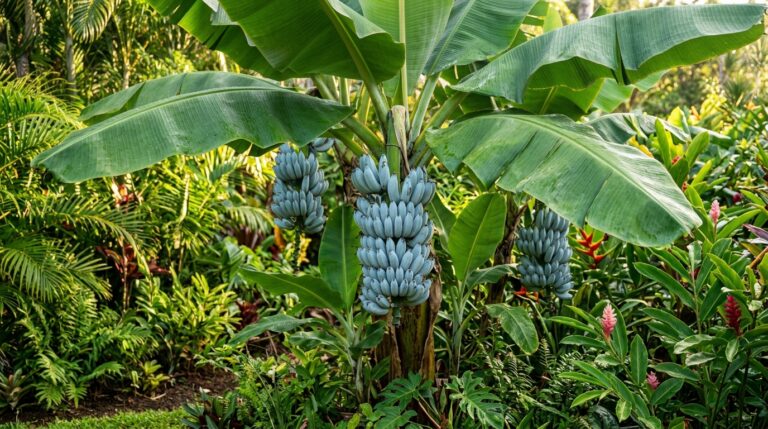
The Blue Java banana sounds like a gardening myth.
A banana with blue skin that tastes like vanilla ice cream? The photos look manipulated. The descriptions sound like marketing.
It is real. The Blue Java is a documented banana cultivar with a well-established history in Southeast Asia, Hawaii, Fiji, and Central America. It does turn blue-silver before ripening. And most people who eat one at peak ripeness genuinely describe the flavor as custard-like, with vanilla overtones unlike any commercial banana they have tasted.
Here is the full honest picture: what it actually looks and tastes like, what growing it requires, and whether it is worth the effort.
What Is the Blue Java Banana?
Blue Java (Musa acuminata × balbisiana, cultivar group ABB) is a banana hybrid between two wild banana species native to Southeast Asia. It belongs to the ABB group, meaning it carries more genetic material from Musa balbisiana — the wild species that contributes cold tolerance, firm flesh, and strong flavor.
Wikipedia describes the fruit as 18 to 23 centimeters long (7 to 9 inches), initially a silvery-green due to a heavy wax coating on the skin. The wax coating gives the illusion of blue — which is real in indirect light and shade, less obvious in direct sun.
The flesh is cream-white, soft, and extremely creamy when fully ripe. The fruit bunches are smaller than commercial Cavendish bananas, bearing 7 to 9 hands per bunch.
What Does a Blue Java Banana Actually Taste Like?
The honest answer requires separating the marketing from the biology.
The “vanilla ice cream” description is accurate in the sense that the flavor profile is genuinely different from the Cavendish banana most Americans know. Blue Java bananas are higher in sugar, have a softer and more mousse-like texture when fully ripe, and contain aromatic compounds that produce a vanilla-custard quality.
However, the comparison to vanilla ice cream is a flavor analogy — not a literal equivalence. You will not bite into a Blue Java and think you are eating a frozen dessert. You will taste a very rich, sweet, aromatic banana with creamy texture and vanilla-adjacent flavor notes that most people find superior to Cavendish.
Note on social media photos: Many widely-shared images of Blue Java bananas are heavily saturated or AI-generated, showing intensely blue fruit with light blue flesh. Real Blue Java fruit is silver-green before ripening and turns pale yellow with cream flesh — not bright blue. The wax coating gives a blue-silver sheen in certain lighting conditions. Manage your expectations based on the real photographs available on Wikipedia rather than Pinterest.
Nutritional Profile
Blue Java bananas share the nutritional benefits of all bananas:
- Potassium: ~400mg per banana — essential for heart health, blood pressure regulation, and muscle function
- Vitamin B6: Supports brain development, immune function, and serotonin production
- Vitamin C: Antioxidant supporting immune response and skin collagen synthesis
- Dietary fiber: 3 grams per banana — supports digestive health and blood sugar stability
- Natural sugars: Fructose, glucose, and sucrose provide quick energy — ideal as a pre- or post-workout snack
- Magnesium: Supports bone density and muscle recovery
Blue Java bananas are not significantly more nutritious than other banana varieties, but they are nutritionally comparable and may be more enjoyable to eat for people who find standard bananas bland.
Growing Blue Java Bananas
Cold Hardiness: The Key Advantage
The defining characteristic that distinguishes Blue Java from other banana varieties for home growers is cold tolerance. Most tropical banana varieties die back to the ground below 28°F and may not recover. Blue Java banana plants tolerate temperatures down to approximately 20°F (-6°C) with some protection — making them viable in USDA zones 8 through 11 outdoors.
In zones 7 and colder, Blue Java can be grown in large containers and brought indoors for winter, or heavily mulched and covered with frost cloth for winter protection with some chance of survival.
Climate and Sun Requirements
- Ideal zones: 9 to 11 for outdoor in-ground growing
- Marginal zones: 8 (south-facing wall protection recommended), 7 (container growing or heavy winter protection)
- Sun: Full sun, at least 6 to 8 hours daily. More sun = faster growth = fruit production
- Wind: Protect from strong winds. The large leaves shred easily and torn leaves dramatically reduce photosynthesis.
Soil
Banana plants are heavy feeders that prefer:
- Rich, loamy, well-draining soil — not clay
- pH between 5.5 and 6.5
- Significant organic matter — mix compost into the planting hole generously
- Consistent moisture but no standing water — poor drainage causes root rot quickly
Planting
Plant banana pups or tissue-cultured starts after the last frost date. In-ground planting:
- Dig a hole twice the size of the root ball.
- Mix removed soil with equal volume compost.
- Plant at the same depth as the container. Do not plant deeper.
- Water thoroughly and mulch 4 to 6 inches deep to retain moisture and moderate soil temperature.
Space plants 10 to 15 feet apart — Blue Java spreads through underground rhizomes and produces clumps over time.
Container Growing
For zones 7 and colder, container growing is the practical approach. Use a minimum 20 to 25-gallon container with excellent drainage. Use a lightweight potting mix amended with perlite.
Container-grown Blue Java plants can fruit but typically produce smaller bunches. The main advantage is being able to bring the plant indoors or into a frost-free garage from October through April.
Fertilizing
Banana plants are heavy nitrogen feeders, especially during the growing season:
- Spring through summer: Apply a high-potassium fertilizer (8-10-10 or similar) monthly
- Add compost around the base every 4 to 6 weeks during the growing season
- Potassium deficiency is common in container plants — banana peel compost tea is an ironic and genuinely effective supplement
- Stop fertilizing in fall as growth slows
When Will It Fruit?
This is the main patience test with Blue Java. According to Wikipedia, Blue Java bananas bloom 15 to 24 months after planting and require 115 to 150 days from flowering to harvestable fruit.
In practice: expect your first fruit approximately 2 to 3 years after planting from a pup, or 1 to 2 years from a tissue-cultured plant started in spring.
Once established, the plant becomes perennial and produces annually — each main stem flowers once and then dies back, replaced by new pups from the rhizome.
Where to Buy Blue Java Banana Plants
- Fast Growing Trees (fast-growing-trees.com): Ships as established plants
- PlantVine (plantvine.com): Specialty tropical nursery
- Logee’s Plants (logees.com): Specialty tropical and subtropical nursery
- Local tropical nurseries in zones 9 to 11
- Etsy specialty plant sellers: Often offer tissue-cultured starts at lower cost
Expect to pay $15 to $60 depending on plant size. Avoid seed offers — banana plants are propagated by pups (rhizome divisions), not seed.
Using Blue Java Bananas in the Kitchen
Harvest when the fruit is plump and the skin begins to show the first traces of yellowing. Do not wait for full yellow ripeness on the plant — cut the entire bunch when the first bananas begin to lighten, and allow them to ripen off the plant in a shaded, warm location for 1 to 2 days.
- Fresh eating: At peak ripeness, eat raw within 2 to 3 days for the best texture
- Smoothies: Blend with coconut milk and a pinch of cardamom for a genuinely tropical drink
- Ice cream: Freeze ripe Blue Java bananas and blend — the creamy texture creates a legitimate banana nice cream without any additional ingredients
- Baking: Substitute in any banana bread or muffin recipe — the vanilla notes add complexity
- Grilling: Grill halved bananas with brown sugar and cinnamon — spectacular at peak ripeness
✅ Tip Once your Blue Java plant fruits for the first time, cut the spent main stalk to the ground after harvest — this is normal banana plant growth. Select 2 to 3 strong pups from the surrounding rhizome to grow into the next season’s plants. In zones 8 and 9, mulch the root zone heavily (8 to 12 inches of straw or wood chips) before the first frost. The rhizome can survive even if the above-ground growth is killed back — new shoots emerge in spring. |
Frequently Asked Questions
Is the Blue Java banana actually blue?
Before ripening, yes — the heavy wax coating on the unripe fruit gives it a distinctly silvery-blue sheen, particularly in indirect light. The effect is genuine, though less dramatic than many viral photos suggest (some widely shared images are saturated or AI-generated). Once ripe, the fruit turns pale yellow, similar to other banana varieties.
How cold-hardy is the Blue Java banana?
Blue Java tolerates approximately 20°F (-6°C) with protection — notably colder than most banana varieties. It is suitable for USDA zones 8 through 11 with increasing protection needed below zone 9. The underground rhizome can survive colder temperatures than the above-ground plant.
How long does it take for a Blue Java banana to produce fruit?
From planting a pup: typically 2 to 3 years to first fruit. From a larger tissue-cultured plant: 1 to 2 years. The fruiting timeline depends heavily on climate — warmer conditions with consistent heat accelerate the process significantly. Once established, the plant produces annually.
The Bottom Line
The Blue Java banana deserves its reputation — not because it literally tastes like vanilla ice cream, but because it is genuinely different and superior to commercial Cavendish in flavor and texture when grown and eaten at peak ripeness.
It is also a significant growing commitment: 2 to 3 years to first fruit, ongoing water and fertilizer requirements, and cold protection in most US climates.
For gardeners in zones 9 and warmer with space for a statement tropical plant, it is worth every year of waiting.
