
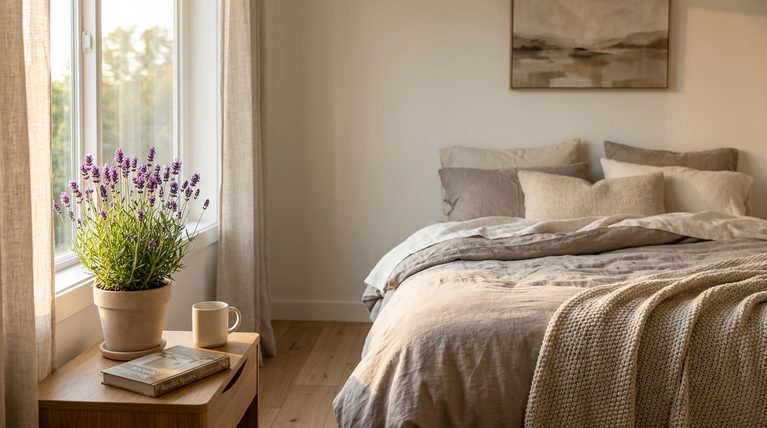
Lavender is one of the most widely used plants in the world for its reported effects on sleep, anxiety, and mood.
It is also one of the most frequently exaggerated.
Headlines like “lavender cures insomnia” or “lavender eliminates panic attacks” circulate widely and are misleading. But so is dismissing lavender’s effects entirely — there is genuine, peer-reviewed evidence supporting specific benefits that are worth understanding accurately.
This article covers what the research actually shows, what it does not support, and exactly how to use a lavender plant in your bedroom to get the documented benefits.
The Active Compounds: What Makes Lavender Work
Lavender (Lavandula angustifolia and related species) contains hundreds of volatile organic compounds in its essential oils, but research has focused most intensively on two:
- Linalool: A terpene alcohol that accounts for 25 to 45% of lavender essential oil. Animal studies and some human trials suggest it has anxiolytic (anti-anxiety) and sedative properties, possibly by modulating GABA receptors in the brain — the same receptors targeted by benzodiazepine anti-anxiety medications.
- Linalyl acetate: A linalool ester that accounts for 25 to 40% of lavender oil. It appears to enhance the anxiolytic effects of linalool and may have mild antidepressant properties.
These compounds are released in small amounts by a living lavender plant’s foliage and, more significantly, by its flowers when warm air moves through them.
What the Research Actually Shows
Sleep Quality
The evidence for lavender improving sleep quality is among the strongest in the literature:
- A 2015 study in the Journal of Alternative and Complementary Medicine found that lavender aromatherapy improved sleep quality, reduced morning grogginess, and decreased heart rate in college students with self-reported sleep difficulties.
- A 2012 study on midlife women with insomnia found that 20 minutes of lavender inhalation through aromatherapy significantly improved sleep quality compared to control conditions.
- Research published in the Journal of Biological and Medical Rhythm Research documented that inhalation of lavender before bed reduced slow-wave sleep (deep sleep) disruptions in young, healthy adults.
The mechanism appears to involve the parasympathetic nervous system — lavender inhalation has been shown to reduce heart rate and blood pressure, physiological markers associated with the pre-sleep relaxation response.
Anxiety
A 2019 systematic review and meta-analysis published in Phytomedicine (Donelli et al.) analyzed 17 clinical trials and concluded that lavender has a meaningful anxiolytic (anti-anxiety) effect compared to placebo across multiple administration routes.
The most clinically studied form is Silexan, an oral lavender oil preparation (marketed as Calm Aid in the US, approximately $20 at health food stores). Multiple randomized controlled trials show Silexan reduces anxiety symptoms comparably to low-dose pharmaceutical anxiolytics without sedation or dependence risk.
For inhalation specifically — relevant to bedroom plant use — the evidence is more moderate. Aromatherapy lavender reduces self-reported anxiety in clinical settings (preoperative anxiety, postpartum anxiety, dental anxiety), but studies in ordinary home environments show smaller effects.
Depression
The evidence for lavender’s effects on depression is more preliminary than for sleep and anxiety. Lavender appears to modulate serotonin and dopamine activity, but clinical trials are limited in size and scope.
A 2006 study found lavender aromatherapy reduced insomnia and depression scores in female college students. A 2020 study showed oral lavender supplementation improved general mental health in PTSD patients.
The honest framing: lavender may support mood as part of a broader wellness approach but should not be considered a primary treatment for clinical depression, which requires professional medical care.
Panic Attacks
There is limited clinical research specifically on lavender and panic attacks (as opposed to general anxiety). The mechanism by which lavender may help — reducing sympathetic nervous system activation through the parasympathetic response — suggests it could support recovery from acute anxiety states, but this is largely theoretical.
Using a lavender plant as a sensory grounding tool during anxiety — focusing on its scent and texture to slow breathing — is a reasonable application of its documented calming effects, even without specific panic attack research.
Does a Living Lavender Plant Work, or Do You Need Oil?
This is the most practical question for someone considering a bedroom plant.
A living lavender plant releases its aromatic compounds primarily from the flowers and, in smaller amounts, from leaf oils. The concentration of these compounds in a normal bedroom is significantly lower than in research studies using diffusers or direct inhalation.
The honest answer: a single potted lavender plant in a bedroom will likely produce a subtle effect, not the significant results documented in studies using concentrated essential oil or dedicated diffusers. You can amplify the effect by:
- Gently rubbing a few leaves before bed to release oils
- Placing the plant near your pillow or bedside table rather than across the room
- Adding a few drops of lavender essential oil to a bedside diffuser alongside the plant — the plant becomes a complement to, not a replacement for, the diffuser
- Growing a well-established plant with significant flower production rather than a small seedling
How to Grow Lavender Indoors Successfully
Lavender is genuinely difficult to grow indoors long-term. It is native to the Mediterranean and evolved in conditions most homes cannot replicate without effort:
Light: The Critical Factor
Lavender needs a minimum of 6 hours of direct sunlight per day — bright, direct sun, not bright indirect light. This is extremely difficult to achieve in most indoor settings without supplemental lighting.
In practice, this means: a south-facing window in the sunniest room of the house, or a T5 or LED grow light positioned 4 to 6 inches above the plant for 14 to 16 hours daily.
Without adequate light, lavender becomes leggy, loses fragrance intensity, and eventually declines. This is the most common cause of indoor lavender failure.
Best Varieties for Indoors
- Hidcote (Lavandula angustifolia ‘Hidcote’): Compact, intensely fragrant, relatively tolerant of indoor conditions
- Vera: Classic English lavender fragrance; compact enough for 12-inch pots
- Avonview: Compact Lavandin hybrid with high fragrance output
- Goodwin Creek Grey: Semi-hardy variety with silver foliage, more tolerant of humidity than most English lavenders
Container and Soil
- Use a terra cotta pot with drainage holes — lavender roots need airflow and terra cotta’s porosity helps prevent overwatering
- Fill with cactus/succulent potting mix or mix standard potting soil 50/50 with perlite for fast drainage
- Pot size: 8 to 12 inches diameter minimum for a full-sized plant
- Place pot in a saucer with pebbles to prevent sitting in water — roots in standing water cause root rot within days
Watering
This is where most indoor lavender dies. Lavender is a drought-adapted plant. It wants the soil to dry out completely between waterings.
- In winter or low-light conditions: water approximately once every 2 to 4 weeks
- In summer or under grow lights: once every 1 to 2 weeks
- Test by pushing a finger 2 inches into the soil — water only when completely dry at that depth
- Never leave in standing water in a saucer after watering; dump excess
Temperature and Humidity
Lavender prefers 60 to 70°F indoors. It tolerates cool winter temperatures (down to 50°F) but suffers in high humidity. Bathrooms are not suitable. Avoid placement near humidifiers.
⚠️ Warning Do not mist lavender. Misting promotes fungal disease on both leaves and stems. Lavender is not toxic to humans or most pets, but should be kept away from cats that chew plants — ingestion of essential oil can cause gastrointestinal upset. |
Frequently Asked Questions
Does lavender really help you sleep?
The research supports that lavender aromatherapy — particularly consistent exposure to lavender scent before and during sleep — modestly improves sleep quality, reduces nighttime wakefulness, and supports the pre-sleep relaxation response. The effect is real but moderate, and more consistent with diffused essential oil than with a single potted plant.
Can lavender cause allergic reactions?
Yes, in a minority of people. Lavender allergy is uncommon but exists — symptoms can include skin contact dermatitis (from topical essential oil) or respiratory irritation (from diffused oil in high concentrations). If you are sensitive to strong floral scents, start with brief, low-concentration exposure and monitor for symptoms.
Is lavender essential oil or a live plant better for sleep?
For the level of concentration research has shown to be effective, lavender essential oil in a bedside diffuser is more reliable than a living plant. A living plant is a beautiful complement and provides continuous low-level exposure, but for documented effects on sleep quality, a diffuser using 2 to 3 drops of pure lavender oil is more consistent.
How do I make my indoor lavender more fragrant?
Fragrance intensity is directly linked to sun exposure. Move the plant to the sunniest window available, or supplement with a grow light. Also: more flowers means more fragrance. Lavender flowers in spring and summer — outside of this period, fragrance comes primarily from gently rubbing the foliage. Pruning by one-third after bloom stimulates new fragrant growth.
The Bottom Line
Lavender’s reputation is earned — but the headlines overstate the effects.
There is genuine peer-reviewed evidence that lavender aromatherapy modestly improves sleep quality, reduces anxiety, and may support mood. A living lavender plant in your bedroom is a beautiful, low-maintenance way to access these effects at a subtle but consistent level.
For stronger effects, pair the plant with a bedside diffuser using 2 to 3 drops of pure lavender essential oil. Give the plant the brightest window you have, plant it in well-draining soil, and resist the urge to overwater.
Used well, it is one of the most pleasant plants you can keep in your most personal space.
