
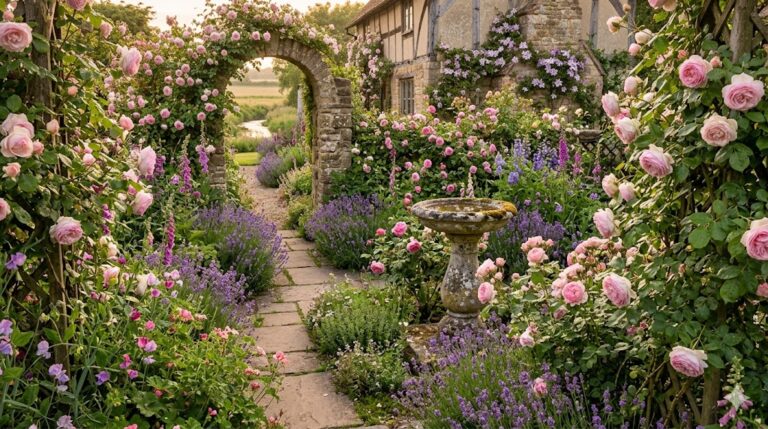
A cottage garden is a deliberate act of imperfection.
Unlike formal garden styles with rigid lines and geometric symmetry, cottage gardens embrace abundance, apparent randomness, and the beauty of plants allowed to self-seed and intermingle at will. They look effortless because the gardener has learned to edit rather than control, guiding the garden’s natural exuberance rather than fighting it.
The Cottage Garden Philosophy
Before the ideas, the philosophy, because cottage gardening is as much an approach as a plant list:
- Embrace self-seeders: Foxgloves, cosmos, calendula, and sweet William freely self-seed. Let them come up where they choose and transplant or thin as needed. These surprise appearances are features, not accidents.
- Layer heights: True cottage borders have tall plants (hollyhocks, delphiniums, foxgloves) at the back, mid-height plants (roses, geraniums, peonies) in the middle, and ground-hugging plants (creeping thyme, alyssum, lamb’s ear) at the front.
- Mix annuals with perennials: Annuals (cosmos, zinnias, sweet peas) provide continuous color; perennials provide structure and return each year. The combination ensures something is always blooming.
- Include herbs and edibles: Traditional cottage gardens mixed food crops with flowers. Rosemary, lavender, sage, chives, and strawberries belong in a cottage garden as much as roses and foxgloves.
- Prioritize scent: Cottage gardens engage the nose as much as the eye. Lavender, roses, sweet peas, stocks, and scented geraniums are essential contributors to the full sensory experience.
17 Cottage Garden Ideas
1. Start with a Signature Rose
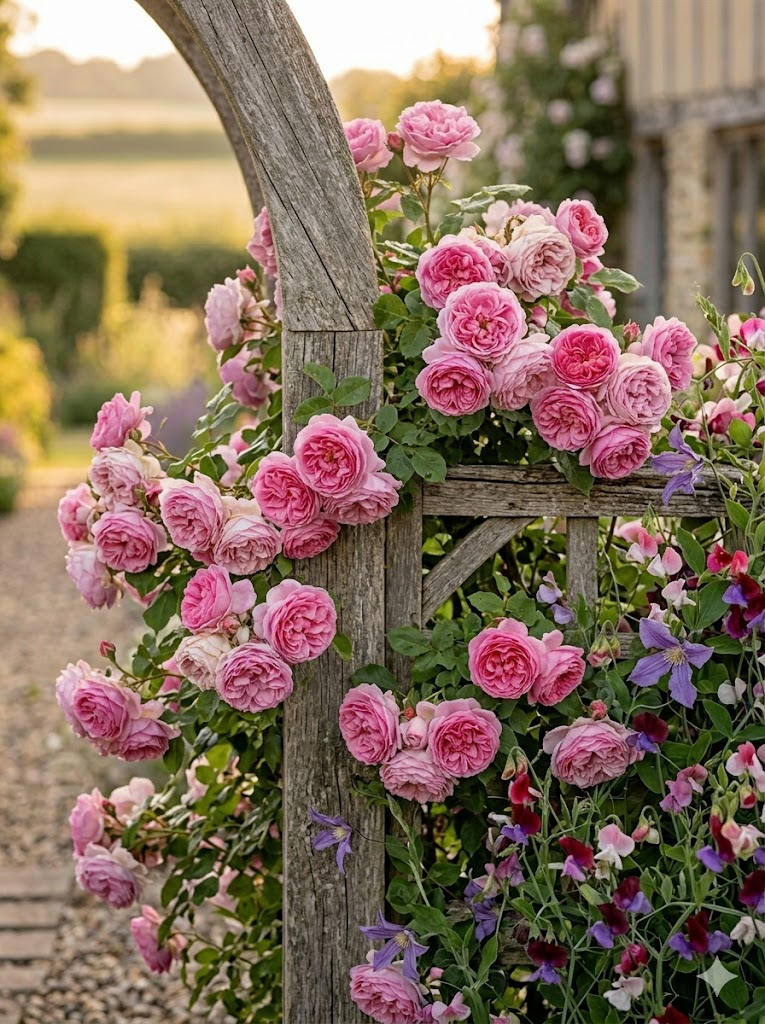
No plant defines the cottage garden more than the climbing or shrub rose. Choose a scented old-fashioned rose (David Austin English roses are bred specifically for this aesthetic): ‘Gertrude Jekyll’, ‘Olivia Rose Austin’, ‘Munstead Wood’, or ‘The Generous Gardener’ all deliver the deep fragrance and full-petaled blooms that define the style.
Plant against a wall, fence, or trellis. Allow it to grow loosely rather than pruning to a rigid form. The imperfect, sprawling growth is correct.
2. Install a Picket Fence or Low Stone Wall
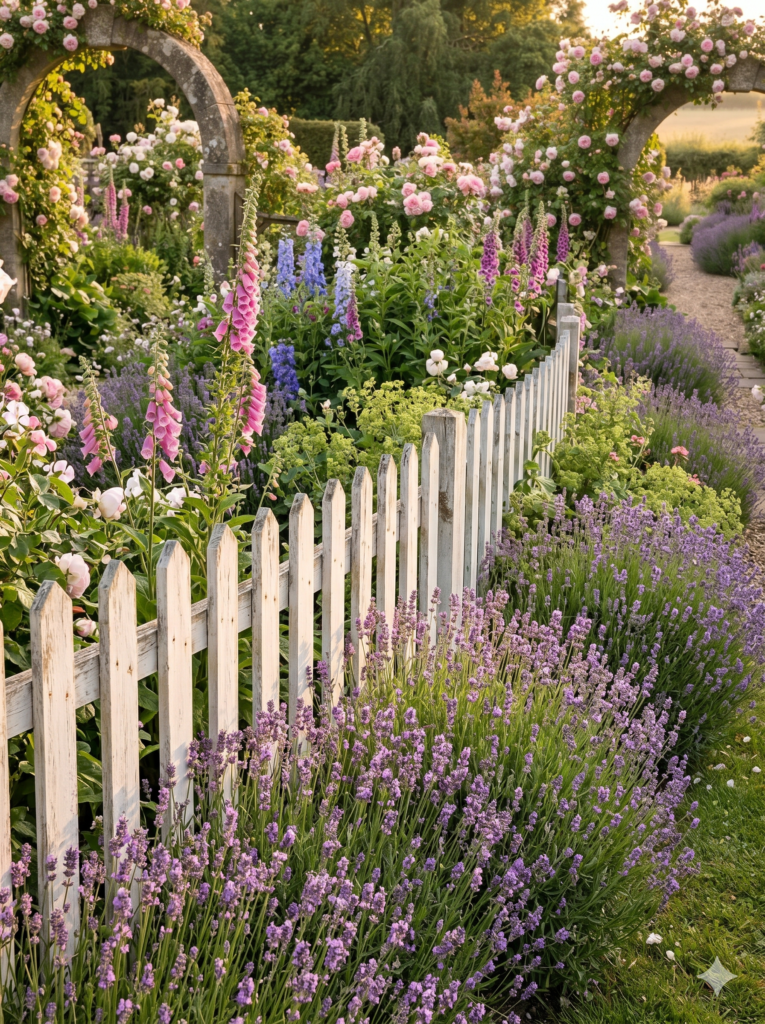
Cottage gardens need a boundary to frame them. A classic white picket fence, a low drystone wall, a hedge of lavender or box, or a simple woven willow hurdle all create the enclosure that makes a cottage garden feel intimate and deliberate rather than just an overgrown bed.
3. Create a Winding Path
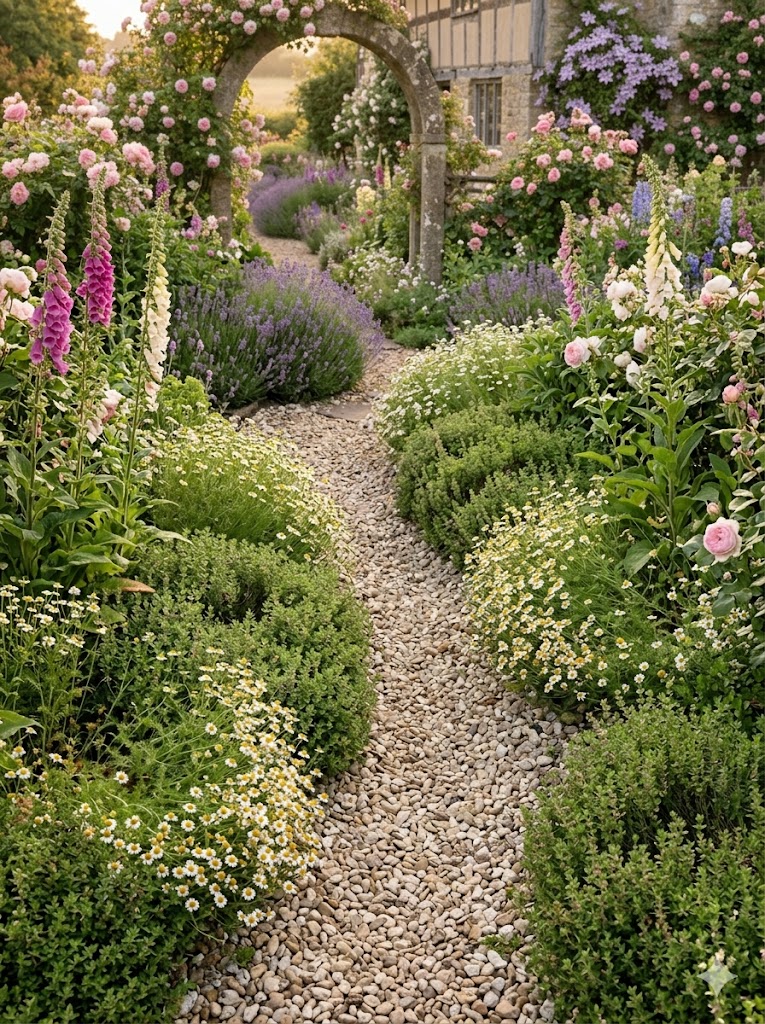
Straight paths belong in formal gardens. Cottage paths should curve. Use gravel, stepping stones, flat fieldstone, or mown grass to create a path that invites exploration. A path that disappears around a curve creates a sense of mystery and makes even a small garden feel larger.
- Best materials: Irregular flagstone, weathered brick, and gravel are all period-appropriate
- Plant path edges with creeping thyme, alyssum, or chamomile that release fragrance when brushed
4. Build a Rose Arch or Arbor
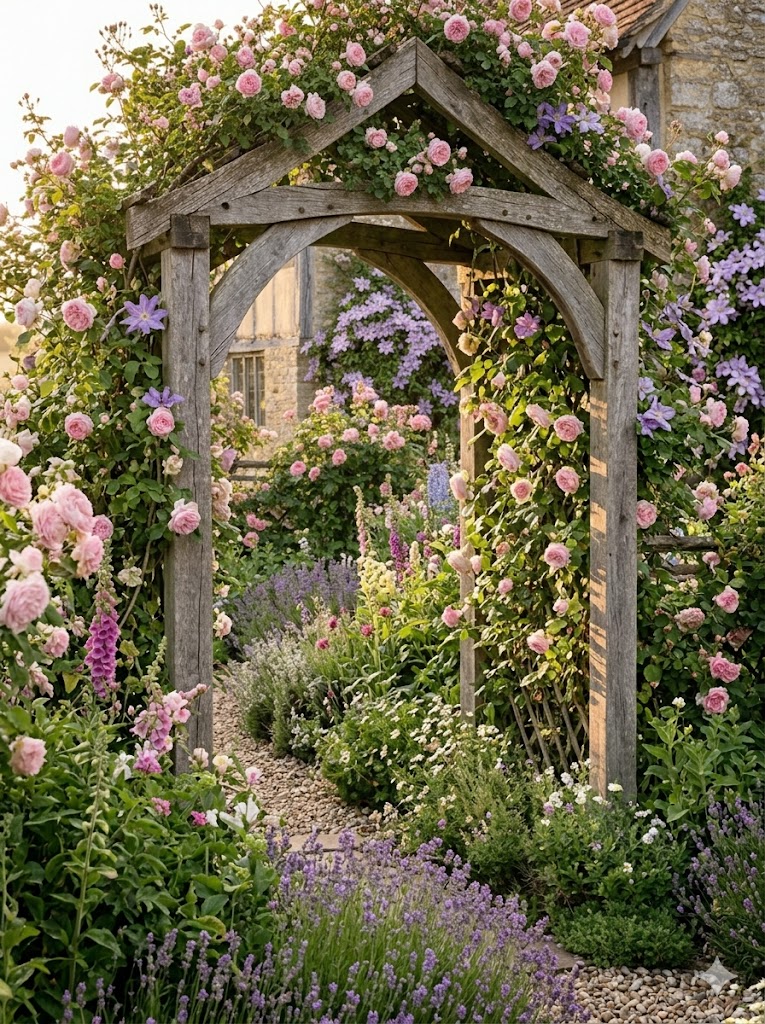
An arch over a gate or path entrance is one of the most powerful statements a cottage garden can make. A simple wooden arch ($50 to $200 at garden centers) draped with a climbing rose, clematis, or honeysuckle creates a threshold that transforms the entrance to the garden.
‘New Dawn’ rose, ‘Rambling Rector’ rose, and ‘Madame Alfred Carriere’ rose are all historically popular arch climbers with appropriate cottage garden character.
5. Fill Borders with Classic Cottage Perennials
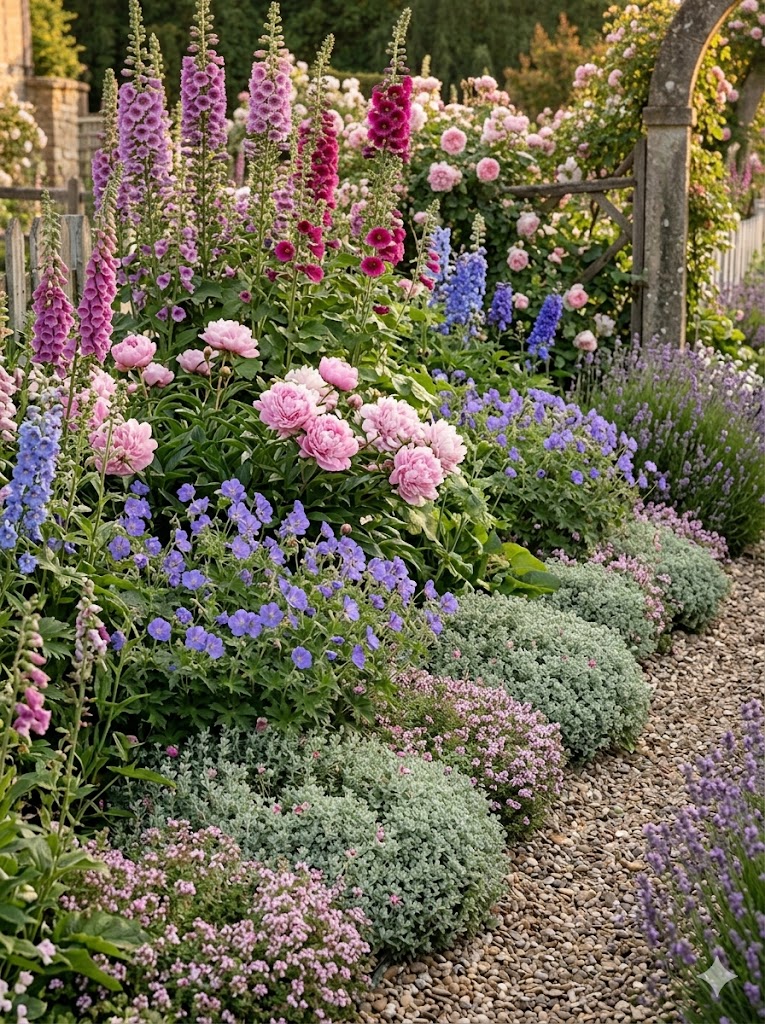
The backbone of any cottage garden is its perennial planting. Layer these classic varieties:
- Back of border (4 to 6 feet): Delphiniums, hollyhocks (Alcea rosea), foxgloves (Digitalis purpurea), tall phlox, and Verbena bonariensis
- Middle border (2 to 4 feet): Peonies, geraniums (Geranium magnificum), achillea, rudbeckia, salvia, catmint, and lupins
- Front border (under 2 feet): Alchemilla mollis (lady’s mantle), lamb’s ear (Stachys byzantina), pinks (Dianthus), heuchera, and creeping thyme
6. Add Self-Seeding Annuals
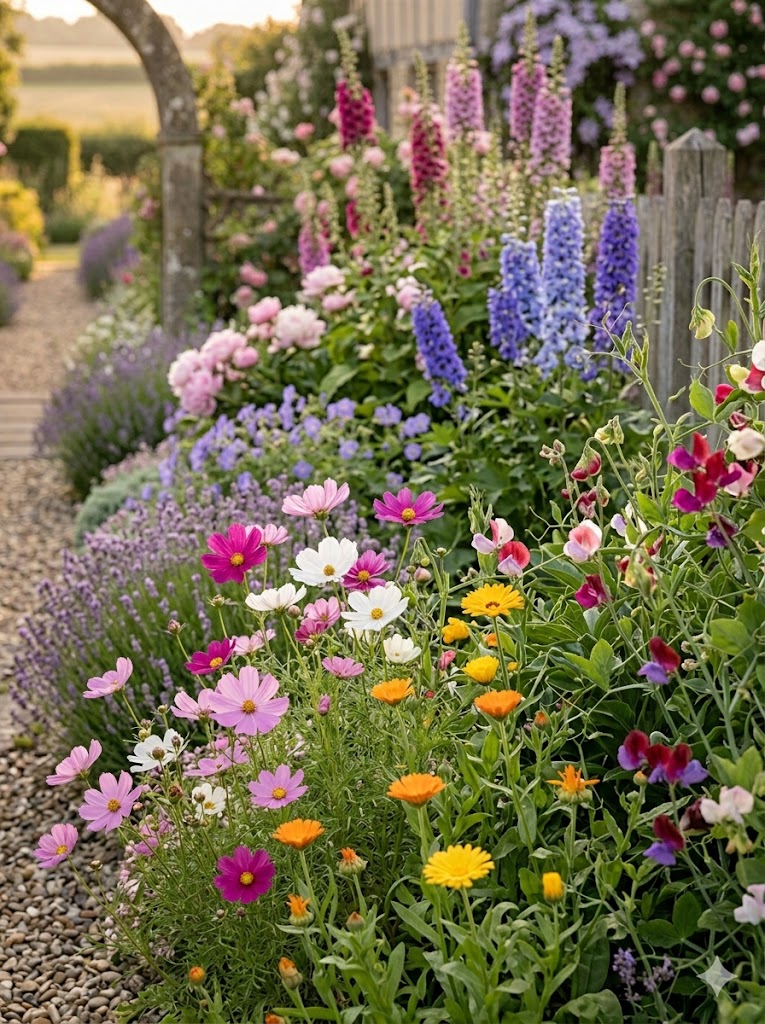
These annuals self-seed freely and colonize bare spots in the cottage border, filling it with color between perennial clumps:
- Cosmos (Cosmos bipinnatus): Airy, pink, white, and magenta flowers on tall stems
- Sweet peas (Lathyrus odoratus): Climbing annual with extraordinary fragrance
- Calendula: Orange and yellow daisy-like flowers with medicinal uses
- Nigella (Love-in-a-mist): Delicate blue flowers with ornamental seed heads
- Aquilegia (Columbine): Nodding, spurred flowers in purple, pink, white, and red
7. Plant Fragrant Shrubs for Structure
Cottage gardens need woody structure between perennial clumps. Fragrant flowering shrubs provide this:
- Lavender (Lavandula): The quintessential cottage shrub. Edge paths, soften borders, attract bees.
- Mock orange (Philadelphus): White flowers with orange-blossom fragrance in early summer
- Old roses (Rosa): Shrub roses with single or semi-double flowers in pink, white, and deep red
- Viburnum (Viburnum carlesii): Incredibly fragrant white flowers in spring
8. Train Clematis on Every Available Surface
Clematis is the cottage garden’s most versatile climber. Train through rose shrubs for a two-plant combination. Grow up obelisks in borders. Allow to scramble over fences. Mix early, mid-season, and late-flowering varieties for continuous bloom from April through October.
- Classic cottage clematis: ‘Perle d’Azur’ (blue), ‘Ville de Lyon’ (red), ‘Nelly Moser’ (pink striped)
9. Incorporate Herbs Throughout the Garden
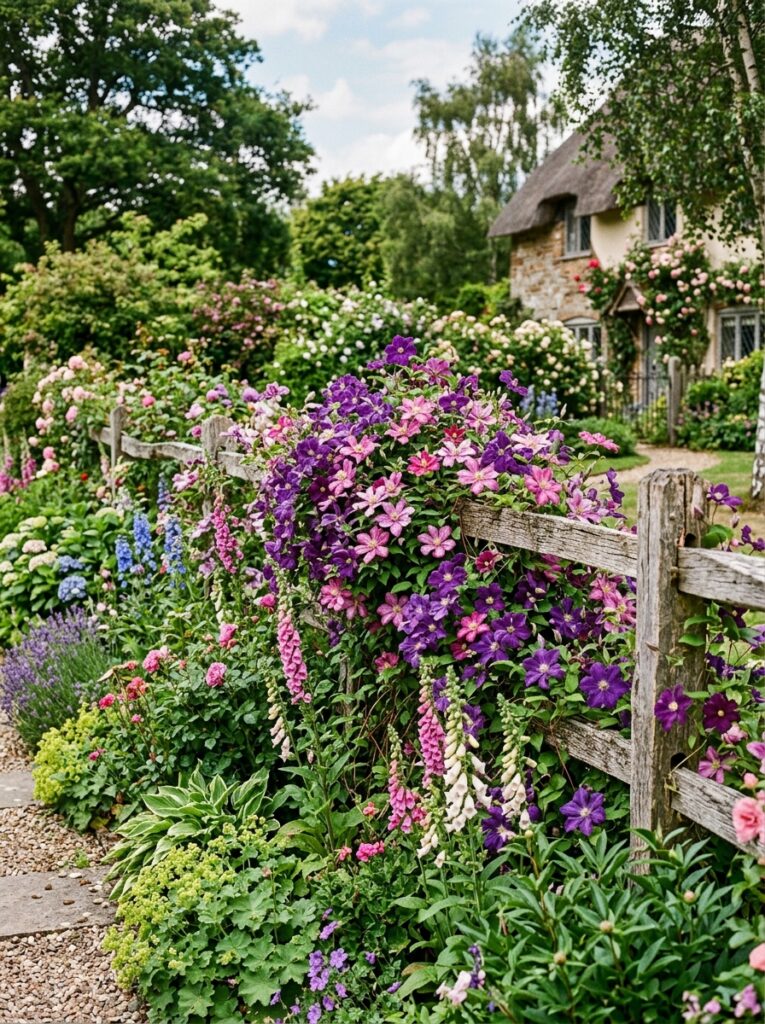
Resist the urge to confine herbs to a separate utility area. Lavender, rosemary, chives, fennel, sage, and thyme all belong woven through the cottage border:
- Fennel (Foeniculum vulgare): Tall architectural plant with feathery bronze or green foliage
- Chives (Allium schoenoprasum): Purple pompom flowers in spring that are edible and beautiful
- Rosemary (Salvia rosmarinus): Silver-gray foliage and blue flowers, drought tolerant
10. Add a Birdbath or Sundial
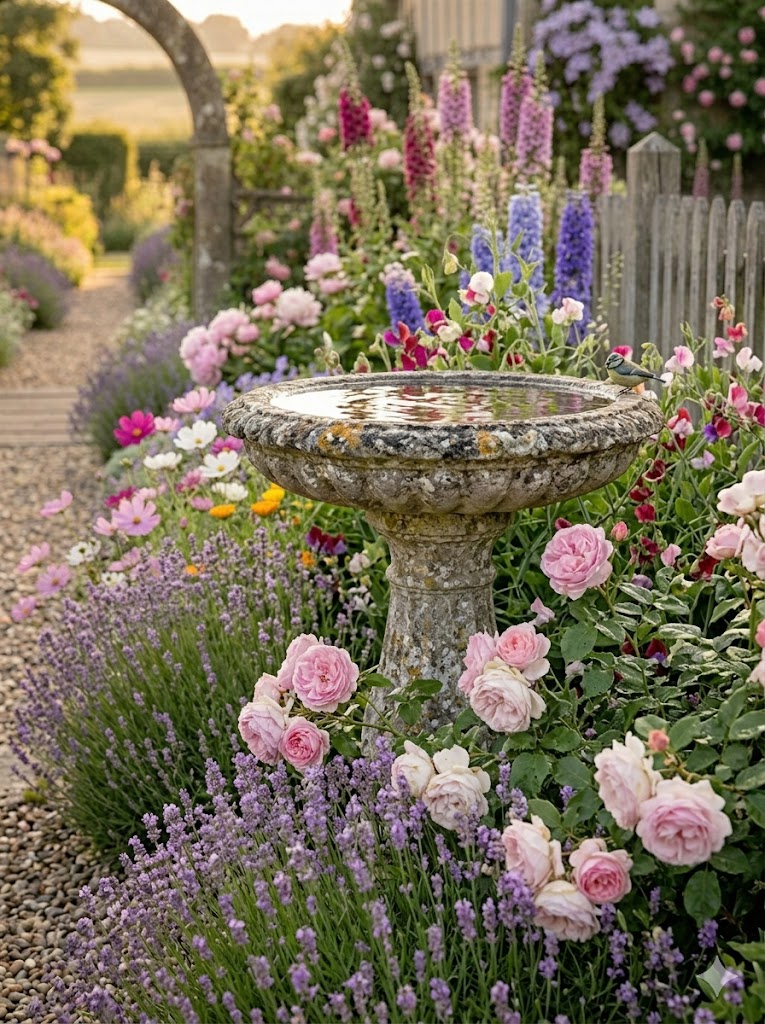
A focal point in the center of a cottage garden border gives the eye somewhere to rest in all the abundant planting. Traditional choices include stone birdbaths, sundials, terracotta urns, or carved stone balls. The object should look like it belongs to the garden, not like garden furniture.
11. Use Vintage Containers Creatively
Cottage gardens traditionally used whatever containers were available: watering cans, stone sinks, terracotta pots, galvanized buckets, even cast-iron water softeners (as described by Laurie Lee in Cider with Rosie). Modern cottage garden makers continue this tradition with thrift store finds and vintage objects used as plant containers.
12. Plant for Bees and Butterflies
A cottage garden that does not buzz with bees and flutter with butterflies is missing something essential. These plants attract pollinators in large numbers:
- For bees: Lavender, single roses, catmint, alliums, foxgloves, borage
- For butterflies: Buddleja (butterfly bush), verbena, scabious, echinacea, single dahlias, knapweed
13. Embrace Controlled Repetition
True cottage gardens are not random. They repeat anchor plants (lavender, roses, catmint) at intervals throughout the border to create visual cohesion within the apparently informal planting. Without repetition, a cottage border becomes chaotic rather than romantic.
Choose 3 to 5 plants that you genuinely love and repeat them throughout the garden in groups of 3 to 5. Then fill in with everything else.
14. Include Foxgloves for Height and Drama
Foxgloves (Digitalis purpurea) are biennial — they grow leaves in year one, bloom in year two, then die. But once established in a garden, they self-seed prolifically and appear reliably each year in slightly different locations. Their tall spires of tubular flowers (purple, white, pink, or apricot) add height and a distinctly cottage character to any planting.
15. Create a Seating Corner
A cottage garden without a place to sit in it is a missed opportunity. A weathered wooden bench tucked into a sheltered corner, under an arbor, or positioned to face the best view of the garden transforms a garden from a display into an experience.
Surround the seating area with the most fragrant plants: lavender, roses, jasmine, or honeysuckle.
16. Paint Woodwork in Soft Muted Colors
Gates, fences, arbors, benches, and sheds in a cottage garden look best in soft, muted colors that complement rather than compete with the planting. Pale sage green, dusty blue, soft white, and warm cream are all period-appropriate and look particularly beautiful with pink and purple planting combinations.
17. Allow Some Wildness
The final idea is the most important one: resist the impulse to make everything perfect. The cottage garden tradition is explicitly one of productive imperfection. Allow some gaps to fill with self-seeders. Let the climbing rose grow a little beyond the arbor. Leave seed heads standing through winter for birds and structure.
The best cottage gardens have the quality of being slightly beyond control in the most beautiful way.
|
✅ Tip Plan for a succession of bloom times by noting when each plant in your cottage garden flowers. If the entire garden peaks in June and is bare by August, add late-summer performers: phlox, rudbeckia, helenium, asters, and Japanese anemone extend cottage garden color into October. In a new cottage garden, fill gaps in the first year with annuals (cosmos, zinnias, nasturtiums) while perennials establish. In year 2 to 3, the perennials will fill in and the annuals can be reduced or redirected to the edges. |
Frequently Asked Questions
What makes a cottage garden different from a regular flower garden?
A cottage garden deliberately mixes edibles with ornamentals, emphasizes fragrance, favors old-fashioned and heritage plant varieties, relies on layered planting rather than formal arrangement, and embraces self-seeding and natural growth habits. The defining characteristic is controlled informality — it should look abundant and slightly untamed while still being the result of intentional design decisions.
Is a cottage garden high maintenance?
Once established (year 2 or 3), cottage gardens are often lower maintenance than formal gardens because their dense planting suppresses weeds, self-seeding plants fill gaps without replanting, and the informal style forgives irregularity. Year one requires investment in establishing perennials and woody plants. The biggest ongoing tasks are editing self-seeders, deadheading roses, and dividing perennials every 2 to 3 years.
The Bottom Line
A cottage garden is one of the most achievable and rewarding garden styles for home gardeners. It forgives imprecision, rewards patience, costs less than formal designs (many plants come from seed or divisions), and becomes more beautiful every year as perennials establish and self-seeders colonize.
Start with a climbing rose, a path, and a border of classic perennials. The rest builds itself.
