
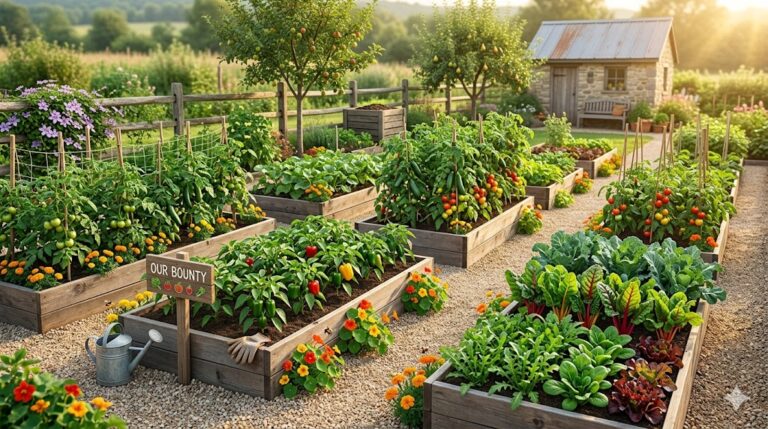
The original GardeningSoul article on this topic is a 2017 photo gallery with minimal text. Vegetable gardening has evolved since then, and home growers deserve more than a collection of images.
This is the comprehensive guide that article should have been: 22 specific, actionable approaches to a productive vegetable garden, from choosing the right site to preserving the harvest.
Site and Setup
1. Choose the Sunniest Spot
This is the single most important decision you will make. Vegetables need a minimum of 6 hours of direct sun daily. Most fruiting crops (tomatoes, peppers, cucumbers, squash) produce their best yields with 8 to 10 hours. Leafy greens tolerate 4 to 6 hours.
Walk your yard on a clear day and observe which spots receive the most direct sun from morning through afternoon. Note shadow patterns from buildings, fences, and trees. This observation takes one hour and saves months of frustration.
2. Grow What You Actually Eat
This seems obvious, but it is consistently ignored. Before deciding what to grow, list the vegetables your household eats regularly. Prioritize those first. A small garden full of crops your family eats is more valuable than a large garden full of vegetables you feel obligated to harvest.
3. Start Small
The Almanac recommends 4×4 or 4×8-foot raised beds for beginners. Starting small allows you to learn what your garden needs without being overwhelmed. Most first-time gardeners underestimate the time commitment of weeding, watering, and harvesting a large space.
A 4×8-foot raised bed with 3 to 5 vegetable types is genuinely sufficient for a first season. Expand from that foundation once you understand your soil, pests, and growing season.
4. Build Your Soil First
Vegetables are heavy feeders that require rich, well-draining soil. Before planting anything, invest in the soil:
- For new in-ground beds: Remove sod. Add 3 to 4 inches of compost and work into the top 12 inches of native soil.
- For raised beds: Fill with a 60/30/10 blend of topsoil, compost, and perlite or coarse sand.
- For containers: Use quality potting mix labeled for vegetables or tomatoes.
The UC Master Gardeners of Santa Clara County recommend keeping soil evenly moist and never working it when wet or frozen, which compacts structure.
5. Test Your Soil pH
Most vegetables prefer a slightly acidic soil with a pH between 6.0 and 7.0. Outside this range, nutrients become chemically unavailable even if present in abundance. A basic soil test ($15 to $25 from your state extension service) identifies pH and major nutrient levels, telling you exactly what amendments your specific soil needs.
Planting and Timing
6. Know Your Last and First Frost Dates
Every vegetable has a minimum temperature threshold for germination and a cold tolerance limit. Planting before the last frost date kills warm-season crops. Planting cool-season crops too late in spring causes them to bolt in summer heat.
Look up your exact frost dates at the Old Farmer’s Almanac website by entering your zip code. Build your planting calendar around these two dates.
7. Separate Cool-Season from Warm-Season Crops
Cool-season crops (lettuce, peas, spinach, broccoli, kale) grow in spring and fall when temperatures are 45 to 65°F. Warm-season crops (tomatoes, peppers, cucumbers, squash, beans) need soil temperatures above 60°F and air temperatures consistently above 50°F at night.
A four-season garden grows cool-season crops in spring, transitions to warm-season in summer, then returns to cool-season crops in fall for a second harvest.
8. Direct Sow vs. Transplant
Some crops are better started from seed directly in the garden:
- Direct sow: Carrots, radishes, beets, turnips, beans, peas, corn, and most root vegetables (transplanting disturbs their taproots)
- Transplant: Tomatoes, peppers, eggplant, broccoli, cauliflower, and crops with long growing seasons that benefit from starting indoors 6 to 8 weeks before the last frost
9. Practice Succession Planting
Instead of planting all your lettuce or beans at once, stagger plantings every 2 to 3 weeks. This extends the harvest across 6 to 8 weeks rather than producing a glut that ripens simultaneously.
Succession planting is particularly effective for lettuce, radishes, cilantro, and beans, all crops with relatively short days-to-maturity that are ready quickly and then decline.
10. Practice Companion Planting
Companion planting uses the biological relationships between plants to reduce pests and improve yields:
- Tomatoes and basil: Basil repels aphids and spider mites and improves tomato flavor
- The Three Sisters (corn, beans, squash): A Native American polyculture, corn provides support for beans, beans fix nitrogen, squash shades the soil suppressing weeds
- Marigolds throughout the vegetable garden: French marigolds (Tagetes patula) repel whitefly, thrips, and some nematodes
- Nasturtiums as trap crops: Aphids prefer nasturtiums over most vegetables, concentrating the pest away from your crops
Water and Nutrients
11. Water Consistently, Not Frequently
Most vegetable crops prefer deep, infrequent watering rather than shallow daily watering. Deep watering (1 inch per week) encourages roots to grow deeper into the soil where moisture is more stable. Shallow daily watering creates shallow roots and plants that are dependent on regular input.
Check soil moisture by inserting a finger 2 inches into the soil. If it is moist, wait. If dry, water deeply.
12. Water at the Root, Not the Foliage
Wet foliage is the primary driver of fungal disease in vegetable gardens. Tomato blight, powdery mildew on cucumbers, and downy mildew on lettuce all spread via water on leaves.
Drip irrigation, soaker hoses, or careful hand watering at the base of plants prevents foliage from getting wet. Morning watering (which allows foliage to dry during the day) is better than evening watering.
13. Mulch Everything
A 3-inch layer of organic mulch (straw, shredded leaves, wood chips, or grass clippings) placed around vegetable plants provides multiple simultaneous benefits:
- Retains soil moisture, reducing watering frequency by 30 to 50%
- Moderates soil temperature in summer heat and late spring cold snaps
- Suppresses weed germination, dramatically reducing weeding time
- Decomposes over the season, adding organic matter to the soil
14. Feed During Key Growth Phases
Vegetables have different nutritional needs at different growth stages:
- Establishment (planting to first month): Nitrogen for leaf and stem growth
- Flowering and fruiting (mid-season): Reduce nitrogen, increase phosphorus and potassium
- Cool-season leafy crops: Consistently nitrogen-forward fertilization throughout the season
A balanced organic vegetable fertilizer (Espoma Tomato-tone, Neptune’s Harvest) applied every 2 to 3 weeks from planting through mid-season is a practical approach that covers most crops.
Pest and Disease Management
15. Inspect Plants Weekly
Most pest and disease problems are manageable when caught early and devastating when ignored. Spend 10 to 15 minutes weekly examining both the tops and undersides of leaves on all major crops.
- Look for: Eggs clusters (often on leaf undersides), chewed or discolored foliage, wilting of specific branches, unusual spots or patterns
- Common culprits: Aphid colonies (soft-bodied clusters), caterpillar frass (small black pellets), spider mites (fine webbing on undersides), squash vine borer entry holes at vine bases
16. Use Row Cover for Pest Exclusion
Floating row cover (lightweight spunbonded fabric) placed over newly planted vegetables physically excludes flying pests. Particularly effective for protecting brassicas from cabbage moths, squash from cucumber beetles, and leafy greens from leaf miners.
Secure the edges with soil, rocks, or stakes. Remove or open during flowering on crops that require insect pollination (squash, cucumbers, melons).
17. Practice Crop Rotation
Do not plant the same vegetable family in the same location two years in a row. Crop rotation prevents the buildup of soil-borne diseases and specific pest populations that overwinter in the soil.
- Rotate: Tomato family (tomatoes, peppers, eggplant), cabbage family (broccoli, kale, cabbage), squash family (cucumbers, zucchini, pumpkin), root vegetables
Advanced Techniques
18. Use Square Foot Gardening for Maximum Density
Square foot gardening (developed by Mel Bartholomew) divides the garden into 1-foot squares and plants each square at its optimal spacing density rather than in rows. This produces higher yields per square foot, reduces wasted space, and simplifies planning.
- Example densities: Tomatoes (1 per square), lettuce (4 per square), carrots (16 per square), radishes (16 per square), basil (4 per square)
19. Grow Vertically in Limited Space
Any garden under 200 square feet benefits dramatically from vertical growing. Pole beans, cucumbers, indeterminate tomatoes, peas, and small squash all grow vertically on trellises, cages, and fences, producing the same or greater yield as sprawling plants in half the ground space.
20. Install Drip Irrigation
A simple drip irrigation system (available in starter kits for $25 to $60 from any hardware store) automatically delivers water to the root zone of plants. For a busy household, the difference between drip irrigation and hand watering is often the difference between a successful harvest and a drought-stressed garden.
21. Keep a Garden Journal
Note planting dates, varieties, first and last harvest dates, what worked, what failed, and what you would plant differently next year. A simple notebook or phone notes app is sufficient. Year 2 gardens that use year 1 observations consistently outperform year 2 gardens that start from scratch.
22. Harvest Regularly to Keep Plants Producing
Most vegetable crops produce continuously as long as they are harvested regularly. Zucchini left on the vine grows to softball size and signals the plant to stop producing. Beans unharvested stop flowering. Lettuce unpicked bolts to seed.
Check harvesting crops every 2 to 3 days during peak season. Pick at the optimal size for flavor (young zucchini, beans before seeds develop in the pod, lettuce before it bolts). The act of harvesting is what keeps production going.
✅ Tip The best fertilizer investment for any vegetable garden is compost. Two to three inches of finished compost worked into beds each spring provides nitrogen, phosphorus, potassium, trace minerals, and beneficial soil organisms simultaneously. Commercial fertilizers provide nutrients but not the biological component that makes soil productive year after year. When selecting vegetable varieties, look for the letters VFN or VFFN after tomato variety names. These letters indicate resistance to Verticillium wilt, Fusarium wilt, and Nematodes, the most common soil-borne diseases that end tomato seasons early. |
Frequently Asked Questions
What vegetables are easiest to grow for beginners?
Lettuce, green beans (bush varieties), radishes, zucchini, and cherry tomatoes are consistently the most reliable crops for first-time gardeners. All germinate quickly, mature relatively fast, and provide early feedback that encourages continued effort.
How much space do I need for a vegetable garden?
A 4×8-foot raised bed (32 square feet) is enough to grow 3 to 5 vegetable types in meaningful quantities. A 10×10-foot in-ground plot (100 square feet) supports 6 to 8 types with room for experimentation. Going larger without experience tends to create more weeding work than additional harvest.
The Bottom Line
A productive vegetable garden is the result of accumulated decisions: the right site, quality soil, appropriate varieties, consistent water, and regular monitoring. No single technique determines success or failure.
Start with the first five items on this list (site, what to grow, starting small, building soil, knowing your frost dates). Master those in year one. The remaining 17 techniques are refinements that improve an already functional garden.
