

Not all perennials are created equal when it comes to longevity. Many popular garden plants, delphiniums, lupins, hollyhocks, are short-lived perennials that perform well for 2 to 3 years before declining. Others persist for decades, improving each year as their root systems deepen and clumps expand.
The 11 plants below are the truly long-lived options, documented to thrive for 20, 30, and in some cases 50+ years in the same location with minimal intervention. Plant them once, and they will likely outlast your mortgage.
1. Baptisia / False Indigo (Baptisia australis)

Baptisia is the perennial equivalent of a slow-burn investment. The first year: modest growth. The second year: stronger. By year five or six, a mature baptisia clump is a magnificent, 4-foot mound of blue-green foliage crowned with indigo-blue flower spikes in May and June. Leave it alone and it will still be there 30 years from now.
- Zone: 3 to 9
- Sun: Full sun to very light shade
- Critical instruction: Do not divide — baptisia does not tolerate root disturbance. Plant it where it will live permanently and let it expand undisturbed.
- Bonus: Nitrogen-fixing legume that improves the soil it grows in
2. Peony (Paeonia lactiflora)

Peonies famously outlive the gardeners who plant them. There are documented specimens still blooming after 100 years in the same location. The spectacular, fragrant flowers in late spring are among the most beloved of all garden blooms.
- Zone: 3 to 8 (requires cold winters — does not perform in zones 9 and warmer without significant chill hours)
- Planting depth critical: Plant “eyes” (red growth buds) no more than 1 to 2 inches below the soil surface. Too deep = no flowers, potentially for years. This is the most common peony mistake.
- Patience: Year 1 to 2 may produce few or no flowers. Year 3 onward: generous bloom.
3. Daylily (Hemerocallis — species varieties)

While modern hybrid daylilies have variable longevity, the species daylilies — particularly Hemerocallis fulva (tawny daylily) and H. citrina — are remarkably long-lived and self-sufficient. They naturalize across difficult sites and bloom reliably for decades without division.
- Zone: 3 to 10 depending on variety
- Note: H. fulva (the common orange roadside daylily) is technically not native to North America and spreads aggressively — suitable for large, naturalized areas but potentially weedy in cultivated beds
4. Hosta (Hosta spp.)

Well-sited hostas are essentially permanent. They expand slowly each year, require no division (though they tolerate it well), and thrive in conditions other perennials avoid. The flowers are attractive, but it is the foliage — in blue, gold, green, and striking variegated patterns — that earns hostas their place on this list.
- Zone: 3 to 9
- Longevity: 20 to 30+ years in appropriate conditions
5. Coneflower (Echinacea purpurea)

A North American native wildflower that blooms from July through September and self-seeds modestly to maintain its own population in the garden. Individual plants live 5 to 10 years, but the colony persists indefinitely through self-seeding. Extremely heat and drought tolerant once established.
- Zone: 3 to 9
- Wildlife: Seed heads left standing through winter provide food for goldfinches and other seed-eating birds
6. Baptisia ‘Purple Smoke’ and Other Modern Baptisia Cultivars

Beyond the species, modern baptisia cultivars extend the color range to pale yellow (‘Screamin’ Yellow’), white (‘White Wild Indigo’), and soft purple-pink (‘Purple Smoke’). All share the species’ extraordinary longevity and structural presence.
7. Yarrow (Achillea millefolium)

Yarrow’s combination of longevity, drought tolerance, and extended bloom period (June through September with deadheading) makes it one of the best value perennials available. The flat-topped flower clusters in yellow, red, pink, white, or salmon attract an impressive diversity of beneficial insects.
- Zone: 3 to 9
- Division: Divide every 3 to 4 years to maintain vigor
- Caution: Spreads by both rhizome and self-seeding; may need management in formal garden situations
8. Salvia nemorosa (Woodland Sage)

The perennial sages are among the most refined long-lived garden perennials. Upright spikes of violet, blue, purple, pink, or white flowers from May through July, with a strong second flush after cutting back. The foliage is aromatic and deer resistant. Plants remain vigorous and well-shaped for 10 to 15+ years.
- Zone: 4 to 9
- Best varieties: ‘Caradonna’ (deep purple, distinctive dark stems), ‘East Friesland’ (compact, purple), ‘May Night’ (Perennial Plant of the Year 1997, reliable)
9. Black-Eyed Susan (Rudbeckia fulgida ‘Goldsturm’)

‘Goldsturm’ is specifically one of the longest-lived and most reliable rudbeckia selections — a cultivar of the native species that produces golden-yellow flowers with black centers from July through October. Named Perennial Plant of the Year in 1999, it has remained a garden staple because it genuinely delivers year after year.
- Zone: 3 to 9
- Longevity: 10 to 20+ years in appropriate conditions
10. Catmint (Nepeta x faassenii)
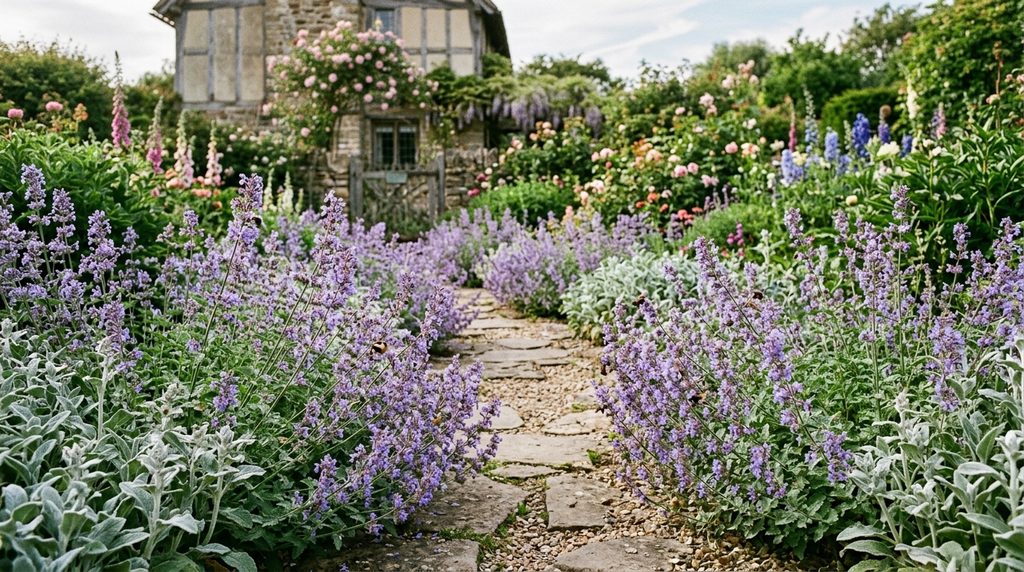
One of the most effortlessly beautiful and longest-blooming perennial edgings available. Silver-gray foliage with lavender-blue flower spikes from May through July, then reblooming in September after the summer cutback. Drought tolerant, deer resistant, and extremely long-lived once established.
- Zone: 3 to 8
- Key care: Cut back by half after the first flush of bloom fades to trigger a strong second and sometimes third flowering period
11. Japanese Anemone (Anemone × hybrida)

Japanese anemones fill the critical late-summer to autumn bloom period when most other perennials are winding down. Delicate-looking but surprisingly tough, the single or semi-double flowers in white and pink sway on tall, wiry stems from August through October.
- Zone: 4 to 8
- Note: Slow to establish (2 to 3 years), but spreads vigorously once established — eventually requiring management in smaller gardens
- Bloom timing: The only perennial on this list that blooms primarily in late summer and autumn, filling a gap that most spring and summer perennials leave
✅ Tip
The single best investment in perennial longevity is correct siting. A peony planted in the wrong location (too much shade, planting depth wrong) will never bloom reliably regardless of how old it gets. A baptisia moved after establishment may not recover for 5 years. Spend extra time researching the ideal conditions for each plant before planting, and you will rarely have to intervene again.
When purchasing perennials from a nursery, larger plants in larger pots are not necessarily a better investment than smaller plants correctly sited. A 1-gallon baptisia planted correctly will outperform a 3-gallon baptisia that spent a year in a pot before being planted.
The Bottom Line
The plants on this list are garden investments rather than impulse purchases. Planted correctly and in the right conditions, a baptisia, peony, or hosta placed in your garden today will likely still be blooming when your grandchildren are tending the same garden. That kind of longevity is genuinely rare in any gardening context and worth prioritizing.
