
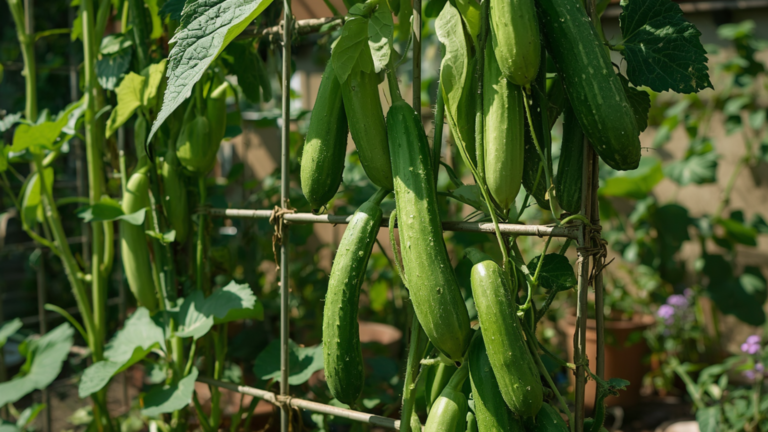
Cucumbers are natural climbers that gardeners have been growing horizontally for decades.
The vine sprawls, fills an entire raised bed, hides fruit under dense foliage, traps moisture against the leaves and soil, and invites the fungal diseases and pests that make cucumber growing the frustrating experience many gardeners have had.
Growing cucumbers vertically solves all of these problems simultaneously.
Why Grow Cucumbers Vertically?

- 3x yield potential: Vertical plants access more light and produce more consistently throughout the season
- Disease prevention: Powdery mildew, downy mildew, and botrytis all thrive in the stagnant, humid conditions of sprawling ground foliage. Vertical growing with open airflow dramatically reduces all three.
- Pest reduction: Cucumber beetles, slugs, and soil-borne pathogens have reduced access to elevated foliage
- Straight fruit: Cucumbers hanging vertically grow straight. Cucumbers on the ground develop curves where they rest.
- Space efficiency: A single vertical trellis supports 2 to 4 plants in the same ground footprint as one sprawling plant
- Easy harvest: No bending, no searching through dense foliage. Cucumbers hanging at eye level are found and picked consistently.
Choosing the Right Cucumber Variety

Not all cucumbers are equally suited to vertical growing. The key distinction is between bush varieties (compact, bred for container or small-space ground growing) and vining varieties (natural climbers that perform best vertically).
Best Vining Varieties for Vertical Growing
- Marketmore 76: Classic slicing cucumber with excellent disease resistance. Grows 6 to 8 feet. One of the most reliable for home gardeners.
- Straight Eight: Classic slicing type that produces truly straight fruits when grown vertically. One of the reasons vertical growing was originally popularized.
- Diva: Thin-skinned, seedless-type cucumber with outstanding powdery mildew resistance. Parthenocarpic (produces fruit without pollination) — ideal for growing under row cover.
- Spacemaster: Compact vining variety that grows 3 to 4 feet, suitable for smaller trellises and containers
- Pickling cucumbers (Calypso, Pioneer): Prolific producers that benefit enormously from vertical growing for easy small-fruit harvest
- English (Telegraph): Long, smooth-skinned cucumbers that benefit from vertical growing to develop their characteristic straight shape
Trellis Options: Strengths and Weaknesses

Wire Mesh / Concrete Reinforcing Mesh
4×8-foot sheets of concrete reinforcing mesh (rebar mesh) attached to 6-foot posts are the most practical and durable trellis for cucumber growing. The mesh grid provides endless attachment points for tendrils and ties. Cost is approximately $8 to $15 per sheet.
- Lifespan: 10+ years
- Best for: In-ground beds and large raised beds
A-Frame Trellis
Two rectangular frames joined at the top with hinges create a self-supporting A-frame that can be planted on both sides. Harvesting from underneath (cucumbers hang through the frame interior) is comfortable and efficient. Folds flat for storage.
- Cost: $25 to $60 DIY
- Best for: Any garden where a self-supporting, movable structure is preferred
Cattle Panel
A 16-foot cattle panel bent into an arch or stretched flat between T-posts provides an extremely sturdy cucumber trellis that lasts decades. Particularly effective for high-production market gardeners or gardeners who want a permanent structure.
- Cost: $25 to $40 per panel
String / Florida Weave Method
Commercial greenhouse growers often use the string method: tie a string from a high overhead point down to the base of the plant. Wind the cucumber stem around the string as it grows, just as commercial tomato growers do. Removes suckers to keep one main leader. Maximum space efficiency.
- Best for: Greenhouse growing or gardens with overhead structures (pergolas, barn rafters)
Bamboo Teepee
A classic bamboo teepee (6 to 8 stakes, 5 to 6 feet tall) supports 4 to 6 cucumber plants. Compact, inexpensive, and completely biodegradable at the end of the season.
Planting for Vertical Growing

The setup must be done in the right order to avoid disturbing roots:
- Install the trellis FIRST before planting. Driving posts or stakes into established beds damages cucumber roots.
- Plant cucumber seedlings or seeds 6 to 12 inches apart at the base of the trellis.
- In warm soil (above 65°F), direct sowing is often faster than transplanting because cucumbers are tap-rooted and dislike disturbance.
- Water the planting area thoroughly after planting.
- Apply 3 to 4 inches of mulch around the plants to retain moisture and prevent soil splash onto foliage (the primary route for soil-borne diseases).
Training and Pruning Cucumbers

Initial Training (Weeks 1 to 3)
Young cucumber vines do not naturally head for the trellis. Gently guide the main stem toward the trellis and loosely tie with soft garden ties or strips of fabric. Within a week or two, the tendrils will grip the wire or mesh on their own and training becomes minimal.
Ongoing Training
Visit the cucumber trellis every 3 to 5 days during the main growing season to guide any errant growth back onto the structure. Cucumbers grow rapidly and can reach neighboring plants or get entangled if left too long.
Pruning: Optional but Beneficial
Cucumbers produce both main stems (primary vines) and lateral shoots (suckers/secondary vines). For maximum production without management, allow all lateral growth. For cleaner, more productive plants with better airflow, prune:
- Remove all lateral shoots from the first 12 to 18 inches of stem to keep the base clear and improve airflow at the critical junction where disease most often starts
- Pinch the growing tip when the vine reaches the top of the trellis. This forces energy into fruit production on the existing laterals.
Common Problems and Solutions

Powdery Mildew
Powdery mildew appears as a white powdery coating on leaves, typically starting in mid-summer. It is triggered by high humidity combined with dry leaf surfaces.
Prevention: Vertical growing with good airflow is the primary prevention. Plant disease-resistant varieties (Diva, Marketmore 76). Avoid overhead watering. Apply a preventive milk spray (1 part milk diluted in 9 parts water, applied to foliage) at the first sign of conditions favorable to mildew.
Bitter Cucumbers
Bitterness in cucumbers is caused by cucurbitacin compounds, which are produced under stress (drought, extreme temperatures, or erratic watering). Consistent moisture is the solution. Mulch the root zone and maintain even watering.
No Female Flowers / No Fruit
Cucumbers produce both male flowers (appear first, have a thin stem) and female flowers (appear later, have a small immature cucumber at the base). Male flowers appearing without females is normal in the first 2 to 3 weeks. If females appear but fruit does not develop, the issue is poor pollination. Attract pollinators by planting flowering herbs nearby, or hand-pollinate with a small paintbrush.
Pale or Yellowing Leaves
Yellowing leaves in cucumbers most often indicate magnesium deficiency or cucumber mosaic virus. For deficiency: apply Epsom salt solution (1 tablespoon per gallon). For mosaic virus (mottled yellow and green patterning): remove and destroy infected plants, as the virus spreads by aphids.
Harvesting Cucumbers

Consistent, frequent harvest is the most important production technique. Cucumbers left on the vine too long signal the plant to reduce new flower production. The goal is to harvest before seeds develop inside the cucumber.
- Slicing cucumbers: Harvest at 6 to 8 inches. Skin is smooth and firm, color is deep even green.
- Pickling cucumbers: Harvest at 2 to 4 inches for sweet pickles, 4 to 6 inches for dills
- English cucumbers: Harvest at 12 to 16 inches before skin begins to yellow
Check vertically grown plants every 2 to 3 days during peak season. The same fruits that are invisible at eye level are obvious hanging from a vertical trellis.
✅ Tip Water cucumbers at the base of the plant, never on the foliage. Wet leaves are the primary driver of powdery mildew and other fungal diseases that end cucumber seasons prematurely. A soaker hose or drip emitter at the base of each plant is the most effective irrigation approach. If cucumber beetles are present in your area, cover newly planted cucumbers with floating row cover for the first 3 to 4 weeks. The row cover prevents adult beetles from laying eggs on the plants. Remove or open the row cover once flowers appear to allow pollinator access. |
Frequently Asked Questions
How tall does a cucumber trellis need to be?
Most vining cucumbers grow 6 to 8 feet in length under good conditions. A 5 to 6-foot trellis is practical for most gardens — you can pinch the growing tip when the vine reaches the top to redirect energy into fruit production. A 4-foot trellis is functional for compact vining varieties like Spacemaster.
Can cucumbers be grown in containers on a trellis?
Yes. A 5-gallon container minimum (10-gallon preferred) can support one compact cucumber variety like Spacemaster or Bush Pickle. Use a bamboo teepee or small wire obelisk as support and fertilize weekly with a balanced liquid fertilizer.
The Bottom Line
Vertical cucumber growing requires one afternoon to set up and saves hours of maintenance throughout the season while increasing yield dramatically. The trellised plants stay healthier, produce more consistently, and are genuinely easier to tend than sprawling ground-grown vines.
Install a trellis before planting this season. The difference in yield and plant health will be immediately apparent.
Related Articles:
