
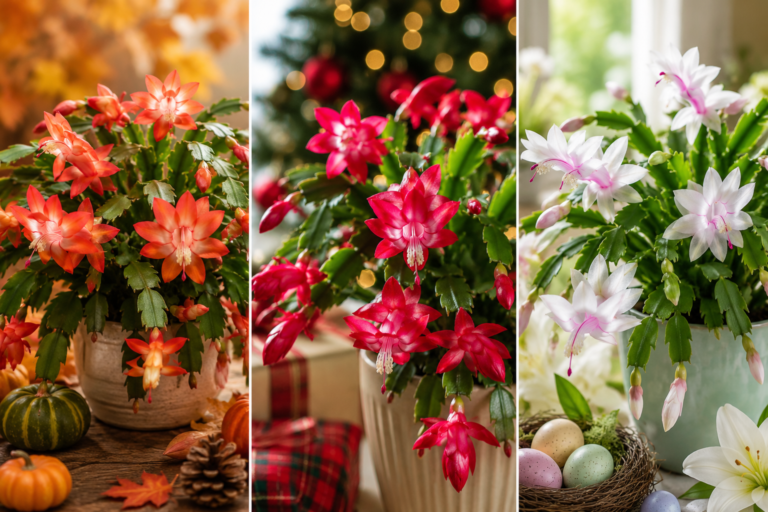
The holiday cacti sold in garden centers and grocery stores from October through December are among the most commonly misidentified plants in cultivation.
The majority of plants sold as “Christmas cactus” are actually Thanksgiving cactus, and the distinction matters because it affects bloom timing and, more importantly, when you trigger the reblooming cycle.
How to Tell the Three Apart
The fastest identification method is examining the edges of the flattened stem segments (called phylloclades):
- Thanksgiving Cactus (Schlumbergera truncata): Stem edges have 2 to 4 pointed, claw-like teeth. The most common plant sold under the “Christmas cactus” label. Blooms naturally October through November. Pollen is yellow.
- Christmas Cactus (Schlumbergera bridgesii / x buckleyi): Stem edges are smooth and scalloped — no pointed teeth. Blooms December through January. Pollen is purplish-pink. Much less common commercially than Thanksgiving cactus.
- Easter Cactus (Hatiora gaertneri / Rhipsalidopsis gaertneri): Stem segments are more symmetrical and rounded, with small bristle-like protrusions at each areole. Blooms March through April. Flowers are more star-shaped than the other two. Belongs to a completely different genus.
Quick test: Look at the stem segment edges. Pointy teeth = Thanksgiving. Smooth scallops = Christmas. Rounded segments with tiny bristles = Easter.
Why This Matters: Timing the Bloom Trigger
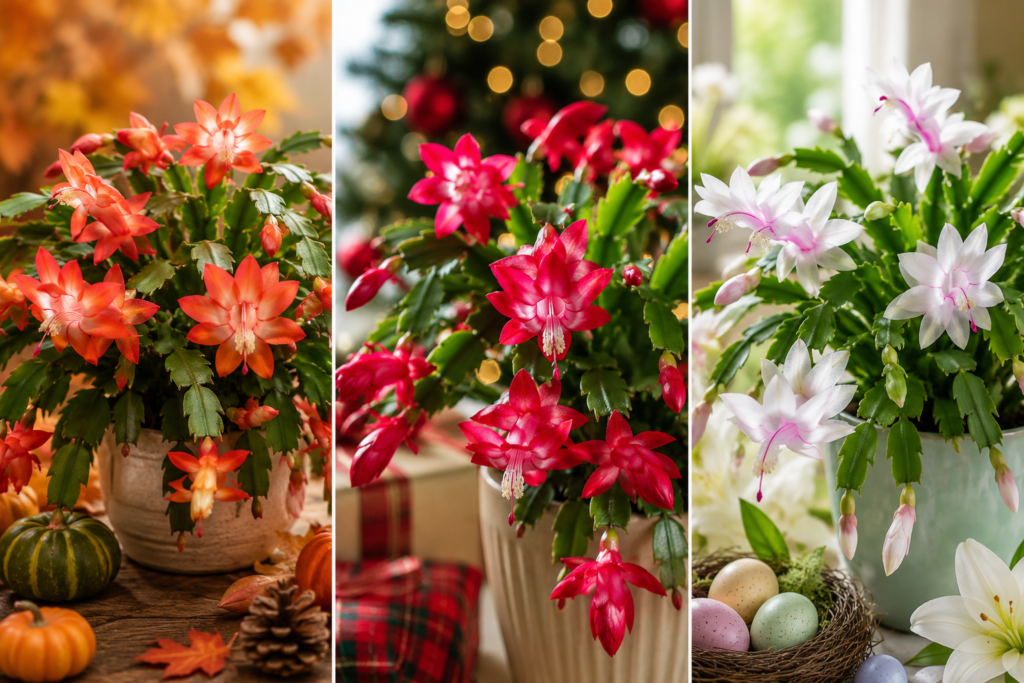
All three holiday cacti bloom in response to the same environmental triggers: short days (long nights) and cool temperatures. The difference is when you apply the trigger:
- Thanksgiving cactus: Begin dark-period treatment in September for November blooms
- Christmas cactus: Begin dark-period treatment in October for December-January blooms
- Easter cactus: Begin dark-period treatment in January/February for March-April blooms; also requires a cool rest period in winter (50 to 55°F) that naturally occurs if kept in a cool room
The Dark-Period Trigger: Step by Step
This is the step most holiday cactus owners skip, which is why their plant blooms once and never again.
- At the appropriate time (see timing above), move the plant to a location that receives absolutely no artificial light between sunset and approximately 8 AM. A closet, unlit spare room, or any space with no night lights, hallway light bleed, or lamp exposure.
- During the day, return to bright indirect light as normal.
- Continue for 4 to 6 weeks until buds become visible.
- Once buds are apparent, return to its normal display location. The plant will continue blooming.
Alternative trigger: Cool temperatures (45 to 55°F nights) alone will initiate bud formation without controlled darkness. If you have a cool room, unheated garage, or sunroom that gets cool at night in autumn, simply moving the plant there naturally triggers blooming.
Year-Round Care for All Three
Light
Bright indirect light year-round. East or north-facing windows work well. Avoid direct midday sun, which scorches the stem segments and reduces their ability to photosynthesize efficiently.
Watering
- Active growth (spring through summer): Water when the top inch of soil is dry
- Autumn rest / trigger period: Reduce watering; allow soil to dry more thoroughly between waterings
- During and after flowering: Water moderately; maintain consistent moisture while buds develop and flowers are open
- Post-bloom rest: Reduce again for 6 to 8 weeks to allow the plant to recover
Soil and Repotting
Use a well-draining mix, cactus potting soil with added perlite (20 to 30%) provides the right balance of moisture retention and drainage. All three holiday cacti are epiphytes in nature (growing on trees in Brazilian cloud forests), they have different needs than desert cacti and require more moisture than standard cactus mixes provide on their own.
Repot every 3 to 4 years, choosing a pot only 1 to 2 inches larger. Holiday cacti actually bloom better when slightly root-bound.
Fertilizing
Feed monthly with a balanced liquid fertilizer at half strength from March through August. Stop fertilizing in September when the bloom trigger period begins. Resume in March after the post-bloom rest period ends.
Easter Cactus Differences
The Easter cactus (Hatiora gaertneri) has a few specific differences from the Schlumbergera species:
- Requires a cooler winter rest period (50 to 55°F) starting in November through January
- Needs 4 to 6 weeks of short days beginning in January to February to trigger spring blooming
- More sensitive to overwatering than Thanksgiving or Christmas cactus
- Prefers slightly brighter light than the Schlumbergera species
Propagation
All three propagate easily from stem cuttings. Twist apart 2 to 4 stem segments at the joints and allow the cut end to callous for 24 to 48 hours. Then insert into barely moist cactus mix with 1 to 2 segments buried. Keep in bright indirect light, water very sparingly, and roots develop within 2 to 4 weeks.
✅ Tip
The most common reason holiday cacti fail to rebloom is that they live in consistently warm, well-lit rooms year-round and never experience the environmental trigger (cool nights or extended darkness) that initiates flower bud formation. If you cannot manage the controlled dark period, simply move the plant to the coolest room in your house (ideally 50 to 55°F nights) from September through November. Natural temperature variation often provides the trigger without any intervention beyond the location change.
These plants are genuinely long-lived — well-maintained holiday cacti have been documented blooming for 50 to 100 years in the same pot. The plant you are caring for today could outlive you.
Frequently Asked Questions
I have had my Christmas cactus for years but it never blooms again, why?
Almost certainly because it has not been exposed to the reblooming trigger since you purchased it. Retail plants bloom due to controlled conditions at the nursery. Once in a warm, consistently-lit home, the plant has no environmental signal to initiate flower buds. Follow the dark-period protocol described above, starting in September for Thanksgiving cactus, October for Christmas cactus, and you will see buds within 4 to 6 weeks.
Can holiday cacti go outside in summer?
Yes, moving holiday cacti outdoors in a shaded, protected spot from late May through September in zones 4 to 9 typically results in vigorous growth, and the natural autumn temperature drop helps initiate bud formation organically. Bring inside before temperatures drop below 45°F.
The Bottom Line
Holiday cacti are rewarding, beautiful, and extremely long-lived, but only if you understand the blooming trigger. Identify which of the three you have (stem edge examination takes 10 seconds), apply the dark-period or cool-temperature trigger at the right time of year, and follow the watering and rest schedule described above.
A holiday cactus that blooms reliably every year for the rest of your life is not an unreasonable expectation, it is simply a matter of understanding what the plant needs and providing it consistently.