
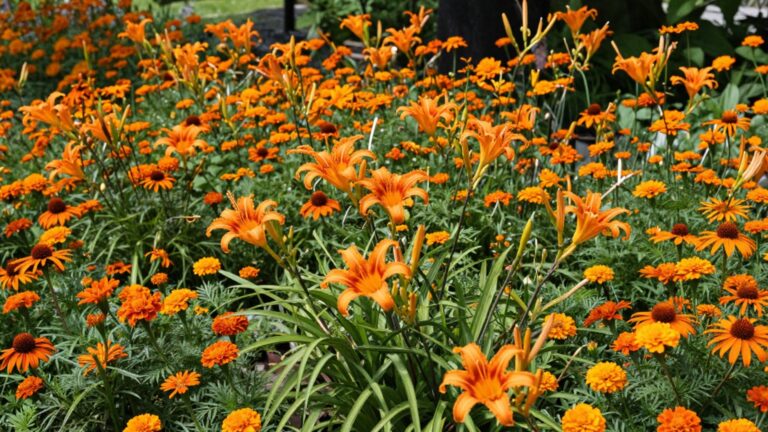
Orange is the most energetic color in the garden palette. It advances visually, making spaces feel warmer and more alive, and it provides a heat-toned counterpoint to the blue-purple perennials that dominate many planting schemes.
These 10 perennials deliver true orange flower color across the full growing season, from late spring through autumn frost.
1. Helenium / Sneezeweed (Helenium autumnale)
Helenium is one of the finest late-summer perennials available, producing masses of daisy-like flowers in vivid tones of orange, red, and yellow from August through October. The reflexed petals and prominent central cone give each flower a distinctive, attractive structure. Native to North America, deer resistant, and exceptionally attractive to bees and butterflies.
- Zone: 3 to 8
- Sun: Full sun
- Height: 3 to 5 feet — excellent for the middle to back of borders
- Best varieties: ‘Mardi Gras’ (orange-red), ‘Sahin’s Early Flowerer’ (orange with red zones, earlier bloom), ‘Rubinzwerg’ (red-orange, 2 to 3 feet)
- Care tip: “Chelsea chop” (cutting back by half in late May) produces a bushier, more compact plant with a longer bloom period
2. Orange Daylily (Hemerocallis — orange varieties)
Daylilies are the most adaptable and reliable perennials for orange garden color. While the species tawny daylily (H. fulva) is extremely common and can become weedy, the many cultivated orange daylily varieties offer refined alternatives with non-spreading habits.
- Zone: 3 to 10
- Best orange varieties: ‘Autumn King’ (deep orange, late season), ‘Apricot Sparkles’ (peach-orange), ‘Ed Murray’ (deep mahogany-orange), ‘Frans Hals’ (bicolor orange-russet)
3. Geum (Geum coccineum and G. ‘Totally Tangerine’)
Geums produce cheerful bowl-shaped flowers on slender stems from May through July, with a second flush if deadheaded. ‘Totally Tangerine’ has become one of the most popular garden perennials of the past decade for its vivid apricot-orange color and exceptionally long bloom period (May through September in cool climates).
- Zone: 5 to 9
- Sun: Full sun to partial shade
- Height: 18 to 24 inches
4. Blanket Flower (Gaillardia x grandiflora)
Gaillardia’s fiery combination of orange-red petals with yellow tips and a dark central cone creates one of the most eye-catching perennial flowers available. It blooms continuously from June through October, one of the longest bloom periods of any perennial.
- Zone: 3 to 10
- Special quality: Thrives in poor, dry, sandy soils where other perennials fail, an excellent choice for difficult spots
5. Oriental Poppy (Papaver orientale)
Oriental poppies produce some of the most spectacular late-spring flowers of any perennial, enormous, tissue-paper-thin petals in vivid orange with black basal blotches. The bloom period is brief (2 to 3 weeks in late May to June) but the visual impact is unmatched.
- Zone: 3 to 9
- Note: Foliage goes completely dormant in summer heat, plant with summer perennials (daylilies, rudbeckia) to fill the gap after the poppy disappears
- Best orange varieties: ‘Prince of Orange’, ‘Beauty of Livermere’ (scarlet-orange), ‘Turkenlouis’ (red-orange, fringed petals)
6. Kniphofia / Red Hot Poker (Kniphofia uvaria)
Red hot poker produces dramatic torch-like flower spikes that transition from red at the top to orange to yellow at the base, a naturally graded color display on a single flower. Hummingbirds are particularly attracted to the tubular flowers.
- Zone: 5 to 9
- Sun: Full sun
- Bloom time: Late June through September depending on variety
7. Crocosmia (Crocosmia x crocosmiiflora)
Crocosmia produces arching stems of tubular orange or red flowers from July through September that sway beautifully in a breeze. The sword-like foliage is attractive through the entire growing season. Spreads by corm to form colonies.
- Zone: 5 to 9 (may need winter mulch in zone 5)
- Best varieties: ‘Lucifer’ (vivid red-orange, 3 to 4 feet, very reliable), ‘Emily McKenzie’ (orange with mahogany center), ‘George Davison’ (golden orange)
8. Agastache ‘Apache Sunset’ and Orange Varieties
Agastache (hyssop) varieties in orange tones combine the aromatic foliage and hummingbird attraction of the genus with warm, sunset colors. The upright flower spikes bloom from July through frost and are exceptionally drought tolerant once established.
- Zone: 5 to 9 depending on variety
- Best for orange: ‘Apache Sunset’ (orange-pink), ‘Tangerine Dreams’ (soft orange)
9. Hemerocallis ‘Frans Hals’ (Spider Daylily)
A distinctive daylily with unusually elongated, spidery petals in a bicolored russet-orange pattern. The unusual form sets it apart from standard round-petaled daylilies and creates a more exotic, sophisticated look in the border.
- Zone: 3 to 9
- Height: 26 inches — excellent for the front to middle of a border
10. Mexican Sunflower (Tithonia rotundifolia)
Technically a tender perennial grown as an annual in most climates, Mexican sunflower produces vivid orange daisy-like flowers from midsummer through frost on large, tropical-looking plants (3 to 4 feet tall). One of the best plants for attracting monarch butterflies during their late-summer migration.
- Annual in zones 3 to 9; perennial in zones 10 to 12
- Heat tolerance: Exceptional — thrives in conditions that wilt most other summer flowers
✅ Tip
Orange is a “hot” color that pairs most effectively in the garden with complementary cool colors — deep purple (salvia, catmint, agastache), blue-violet (baptisia, veronicastrum), and rich burgundy (heuchera, dark-leaved dahlias). Avoid pairing orange with pink, which creates a visual clash without complementary contrast.
For the longest season of orange in the garden, layer early bloomers (geum, oriental poppy in May-June) with midsummer plants (crocosmia, gaillardia in July-August) and late-season plants (helenium, agastache in September-October). This layered approach produces orange color for 5 to 6 continuous months.
The Bottom Line
Orange perennials deserve a more central place in garden design than they typically receive. From the brief spectacular display of oriental poppies in May to the long-season performance of helenium and crocosmia through September and October, these 10 plants deliver some of the most vibrant color available in the perennial world.
