
Tomatoes are the most grown vegetable in American home gardens, and frequently the most disappointing.
The gap between a decent tomato harvest and an exceptional one often comes down to what happens before the plant goes in the ground.
The soil environment directly around newly transplanted roots determines how quickly they establish, how efficiently they absorb nutrients through the long growing season, and how well the plant resists disease.
The good news: preparing the perfect tomato planting hole takes 5 to 10 extra minutes and costs almost nothing.
Here are 8 additions that experienced tomato growers use consistently, with the science behind why each one works.
The Foundation: Planting Depth
Before the amendments: bury tomatoes deep.
Tomatoes produce roots all along their buried stem, a unique trait among vegetables. A plant transplanted from a 4-inch pot can be buried to leave only the top 2 to 3 leaf clusters above soil. The 6 to 8 inches of stem now underground develops into roots within 1 to 2 weeks, creating a dramatically more robust root system than surface planting allows.
This deeper root system accesses more soil moisture and nutrients, the foundation that makes every amendment below more effective.
The 8 Best Additions
1. Compost (The Most Important One)
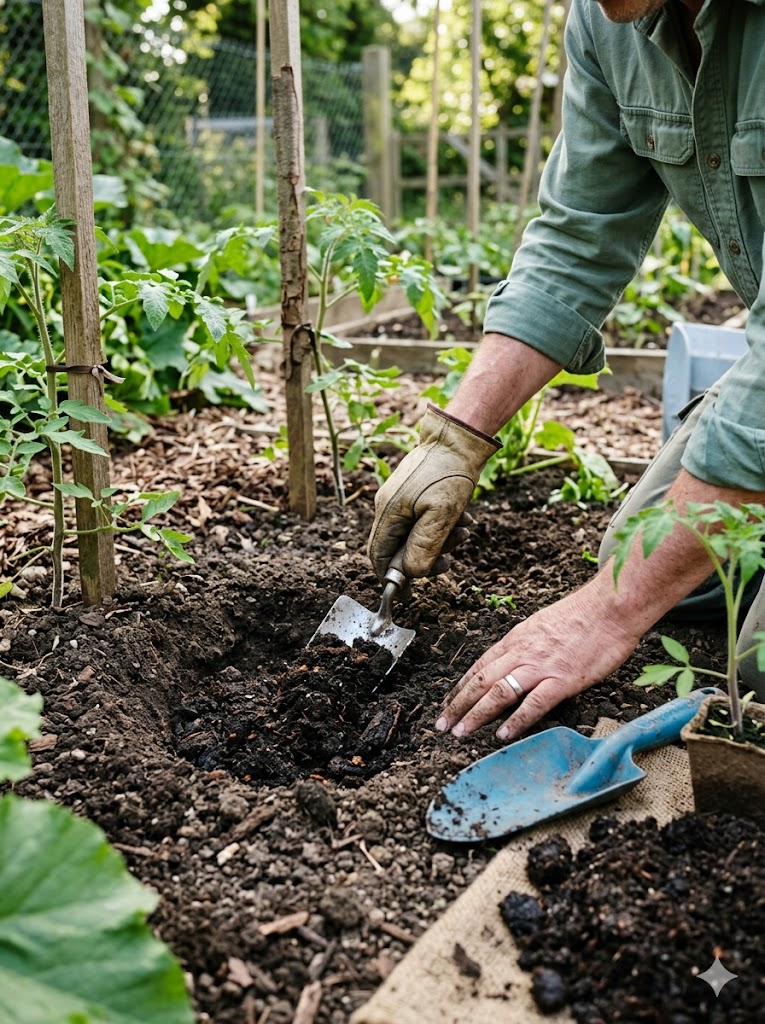
Amount: 2 to 3 cups per hole, mixed thoroughly with native soil
Why it works: Compost provides three things simultaneously that synthetic fertilizers cannot: slow-release nutrients in bio-available form, beneficial microorganisms that improve nutrient cycling, and improved soil structure that balances water retention with drainage.
Good compost contains bacteria and fungi that form symbiotic relationships with tomato roots, helping them access nutrients the plant cannot absorb alone. This microbial community is arguably more valuable than the nutrients themselves.
- Use: Well-aged backyard compost or commercial products like Dr. Earth All-Purpose Compost ($10 to $15 at garden centers)
- Important: Mix thoroughly with surrounding soil, placing uncomposted material directly against roots can temporarily tie up nitrogen
2. Worm Castings
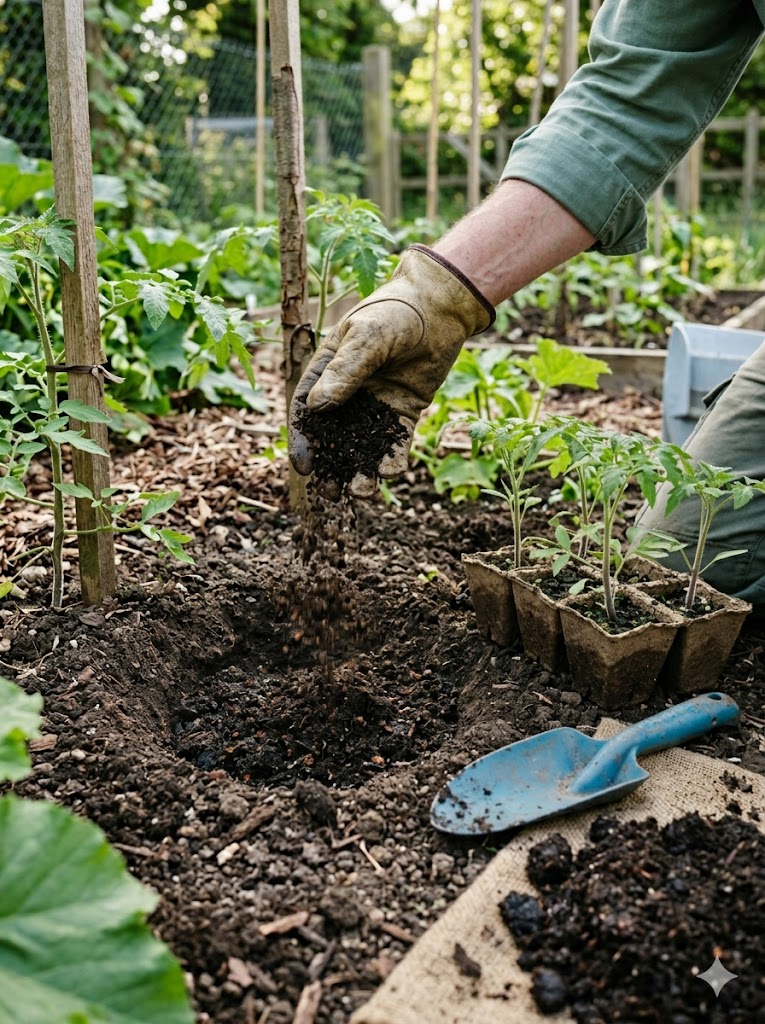
Amount: 1/4 to 1/2 cup per hole
Why it works: Worm castings (worm manure from vermicomposting) are often called the perfect natural fertilizer because their nutrients are in a form immediately bio-available to plant roots without burning risk, even in direct contact.
Castings contain a natural growth hormone (auxin) that stimulates root development, beneficial bacteria that protect against soil-borne pathogens, and perfectly balanced NPK in slow-release form.
- Find them: Dr. Earth Worm Castings, Wiggle Worm Soil Builder, or your own vermicompost ($8 to $15 per pound at garden centers)
3. Bone Meal
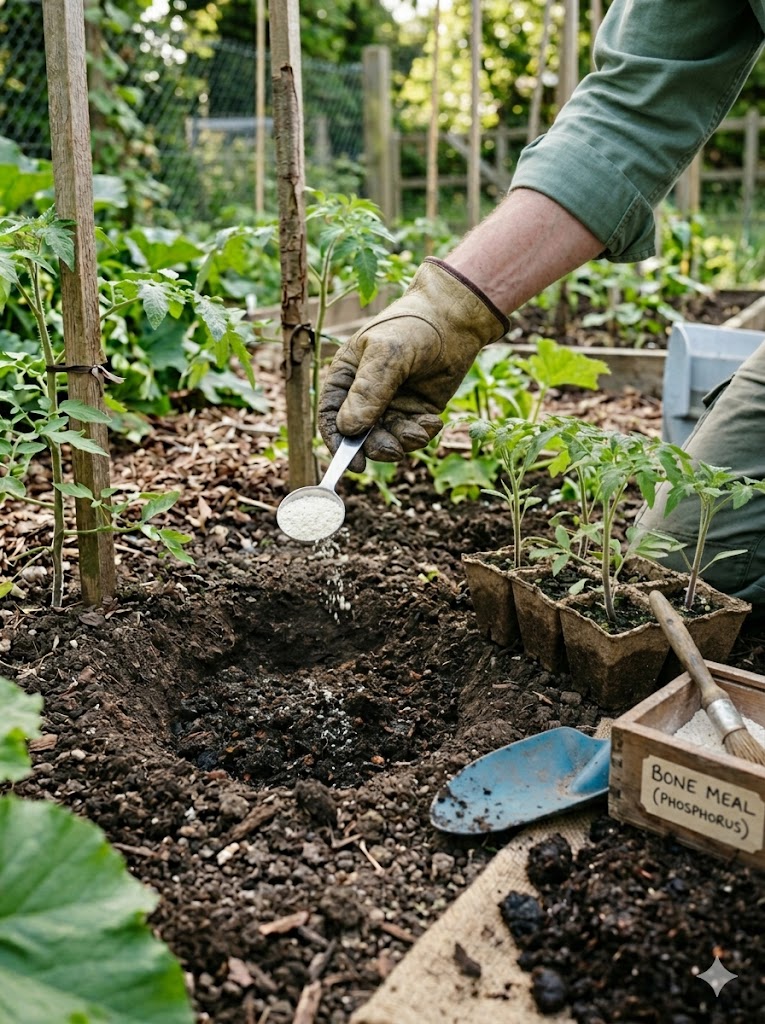
Amount: 1 to 2 tablespoons per hole
Why it works: Bone meal is a high-phosphorus, high-calcium organic fertilizer derived from ground animal bones. Phosphorus is critical for root development (highest need during establishment) and fruit production (highest need during flowering and setting).
Tomatoes planted in phosphorus-adequate soil establish roots faster, develop stronger transplant shock recovery, and set fruit more reliably.
- Product: Down to Earth Bone Meal ($8 at most garden centers) or any OMRI-listed organic bone meal
- Caution: Do not use bone meal if you have dogs, the odor attracts them and they will dig up plants to find it
4. Crushed Eggshells
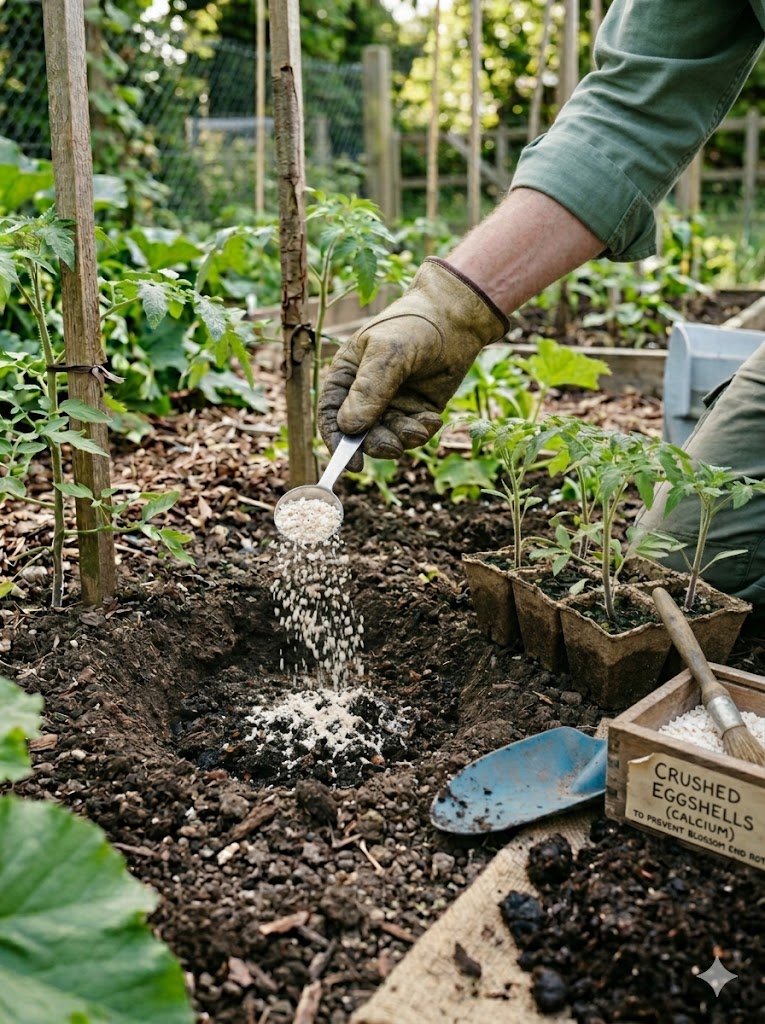
Amount: 1 to 2 tablespoons of finely crushed shells per hole
Why it works: Tomatoes are notorious for blossom end rot, a calcium deficiency disorder that causes leathery, dark patches on the bottom of developing fruit. Blossom end rot is not a disease; it is a physiological disorder caused by insufficient calcium uptake, often compounded by irregular watering.
Eggshells are approximately 95% calcium carbonate. Added to the planting hole, they provide a slow-release calcium reservoir directly in the root zone.
Critical detail: Eggshells decompose slowly unless ground finely. Use a coffee grinder, food processor, or mortar and pestle to grind shells to near-powder. Coarsely crushed shells do not break down quickly enough to supply calcium to plants during the season they are needed.
- Collect throughout winter, dry in the oven at 200°F for 15 minutes, then grind and store in a jar
5. Epsom Salt (Magnesium Sulfate)
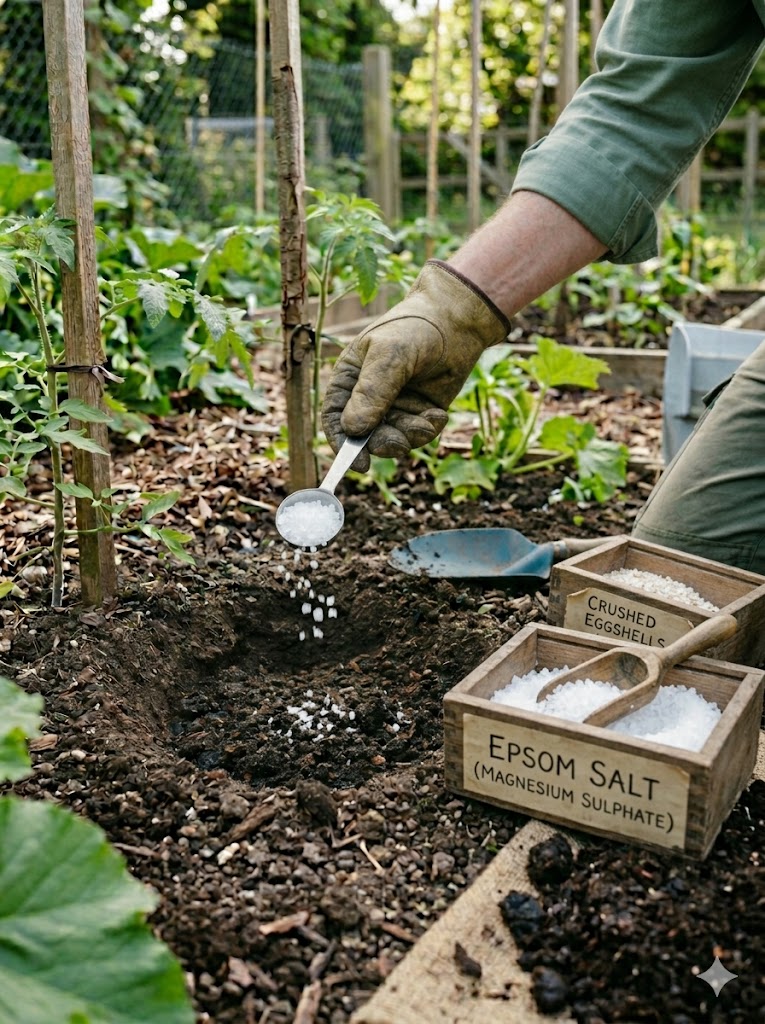
Amount: 1 tablespoon per hole
Why it works, with a caveat: Magnesium is essential for chlorophyll production and plays a key role in nutrient transport within the plant. Magnesium deficiency in tomatoes causes yellowing between leaf veins (interveinal chlorosis) and reduced fruit flavor.
Epsom salt (magnesium sulfate) provides magnesium in a water-soluble, immediately available form. Many tomato growers report improved fruit flavor, leaf color, and overall plant vigor from Epsom salt use.
The caveat: Epsom salt only helps if your soil is actually magnesium-deficient. Adding magnesium to soil already adequate in magnesium can actually impair calcium uptake. If you have never tested your soil, a soil test ($15 to $25 from your state extension service) is worth doing before applying Epsom salt as a routine practice.
6. Mycorrhizal Fungi Inoculant
Amount: Per package directions, typically 1 to 2 teaspoons applied directly to roots at planting
Why it works: Mycorrhizal fungi form a symbiotic network with plant roots, extending their effective reach by factors of 10 to 100 times. The fungi deliver water and minerals (particularly phosphorus and zinc) to the plant in exchange for photosynthetically produced sugars.
Research suggests that mycorrhizal-inoculated tomato plants establish faster, are more drought-resistant (due to the extended water-accessing network), and produce heavier yields than non-inoculated plants.
The inoculant must contact the roots, apply to root ball just before placing in hole rather than mixing into surrounding soil.
- Products: Mycorrhizal Applications Endo Starter, BioAg Ful-Power, or Espoma BioTone Plus ($10 to $20)
7. Banana Peel Pieces
Amount: 1 banana peel, cut into small pieces
Why it works: Banana peels are rich in potassium and phosphorus, the two nutrients most critical for tomato flowering and fruit development. As the peel decomposes (2 to 4 weeks), it releases these nutrients at exactly the stage the plant needs them for establishing flower set.
Unlike some organic amendments, banana peel is free, available year-round in most households, and decomposes rapidly in warm soil.
- Place pieces 2 to 3 inches below where the root ball will sit, not in direct contact with roots, which can cause localized nutrient imbalance during rapid decomposition
8. Aspirin (Acetylsalicylic Acid)
Amount: 1/2 aspirin tablet crushed per hole
Why it works: This one sounds absurd but has genuine scientific support. Salicylic acid, the active compound in aspirin, is a plant hormone that activates systemic acquired resistance (SAR), the plant’s natural immune response against pathogens including late blight (Phytophthora infestans) and early blight (Alternaria solani).
Several university studies have found that tomatoes treated with salicylic acid at planting show reduced susceptibility to fungal diseases throughout the season. The effect is a genuine activation of the plant’s immune system, not a direct antifungal application.
- Use: One standard 325mg uncoated aspirin tablet, crushed and mixed into the soil at the bottom of the hole
What NOT to Put in Your Tomato Planting Hole
Equally important: what to avoid.
- Undiluted synthetic fertilizer: High-concentration fertilizer directly against newly developing roots causes fertilizer burn, root cell damage that creates the opposite of the desired effect
- Fresh manure: Fresh (not composted) manure releases ammonia that burns roots and may introduce pathogens
- Bone meal directly against roots if dogs are present: They will dig up your plants to find the source of the scent
- Coffee grounds as a primary amendment: Coffee grounds are acidifying and, used in excess, can create soil too acidic for tomatoes. Use sparingly (1 to 2 tablespoons maximum) as one of several amendments, not as a primary fertilizer
The Complete Planting Hole Recipe
To implement all of the above efficiently:
- Dig hole at least 12 inches deep (for deep planting).
- At the bottom of the hole: place banana peel pieces. Cover with 1 inch of soil.
- Mix into the hole: 2 cups compost, 1/4 cup worm castings, 1 tablespoon bone meal, 1 tablespoon crushed eggshell powder, 1 tablespoon Epsom salt, 1/2 crushed aspirin tablet.
- Water the open hole and allow to drain completely.
- Dust the root ball of the transplant with mycorrhizal inoculant.
- Place plant in hole, positioning depth for deep planting.
- Backfill with native soil plus additional compost mixed in.
- Water in thoroughly and mulch the surface 3 to 4 inches deep.
✅ Tip Don’t transplant tomatoes into cold soil. The soil temperature at planting should be at least 60°F, ideally 65°F or above. Cold soil dramatically slows root establishment and can allow soil-borne pathogens to attack stressed roots. Water the hole thoroughly 30 minutes before transplanting. You want the soil wet when the roots go in, this prevents air pockets from forming around root tips and gives roots immediate access to moisture without requiring the fragile transplant to search for water. |
Frequently Asked Questions
Does putting a fish head in a tomato planting hole actually work?
The fish head tradition (also called fish emulsion planting) is genuinely effective, decomposing fish provides nitrogen, phosphorus, and calcium to the root zone as it breaks down. The evidence is anecdotal but consistent across many gardening cultures. If you have access to fish scraps, burying them 6 inches below the root ball is a legitimate soil amendment. The practical downside is that it attracts cats, raccoons, and other animals that may dig up your transplant.
How deep should I plant a tomato?
Bury up to 2/3 of the plant’s stem, leaving only the top 2 to 3 sets of leaves above soil. This produces roots from the buried stem and creates a dramatically more extensive root system than shallow planting. Remove lower leaves that would be buried before planting.
Is it worth buying special tomato fertilizer?
The amendments described above, compost, worm castings, bone meal, provide everything tomatoes need at planting. During the growing season, any balanced organic tomato fertilizer (Espoma Tomato-tone, Neptune’s Harvest Tomato and Vegetable) applied every 2 to 3 weeks once flowers appear is an effective follow-up program.
The Bottom Line
The tomato planting hole is the one moment in the growing season when you have complete access to the root environment. Five minutes of thoughtful preparation at planting creates conditions that benefit the plant for the next 6 months.
Compost, worm castings, and bone meal are the foundation. Eggshells, mycorrhizal inoculant, and aspirin are worth the small effort they require. Combined, they give every tomato transplant the best possible start for a big, flavorful harvest.
