
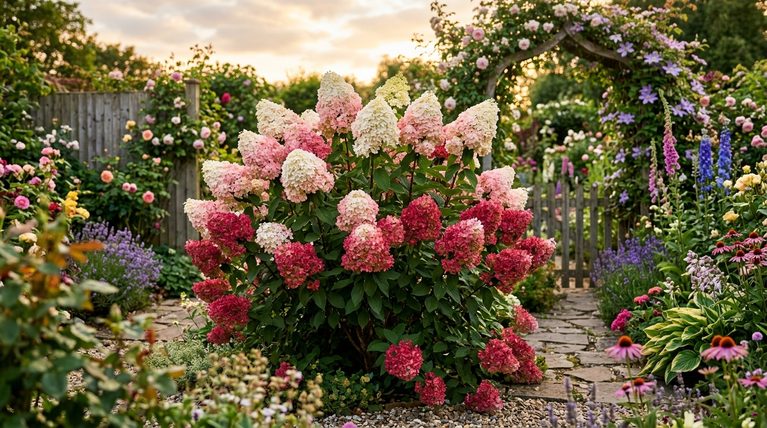
If there’s one plant that consistently stops people in their tracks, it’s the Vanilla Strawberry Hydrangea.
Over the course of a single season, its massive flower clusters transform from pure white to blush pink to deep strawberry red, a living color show that makes it one of the most spectacular flowering shrubs available to home gardeners.
Formally named Hydrangea paniculata ‘Renhy’ (sold under the trade name Vanilla Strawberry), this panicle hydrangea was developed in France and has become one of the best-selling ornamental shrubs in the world.
This guide covers everything you need to know to grow this beauty to its full potential.
What Makes Vanilla Strawberry Hydrangea Special?
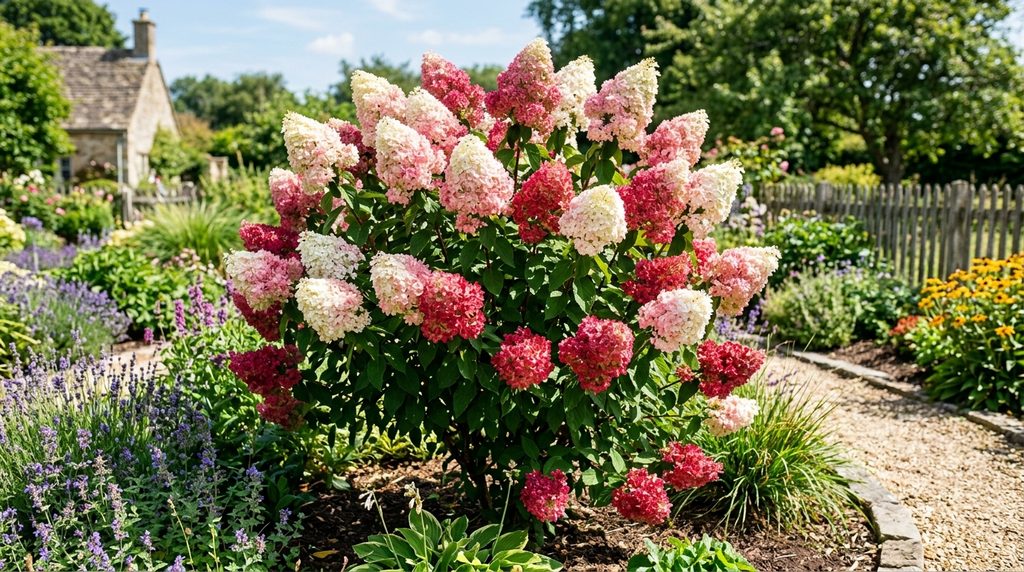
Most hydrangeas offer one color. Vanilla Strawberry offers a seasonal transformation that unfolds over months.
The blooms emerge in mid-summer as pure, creamy white. As summer progresses into early fall, they flush with soft pink. By late summer and early fall, they’ve deepened to a rich strawberry red — all on the same plant, at the same time. The flower clusters near the top (newer blooms) stay white while older clusters at the bottom deepen to red, creating a stunning tri-color effect.
Additional features that make it exceptional:
- Extremely cold hardy — thrives in zones 3-8, far hardier than many popular hydrangea types
- Blooms on new wood — no worrying about protecting buds over winter
- Large, upright flower panicles can reach 12-16 inches long
- Compact for a panicle hydrangea — typically 6-7 feet tall and wide
- Strong stems hold blooms upright even after rain (unlike some hydrangeas)
- Flowers dry beautifully for long-lasting indoor arrangements
How to Plant Vanilla Strawberry Hydrangea
Getting the planting right sets your hydrangea up for a lifetime of spectacular performance.
Choosing the Right Location
Vanilla Strawberry needs at least 4-6 hours of direct sunlight for best blooming and color development. Morning sun with afternoon shade is ideal in hotter climates (zones 7-8). In cooler climates (zones 3-6), full sun is fine and actually intensifies the strawberry coloring.
Soil Requirements
Plant in moist, well-drained, humus-rich soil. Vanilla Strawberry is more tolerant of varying soil types than many hydrangeas — it grows in clay, loam, and sandy soils, provided drainage is reasonable. Amend heavy clay with compost before planting.
When to Plant
Plant in spring or early fall. Spring planting gives roots a full growing season to establish before winter. Fall planting works well if done at least 6 weeks before your first hard freeze.
Planting Steps
Dig a hole 2x wider than the root ball and the same depth. Remove the plant from its container and gently loosen circling roots. Position so the top of the root ball sits level with or just above the surrounding soil. Backfill with native soil mixed with compost. Water deeply and apply 3-4 inches of mulch.
Caring for Vanilla Strawberry Hydrangea Year-Round
Once established (after its first full season), Vanilla Strawberry is remarkably low maintenance. Here’s your seasonal care guide:
Spring Care
This is pruning season. Cut stems back by one-third to one-half in early spring, before new growth emerges. This is what drives the vigorous new growth that carries the summer’s flowers. Remove any dead, damaged, or crossing stems at the base.
Summer Care
Water regularly during the first two summers, especially during dry spells. Established plants are reasonably drought tolerant. Fertilize once in spring with a slow-release balanced granular fertilizer. Avoid high-nitrogen fertilizers — they promote leafy growth at the expense of flowers.
Fall Care
Enjoy the stunning color transformation! Leave the flower heads on through winter — they provide visual interest and protect the stem tips. The dried flowers also look beautiful dusted with snow.
Winter Care
Vanilla Strawberry is exceptionally cold-hardy. In zones 3-7, no winter protection is needed. In zone 8, a light layer of mulch over the root zone is sufficient. Since it blooms on new wood, late frosts don’t affect summer flowering.
Pruning Tips for Maximum Blooms
Unlike the familiar blue bigleaf hydrangeas, Vanilla Strawberry blooms on new wood — meaning it produces flowers on stems grown in the current season. This makes pruning simple and forgiving:
- Prune in late winter or early spring, just before new growth begins
- Cut all stems back by one-third to one-half — this stimulates vigorous new growth and large flower clusters
- Remove weak, thin stems at the base to focus the plant’s energy on strong, upright growth
- Hard pruning (cutting back to 12-18 inches) produces fewer but larger, more dramatic flower clusters
- Light pruning produces more flower clusters but each will be somewhat smaller
- Never prune in fall — wait until late winter to preserve stem structure through winter
Companion Plants for Vanilla Strawberry Hydrangea
The white-to-strawberry color range of Vanilla Strawberry pairs beautifully with a wide range of companions:
- Blue salvia or agastache: The blue-purple tones contrast beautifully with the pink and red flowers
- White echinacea (coneflower): Extends the white-and-pink theme and attracts pollinators
- Russian sage: Airy blue-lavender flowers complement the hydrangea’s density with lightness
- Dark-leaved plants (black elder, purple barberry): Make the white flowers pop dramatically
- Ornamental grasses: Create movement and texture that contrasts with the bold flower clusters
|
🌿 Pro Tip: Before publishing, make sure your article includes at least one original image, a proper schema markup (Article or HowTo), and links to 3-5 of your own related posts to build topical authority. |
Frequently Asked Questions
These FAQs are optimized for Google’s ‘People Also Ask’ featured snippets. Answer each clearly and concisely in your published article.
|
Q: Why is my Vanilla Strawberry Hydrangea not turning pink? A: The most common cause is insufficient sunlight. The strawberry coloring intensifies with more sun exposure. Plants in too much shade often stay white or produce only faint pink tones. Also, younger plants in their first season may not develop the full color range — this often improves in subsequent years. |
|
Q: Can I change the color of my Vanilla Strawberry Hydrangea with soil amendments? A: No. Unlike bigleaf hydrangeas (Hydrangea macrophylla), panicle hydrangeas including Vanilla Strawberry are not affected by soil pH. Their color change is genetically programmed and temperature/light-influenced — not altered by aluminum sulfate or lime. |
|
Q: How fast does Vanilla Strawberry Hydrangea grow? A: It’s a moderate-to-fast grower, typically adding 12-24 inches of new growth per year in good conditions. A newly planted 1-gallon shrub will reach full size (6-7 feet) within 4-5 years. |
|
Q: Can I grow Vanilla Strawberry Hydrangea in a container? A: Yes, though it’s challenging due to its eventual size. Use a very large container (at least 25 gallons) with excellent drainage. Container-grown plants need more frequent watering and fertilizing and may need winter protection in colder zones. |
|
Q: Do I need to deadhead my Vanilla Strawberry Hydrangea? A: No — in fact, it’s better to leave the flower heads on through winter. They add visual interest, protect stem tips, and dry beautifully. Remove them in late winter/early spring when you do your annual pruning. |
Conclusion
Vanilla Strawberry Hydrangea earns its reputation as one of the most spectacular flowering shrubs available to home gardeners. Its dramatic seasonal color transformation, exceptional cold hardiness, low maintenance requirements, and sheer visual impact make it a plant that pays dividends year after year.
Whether you plant it as a standalone specimen, a flowering hedge, or as the anchor of a mixed border, it will be the first thing visitors notice — and the first thing they ask about.
Plant it once, prune it each spring, and enjoy a lifetime of strawberry-and-cream drama.
