
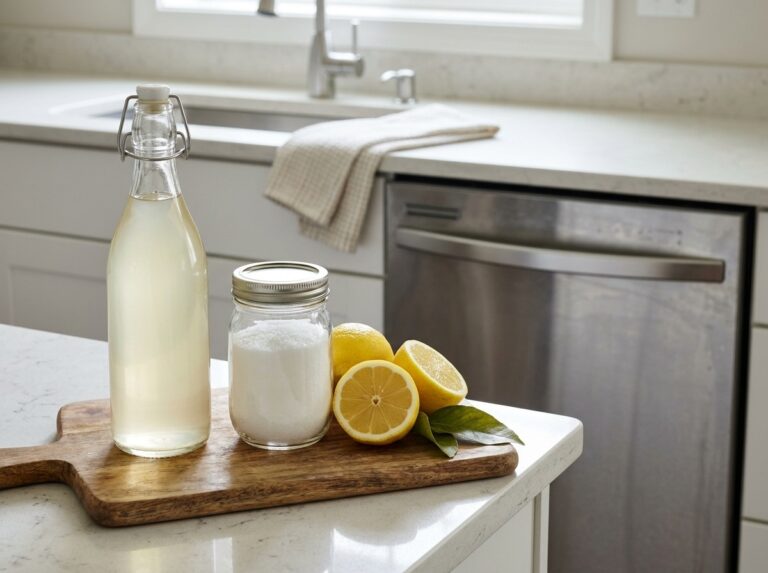
Commercial rinse aids work well, but they contain a mix of surfactants, preservatives, and fragrance chemicals that many people prefer to avoid. The good news is that the core job of rinse aid, making water sheet off dishes quickly so it does not leave spots when it dries, can be done with a few simple, natural ingredients you probably already have.
This guide covers four homemade rinse aid options, the science behind why each one works, how to make and use each one correctly, and which choice is best depending on how hard your water is.
Table of Contents
What Does Rinse Aid Actually Do?
Water naturally forms droplets on surfaces. When those droplets dry on glass or dishes, the minerals dissolved in the water stay behind as spots. Rinse aid contains surfactants that lower the surface tension of water. With lower surface tension, water spreads into a thin sheet rather than beading up. That thin sheet slides off the dish surface and drains away cleanly, taking the dissolved minerals with it rather than leaving them behind as spots.
Any substance that reduces water’s surface tension or dissolves mineral deposits as the water drains can serve as a rinse aid. Several natural acids and surfactants do this effectively.
Recipe 1: Plain White Vinegar (Easiest Option)
White distilled vinegar is the simplest homemade rinse aid. It contains acetic acid (typically 5%), which dissolves calcium carbonate mineral deposits as the rinse water drains off your dishes, preventing spots from forming.
How to use it
- Pour plain white distilled vinegar directly into the rinse aid dispenser on your dishwasher door.
- Fill it to the max line as you would with commercial rinse aid.
- Run your dishwasher normally. The dispenser releases a small amount of vinegar during the final rinse cycle.
That is all. No mixing, no preparation. Replace when the dispenser shows low.
How well does it work?
Very well for removing spots on glassware. Vinegar outperforms many commercial rinse aids at keeping glasses clear and streak-free, particularly for light-to-moderate hard water. One area where it falls short is drying. Commercial rinse aids contain drying agents that speed up evaporation from dish surfaces. Vinegar does not. Your dishes may need a few extra minutes to dry, or you may want to open the dishwasher door at the end of the cycle to let steam escape and speed drying.
WARNING: Use only white distilled vinegar with an acidity of 5% or less. Higher-concentration cleaning vinegars (10% or 30% acidity) can damage the rubber seals and gaskets inside the rinse aid dispenser and elsewhere in the dishwasher. Check the label before using. Standard grocery store white vinegar is always 5% and is safe.
Recipe 2: Citric Acid Solution (Best for Hard Water)
Citric acid is a stronger acid than acetic acid in vinegar, making it more effective at dissolving mineral deposits in hard water areas. It is sold as a powder in grocery stores (in the canning section), health food stores, and on Amazon. A pound makes many batches of rinse aid.
How to make it
- 2 cups (480 ml) of warm water
- 2 tablespoons of citric acid powder
- Measure 2 cups of warm water into a clean bottle or container.
- Add 2 tablespoons of citric acid powder.
- Stir or shake until the powder is completely dissolved. The solution will be clear.
- Pour into a clean labeled bottle for storage or directly into the rinse aid dispenser.
- Use within 2 weeks. Citric acid solutions lose potency over time once dissolved. Mix fresh batches rather than making large quantities.
How to use it
Fill the rinse aid dispenser with the citric acid solution exactly as you would with commercial rinse aid. The machine dispenses a small amount during the final rinse.
How well does it work?
Citric acid is more effective than vinegar for hard water areas because it is a stronger acid at the same concentration. It dissolves calcium and magnesium deposits more aggressively, leaving glasses notably clearer. It is also gentler on rubber seals than high-concentration vinegar. For households in areas with very hard water (above 180 ppm), this is the best natural option.
TIP: If you prefer your dishes to come out with a subtle fresh scent, add 3 to 4 drops of lemon essential oil to the citric acid solution before filling the dispenser. Keep the essential oil addition minimal. Too much oil can leave a residue inside the dispenser over time.
Recipe 3: Citric Acid and White Vinegar Blend (For Spotting and Drying)
Combining citric acid and white vinegar creates a rinse aid that addresses both mineral deposits and surface tension more effectively than either ingredient alone. This is the best all-around homemade formulation for moderate-to-hard water.
Ingredients
- 1 cup (240 ml) of white distilled vinegar
- 1 cup (240 ml) of warm water
- 1 tablespoon of citric acid powder
Instructions
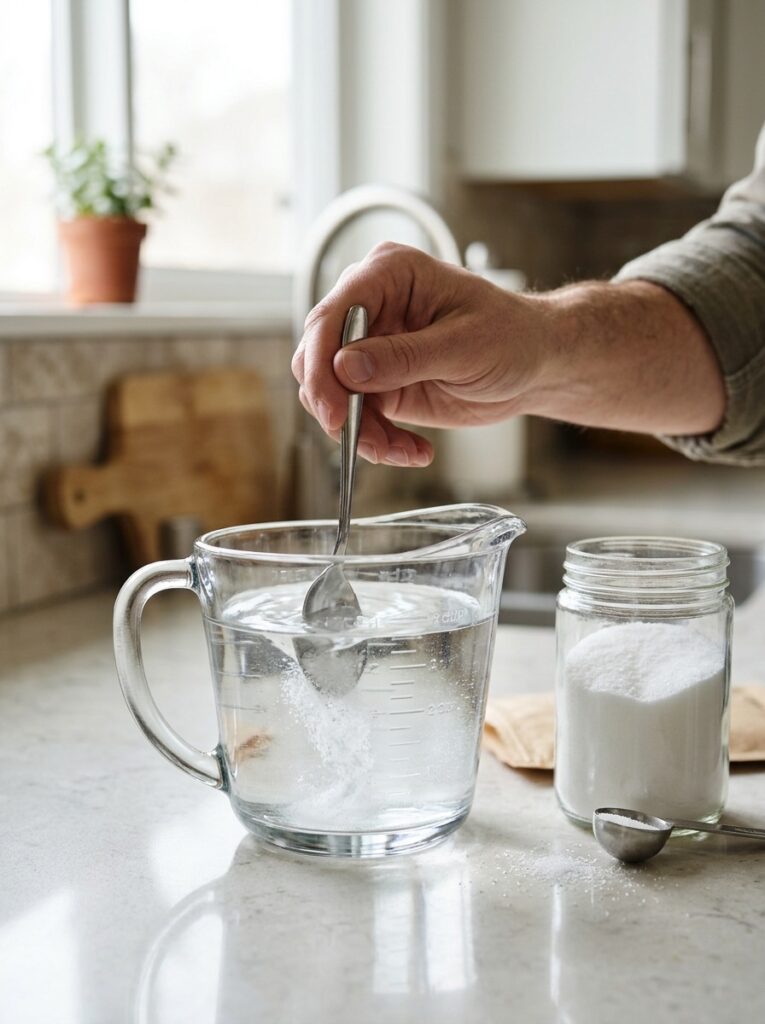
- Warm the water slightly (do not boil).
- Dissolve the citric acid powder in the warm water first, stirring until fully clear.
- Add the white vinegar and stir to combine.
- Pour into a clean bottle. Label it clearly.
- Use within 2 weeks.
How to use it
Fill the rinse aid dispenser with this solution. The combination gives both the mineral-dissolving power of citric acid and the mild surfactant properties of vinegar working together during the rinse cycle.
Recipe 4: Hydrogen Peroxide Solution (For Sanitizing and Spot Prevention)
Hydrogen peroxide (3% drugstore grade) is a mild, food-safe oxidizer that reduces surface tension and helps sanitize dish surfaces. It leaves no chemical residue and breaks down into water and oxygen. It is available at any pharmacy or grocery store.
How to use it
- Pour 3% hydrogen peroxide directly into the rinse aid dispenser, undiluted.
- Fill to the max line.
- Run the dishwasher normally.
How well does it work?
Hydrogen peroxide works well for reducing water spots on dishes and provides a mild sanitizing effect during the rinse. It is less effective than citric acid at dissolving heavy mineral deposits in hard water but works adequately in soft-to-moderate water areas. It is the best choice if you want a sanitizing effect alongside spot prevention.
WARNING: Use only 3% hydrogen peroxide (the standard pharmacy grade sold in brown bottles). Higher concentrations are not necessary and may affect rubber seals. Do not mix hydrogen peroxide with vinegar in the same container, as combining the two produces peracetic acid, which can be irritating.
Comparison: Which Homemade Rinse Aid Should You Use?
For soft water: Plain white vinegar works well and costs almost nothing. Spot prevention is excellent and drying is adequate.
For moderate hard water (60 to 180 ppm): The citric acid and vinegar blend gives the best results. Mineral deposits are dissolved more aggressively than vinegar alone.
For hard water (above 180 ppm): Citric acid solution is the strongest natural option available. For very hard water areas, a commercial rinse aid such as Finish Jet-Dry (available at any grocery store) may still outperform homemade options at full hardness levels, but citric acid gets close.
For antibacterial preference: Hydrogen peroxide is the best choice if you want both spot prevention and mild sanitizing.
How to Fill the Rinse Aid Dispenser
- Open the dishwasher door fully.
- Locate the rinse aid dispenser. It is on the inside of the door, next to the detergent dispenser. It has a round cap with a star-shaped symbol or the words ‘Rinse Aid’.
- Open the cap by pressing the latch and lifting, or by turning counterclockwise depending on your machine.
- Pour your chosen homemade rinse aid into the dispenser until it reaches the max fill line. Do not overfill.
- Close the cap firmly.
- Wipe any spilled liquid from the door surface with a damp cloth.
TIP: Most dishwashers have a dispenser dial or setting that controls how much rinse aid is released per cycle. For homemade rinse aids, start with the dispenser set to its middle setting. If you still see spots after a few cycles, increase the setting. If dishes come out with streaks, reduce the setting slightly.
How Often to Refill
A filled rinse aid dispenser typically lasts 3 to 8 weeks depending on how often you run the dishwasher and how much the machine is set to dispense per cycle. Most dishwashers have an indicator light that turns on when rinse aid is low. Check it weekly if your machine does not have an indicator.
To understand what makes tap water hard, see the USGS explanation of water hardness.
Related Guides
- Dishwasher Salt Alternatives: What Works and What Doesn’t
- How to Clean a Dishwasher (Every Part, Step-by-Step)
- Dishwasher Making Dishes Smelly or Dirty? Causes and Fixes
Frequently Asked Questions
Will white vinegar damage my dishwasher if I use it as rinse aid regularly?
Standard 5% white vinegar used in the rinse aid dispenser is safe for regular use. The dispenser releases only a small amount per cycle, further diluted by the rinse water, so the actual concentration of acetic acid that contacts rubber seals and internal components is very low. The concern arises only with higher-concentration cleaning vinegars above 5%, which should not be used in the dispenser. If you use standard grocery store vinegar, the risk of damage is negligible.
My dishes still have spots after using homemade rinse aid. What should I check?
First, confirm that the dispenser is actually releasing the rinse aid during the cycle. Open the dispenser after a cycle and check whether it is empty or significantly reduced. If the dispenser level has not changed, it may be clogged. Clean it by rinsing it out with warm water using a small brush or toothpick to clear the release opening. Also check that you are using the right formula for your water hardness. If you are in a very hard water area, plain vinegar may not be strong enough and you should switch to the citric acid solution.
Can I add essential oils to make my homemade rinse aid smell better?
Yes, but use a maximum of 3 to 4 drops per batch. Essential oils are highly concentrated and can leave a residue inside the dispenser if used in larger amounts. Lemon and orange essential oils work particularly well because they also contain small amounts of limonene, which has mild degreasing properties. Do not use oils that are solid at room temperature (like coconut oil) as they can solidify inside the dispenser.
Is homemade rinse aid safe for baby bottles and children’s dishes?
Yes. All four homemade options in this guide are safer for food-contact surfaces than commercial rinse aids. White vinegar, citric acid, and hydrogen peroxide all break down into harmless compounds and do not leave chemical residues on surfaces after rinsing and drying. Commercial rinse aids contain surfactant chemicals that some studies have identified remaining on dishes after drying. Homemade alternatives avoid this concern.
Can I use lemon juice instead of citric acid powder?
Yes. Lemon juice contains citric acid and works as a substitute. Use 3 tablespoons of fresh lemon juice per cup of water as a rough equivalent to the citric acid powder recipe. The downside is that lemon juice also contains sugars and other organic compounds that can leave a slight residue in the dispenser over time if used repeatedly. It is fine as an occasional substitute but not ideal as a permanent long-term solution. Citric acid powder is purer and more effective per use.
