
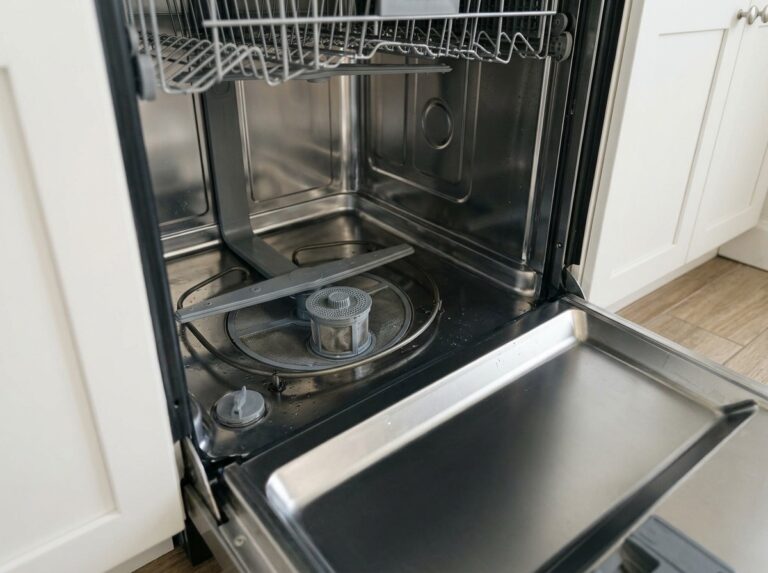
Yes, every dishwasher has a filter. Without one, food particles washed off your dishes would circulate through the water repeatedly, redepositing on clean dishes and eventually clogging the drain pump. The filter catches these particles and keeps the wash water from becoming a soup of food debris.
What most people do not know is that there are two fundamentally different types of dishwasher filters, and they require completely different levels of maintenance. One type cleans itself. The other needs you to do it manually. Knowing which type you have determines whether you need to add filter cleaning to your routine, and the difference matters a lot for how your dishwasher performs over time.
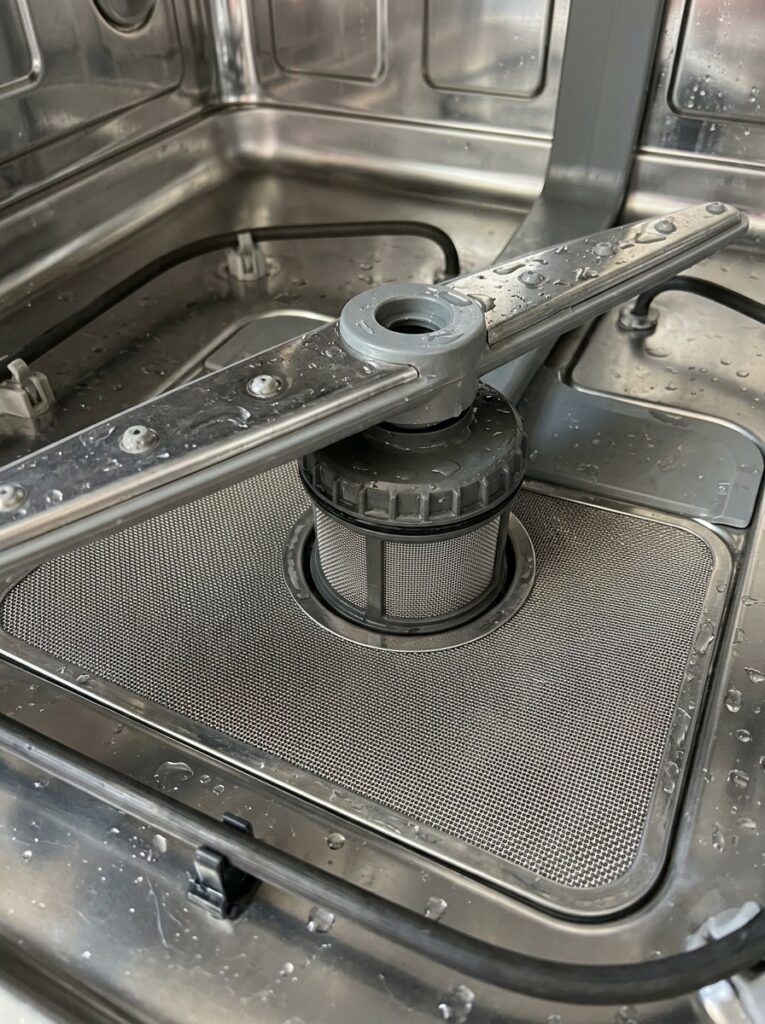
Table of Contents
The Two Types of Dishwasher Filters
Self-Cleaning Filters
Self-cleaning filters are built into older dishwashers, particularly models made before the mid-2000s, and into some current budget models. They contain a built-in grinder, similar in principle to a garbage disposal, that pulverizes food particles during the wash cycle. The ground particles are then flushed out through the drain with the wastewater.
Dishwashers with self-cleaning filters do not require you to manually remove and clean the filter. They handle their own maintenance. However, they are noisier than dishwashers with manual filters because of the grinding mechanism. The grinding sound during a cycle is normal and expected.
You can identify a self-cleaning filter by looking at the bottom of the dishwasher tub with the bottom rack removed. If there is no removable mesh cylinder or flat filter plate, and the drain area appears to be a fixed sealed unit, it is a self-cleaning model.
Manual Filters
Manual filters are standard in almost all current mid-range and high-end dishwashers, including most Bosch, KitchenAid, Whirlpool, GE, and Miele machines. They consist of two components: a cylindrical upper filter and a flat mesh lower filter that sits beneath it. Together they catch food particles before they reach the drain pump.
Manual filters are quieter than self-cleaning filters because they have no grinding mechanism. The trade-off is that they accumulate food particles and need regular cleaning. A neglected manual filter is the single most common cause of a dishwasher that smells bad, leaves dishes dirty, or drains slowly.
How to Tell Which Type You Have
Check your dishwasher manual. It will state the filter type directly. If you do not have the manual, search for your dishwasher model number (usually printed on a label inside the door frame) followed by the word ‘filter’ on the manufacturer’s website or on YouTube.
You can also check physically. Remove the bottom rack and look at the floor of the dishwasher tub. A manual filter system has a clearly visible round mesh cylinder standing upright in the center or rear of the tub floor, often with an arrow or icon on top indicating the direction to turn it for removal. If you see this, you have a manual filter that needs regular cleaning.
Where Is the Dishwasher Filter Located?
On almost all dishwashers with manual filters, the filter is at the bottom of the dishwasher tub. Pull out the bottom rack fully and look at the tub floor. The cylindrical upper filter is the most visible component, typically positioned centrally or slightly toward the rear. In most machines it is in the same area as the lower spray arm.
On some Bosch and Siemens models, the filter sits just below the lower spray arm. On many KitchenAid and Whirlpool models, it is at the rear center of the tub floor. On GE dishwashers, it is typically at the back center and has a slightly different removal mechanism. Check your specific model’s manual for the exact location if you cannot locate it by looking.
How to Remove and Clean a Manual Dishwasher Filter
What you need
- Rubber gloves
- Old toothbrush
- Dish soap
- Warm water
- White vinegar (for heavy mineral buildup)
Step-by-step cleaning process
- Make sure the dishwasher is off and empty.
- Pull the bottom rack all the way out and set it aside.
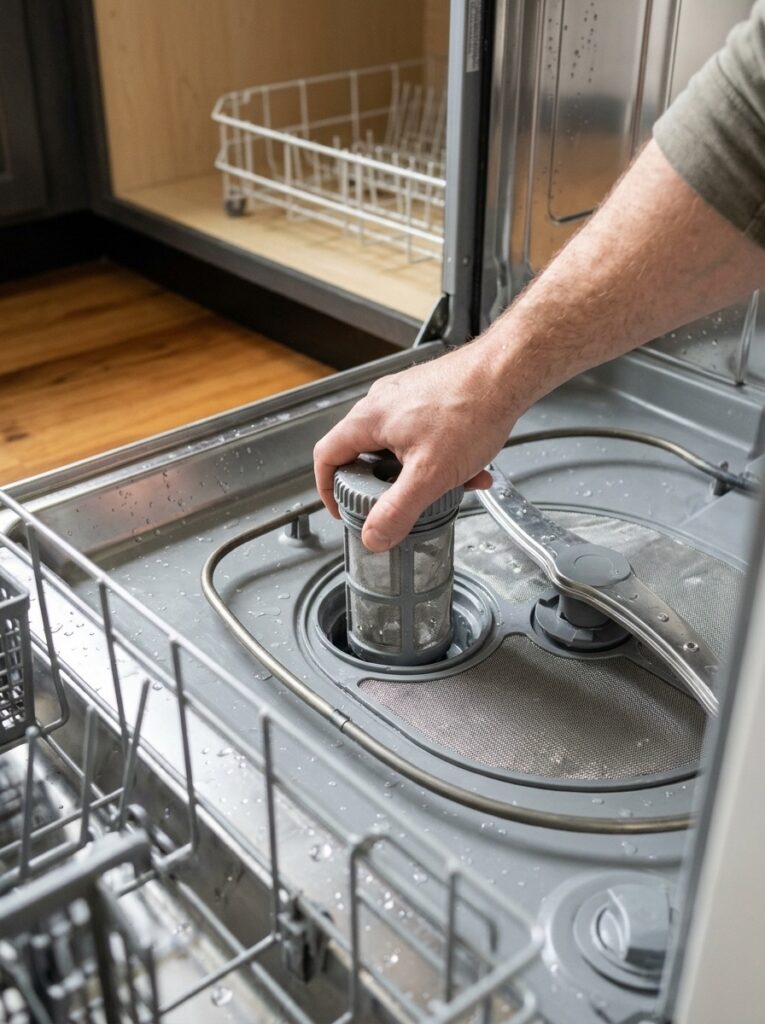
- Locate the cylindrical filter. Most have a small arrow or lock icon indicating the direction to turn for removal. Grip the top of the cylinder and twist it in the direction of the arrow, usually counterclockwise, about a quarter turn. Then lift it straight up out of its housing.
- Once the upper cylinder is removed, you will see the flat mesh filter plate underneath. Lift this out too. It usually slides or lifts straight up without twisting.
- Carry both filter components to the kitchen sink.
- Rinse both pieces under warm running water. Hold them so the water runs from the inside of the mesh outward to push trapped particles out rather than further in.
- Apply a few drops of dish soap to the toothbrush and scrub the mesh on both filter pieces. Work in circular motions, paying attention to every part of the mesh surface. The tiny holes in the mesh are where greasy debris accumulates most.
- If the filter has white mineral crusting or a strong food smell despite scrubbing, soak both pieces in undiluted white vinegar for 20 to 30 minutes. The acid dissolves mineral deposits and kills odor-causing bacteria. Then scrub again and rinse.
- Rinse both filter pieces thoroughly under clean running water until no soap or vinegar remains.
- Do not use abrasive scrubbers on the filter mesh. Steel wool or abrasive pads tear the fine mesh and reduce its effectiveness.
- Before replacing the filter, look into the filter housing in the tub floor. Use a damp cloth or paper towel to wipe away any food debris that has settled in the housing while the filter was removed.
- Seat the flat lower filter back into its housing first. Then insert the cylindrical upper filter and twist it clockwise until it locks into position. You should feel it click or stop firmly when it is correctly seated.
- Replace the bottom rack.
TIP: If your filter has an unusually strong smell after cleaning, soak it in a bowl of warm water with 1 tablespoon of baking soda for 15 minutes after the vinegar soak. The baking soda neutralizes any residual acidic or sour smell. Rinse thoroughly before reinstalling.
How Often Should You Clean the Dishwasher Filter?
The right cleaning frequency depends on how you use your dishwasher.
- Once a month: suitable if you scrape food off plates before loading, run the dishwasher 5 to 7 times per week, and do not put heavily food-coated items in without rinsing.
- Every 2 weeks: appropriate if you often load dishes with significant food residue, use the dishwasher for pots and pans with stuck food, or run it daily for a large household.
- Immediately: if the dishwasher smells bad, leaves food particles on dishes after a cycle, or drains slower than normal. These are all signs of a blocked filter.
Manufacturers typically recommend monthly cleaning as a baseline. If you consistently pre-scrape your dishes, monthly cleaning is sufficient for most households.
What Happens If You Never Clean the Filter
A clogged manual filter creates a cascade of problems. The mesh holes become blocked with grease and food debris, which means the filter can no longer catch new particles effectively. These particles then recirculate in the wash water and deposit back onto dishes, leaving them dirtier than before the wash. The stagnant food in the warm, moist filter becomes a bacterial breeding ground within days, producing the rotten or sour smell that people associate with a bad dishwasher. The restricted drainage caused by a blocked filter also puts additional strain on the drain pump, shortening its life.
Most dishwasher technicians report that filter neglect is the leading cause of dishwasher complaints that turn out not to require any actual repairs.
Cleaning the Filter Housing and Surrounding Area
The area around and below the filter housing also accumulates food debris and should be wiped down whenever you clean the filter. Use a damp cloth to wipe the floor of the tub around the filter housing. For debris that has settled into the drain area below where the filter sits, use a thin cotton swab or the corner of a damp cloth to reach in and wipe it out.
While you have the filter out, also check that the lower spray arm can spin freely. Spin it by hand. If it catches or does not spin smoothly, a piece of debris may be jammed in the spray arm mount. Remove the spray arm (most unclip by lifting or unscrewing counterclockwise) and clear any obstruction.
For more on washing dishes, see the dishwashing tips from the American Cleaning Institute.
Related Guides
- How to Clean a Dishwasher Filter (Step-by-Step, All Brands)
- Dishwasher Making Dishes Smelly or Dirty? Causes and Fixes
- How to Clean a Dishwasher (Every Part, Step-by-Step)
Frequently Asked Questions
My dishwasher filter looks clean but my dishes are still coming out dirty. What else should I check?
Check the spray arm holes next. Remove the lower spray arm by pulling it upward or unscrewing it counterclockwise, and hold it under running water to see if all the holes are fully open. Use a toothpick to clear any blocked holes. Also check the upper spray arm on the underside of the upper rack. Blocked spray arm holes are the second most common cause of poor cleaning after a dirty filter.
I lost the filter for my dishwasher. Can I run it without one?
Do not run the dishwasher without the filter installed. Without a filter, food particles will enter the drain pump directly, causing blockages and potential pump damage. Replacement filters are available for most brands on Amazon, AppliancePartsPros.com, and the manufacturer’s website. Search by brand and model number. Choose a genuine replacement filter assembly for your model.
Does my dishwasher have a second filter I might have missed?
Most dishwashers with manual filters have just the two-piece assembly (cylindrical upper and flat lower). However, some models have an additional coarse debris trap that sits around the base of the spray arm mount. Check your manual to see if your model has more than two filter components. On some Bosch models, there is also a microfilter integrated into the recirculation pump that is not user-serviceable but rarely causes problems in normal use.
My filter is cracked or has a torn mesh section. Does it need replacing?
Yes, replace it. A cracked or torn filter cannot catch fine food particles effectively. Food will bypass the damaged section and circulate freely in the wash water. Continuing to use a damaged filter risks clogging the drain pump. Replacement filter assemblies for most major brands are available online.
I cleaned the filter and the dishwasher still smells. Where else should I look?
Check the door seal (the rubber gasket around the door opening). Wipe it down thoroughly with a toothbrush and baking soda paste. Also run an empty hot cycle with 2 cups of white vinegar in a bowl on the top rack. If the smell persists after that, check the drain hose connection under the sink for any accumulated food debris at the junction with the garbage disposal or sink drain.
