
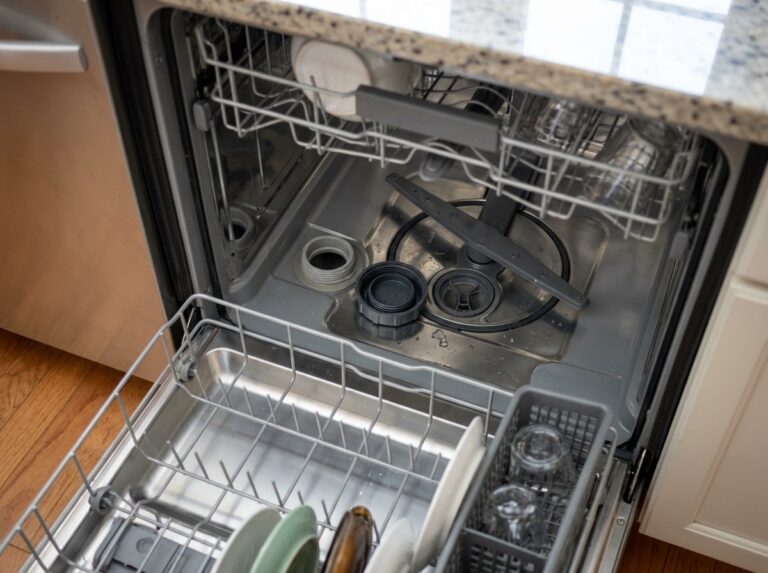
Under normal use, dishwasher salt should last anywhere from two weeks to several months depending on how hard your water is and how often you run the machine. If you are topping up salt every few days, or if the salt indicator light comes on shortly after a fresh refill, your dishwasher has a problem. This is not just inconvenient. Excess salt dissolving into the wash water can leave a salty residue on dishes and, in some cases, scratch glassware.
This guide covers every known cause of a dishwasher using too much salt, how to identify which one applies to your machine, and the specific steps to fix each issue.
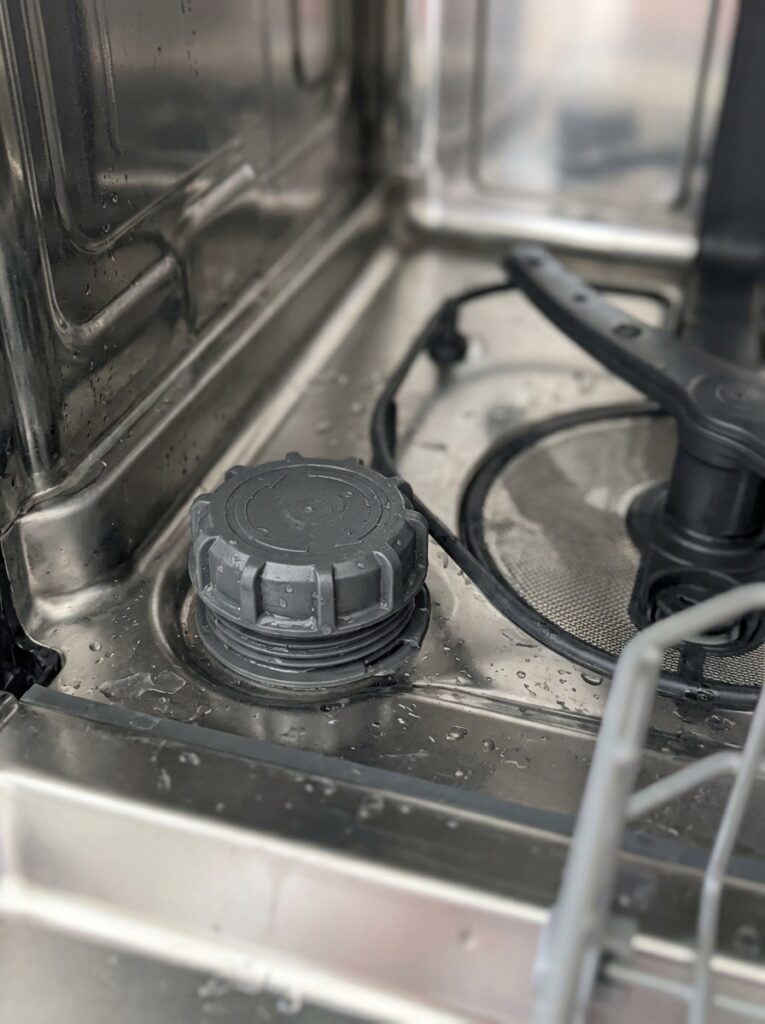
Table of Contents
How Much Salt Should a Dishwasher Use Normally?
In a hard water area (above 180 ppm), a dishwasher running once per day will typically use between 1 and 2 kg of salt per month. In a moderate hard water area (80 to 180 ppm), expect to refill every 6 to 8 weeks. In a soft water area (below 60 ppm), you may go 3 to 6 months without needing to refill.
If you are refilling more than twice per month with daily use in a moderate-to-hard water area, something is wrong. If the indicator light comes back on within 1 to 2 cycles of a fresh refill that you can physically see was full, that is almost certainly a sensor or float fault rather than genuine salt consumption.
Cause 1: Water Hardness Setting Is Too High
Every dishwasher with a water softener has a water hardness setting in its control panel or menu. This setting tells the machine how aggressively to regenerate the resin beads and therefore how much salt to use per cycle. If this setting is configured for harder water than you actually have, the machine runs the regeneration process more often than needed and burns through salt faster.
How to check and correct this
- Find your actual water hardness by visiting your water utility’s website or using a water hardness test strip. Both Hach and API make affordable test kits available on Amazon.
- Check your dishwasher manual for how to access the water hardness setting. On most machines, it is accessed through a combination of button presses at startup. Bosch, Siemens, and Miele all have specific procedures outlined in their manuals.
- Adjust the setting to match your actual water hardness. The manual will give a conversion table between measured water hardness (usually in grains per gallon or parts per million) and the machine’s numbered scale.
This is one of the most common and easily fixed causes of excessive salt use. Many households never adjust the factory default setting, which is often set high to suit hard water areas.
Cause 2: Loose or Damaged Salt Cap
The salt reservoir sits at the bottom of the dishwasher tub, covered by a screw cap. If this cap is loose, cracked, or has a degraded seal, rinse water from the main wash cycle floods into the reservoir during each cycle. This floods the water softener unit with more water than it is designed to process, diluting the salt solution and making the machine regenerate more frequently. You may also notice that dishes come out with a slightly salty taste or white residue that looks powdery rather than like typical hard water film.
How to identify a cap problem
After a cycle finishes and the machine has cooled, pull out the bottom rack and unscrew the salt cap. Check the rubber seal that sits inside the cap or around the reservoir opening. A healthy seal is soft, supple, and creates a tight fit. A worn seal is hard, cracked, or compressed flat. Also check whether the cap itself is cracked or distorted.
How to fix it
Replacement salt caps and seals are available for most dishwasher brands on Amazon, eBay, or through appliance parts retailers such as AppliancePartsPros.com and RepairClinic.com. Search by your dishwasher’s brand and model number. Replacement caps are easy to find for most brands. Replacing it is straightforward: screw off the old cap, fit the new cap with its seal, and tighten firmly. Run a cycle and check the reservoir level again after. Normal salt consumption should resume.
Cause 3: Water Inlet Valve Stuck Open
The water inlet valve controls water flow into the dishwasher. If the solenoid that opens and closes this valve fails in the open position, more water than intended enters the machine per cycle. This excess water floods the salt reservoir repeatedly, diluting the salt concentration faster than normal and triggering more frequent regeneration cycles.
Identifying a stuck inlet valve
Signs of a stuck water inlet valve include: the machine taking noticeably longer to fill at the start of a cycle, water continuing to flow after the cycle has ended, water pooling at the bottom of the tub when the machine has been idle, and the salt compartment being unusually wet or diluted. In some cases, the machine may overflow.
How to fix it
The water inlet valve is located at the bottom left or bottom rear of the dishwasher, accessible by removing the lower access panel. Replacing a faulty inlet valve is a moderate DIY repair. Search for your model number on AppliancePartsPros.com or RepairClinic.com. If you are not comfortable with appliance repairs, a technician can replace it in under an hour. This repair is worth doing rather than replacing the machine, as the valve is a small, inexpensive component.
WARNING: Before inspecting or working on the water inlet valve, turn off the water supply to the dishwasher at the shutoff valve under the sink and disconnect the machine from power. Do not work on plumbing components with the water supply running.
Cause 4: Salt Level Sensor or Float Fault
Many dishwashers use a small float inside the salt reservoir cap to detect salt levels. When the reservoir is full, the float rises and signals the indicator to turn off. When salt is low, the float sinks and triggers the indicator light. If this float is stuck in the down position due to salt buildup around it, or if the sensor electronics have failed, the indicator will show low salt even immediately after a full refill.
This does not cause the machine to actually use more salt. But it creates the impression that salt is running out fast because the light keeps coming on.
How to diagnose a float fault
Fill the salt reservoir completely and screw the cap back on. Run one full cycle. Open the reservoir immediately after the cycle and look directly into it. If you can clearly see granular salt filling the reservoir, it is genuinely full and the indicator should be off. If the indicator is still showing low salt after a cycle with a visibly full reservoir, the float or sensor is faulty.
How to fix it
Clean around the float mechanism inside the cap by soaking the cap in warm water for 15 minutes to dissolve any salt crust that may be jamming the float. After cleaning, dry the cap and refit it. If the problem persists, the cap assembly (which includes the float) needs replacing.
Cause 5: Running the Dishwasher on Cycles That Regenerate More Frequently
Some dishwasher programs trigger the water softener regeneration process at the end of every single cycle, regardless of how much salt was actually used. More intensive programs such as intensive wash, pots and pans, or sanitize cycles use more hot water and may trigger more frequent regeneration than a standard cycle. If you recently switched from a quick wash cycle to a full wash cycle, you may notice salt being used faster. This is expected and normal behavior, not a fault.
Cause 6: Overfilling the Reservoir
Filling the salt reservoir above the waterline causes excess salt to dissolve rapidly into the standing water rather than being held in reserve as solid granules. The machine then regenerates with a higher-than-normal salt concentration, which does not improve softening performance but does deplete the salt faster. Fill the reservoir to within about 1 cm (half an inch) of the top, not to the absolute brim.
How to Refill Dishwasher Salt Correctly
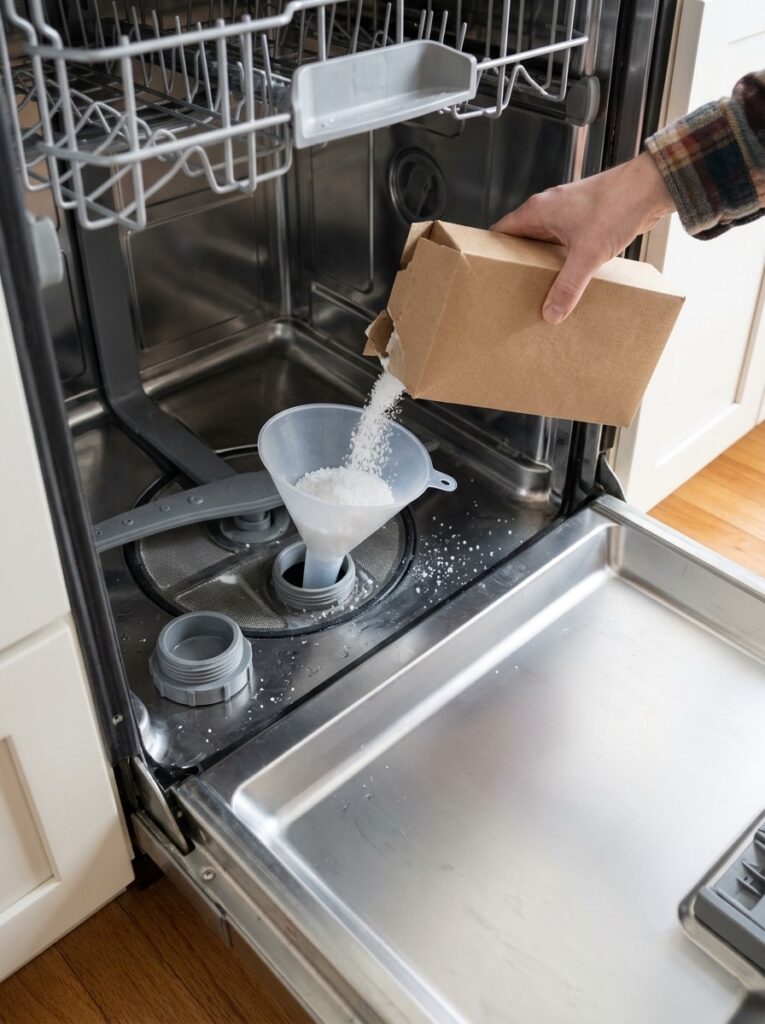
- Pull out the bottom rack and locate the salt reservoir cap. It is usually a round screw cap on the floor of the tub, offset to one side.
- Unscrew the cap counterclockwise. The first time you fill a new dishwasher, add 1 liter of water to the empty reservoir before adding salt. On subsequent refills, this is not necessary.
- Use the funnel that came with your dishwasher, or a kitchen funnel. Pour salt into the funnel steadily. Some water will overflow from the reservoir as you pour. This is normal.
- Fill to within about 1 cm of the top. Do not overfill.
- Wipe any spilled salt granules from around the reservoir opening with a damp cloth. Salt left loose in the tub can scratch glassware.
- Screw the cap back on firmly clockwise until it is tight. A loose cap is one of the most common causes of salt problems.
- Run a short rinse cycle to flush any residual salt from the tub before your next full wash.
To understand what makes tap water hard, see the USGS explanation of water hardness.
Related Guides
- Dishwasher Salt Alternatives: What Works and What Doesn’t
- How to Clean a Dishwasher (Every Part, Step-by-Step)
- Can Denture Tablets Remove Limescale? (What Actually Works)
Frequently Asked Questions
My dishes taste salty after a cycle. Is the salt getting into the wash water?
Yes, if dishes taste salty, salt is entering the main wash compartment. The most likely cause is a loose or damaged salt cap seal allowing wash water to flood the reservoir and salt solution to flow back out. Check and replace the cap seal. Also check whether you overfilled the reservoir, as very high salt concentrations can sometimes overflow into the tub. Run the machine empty for one cycle to flush out excess salt, then check the cap seal.
I adjusted the water hardness setting but my salt is still running out fast. What next?
Check the cap seal first. Then look for signs of a stuck water inlet valve: water pooling in the bottom of the machine after a completed cycle, or the machine taking an unusually long time at the fill stage. If both the cap and inlet valve appear fine, the float sensor is the next most likely culprit. Replace the cap assembly as this is the cheapest and easiest component to address.
How do I find out what water hardness setting my dishwasher is currently on?
Consult your machine’s manual. On Bosch and Siemens dishwashers, holding the On/Off button while turning the machine on usually enters a diagnostic or settings mode. The display shows the current hardness level. Miele machines have a dedicated settings menu accessible from the main panel. If you do not have the manual, search for your model number plus ‘water hardness setting’ on the manufacturer’s website or YouTube for a specific walkthrough.
Does a dishwasher use more salt in winter?
Not directly. The water hardness in your supply does not change significantly by season. However, if your home’s internal water temperature drops in winter, the cold water filling the dishwasher may cause the machine to run longer heating cycles. Some machines tie more intensive heating cycles to more frequent regeneration cycles, which could use slightly more salt. Any seasonal difference is minor and not a cause for concern.
I never use dishwasher salt and my machine has never had a problem. Should I start?
If you are in a soft water area and your dishes come out clean and spot-free, you do not need to start. Your water simply does not have enough calcium and magnesium to cause problems. If you are in a moderate or hard water area and getting clean results, you may be using an all-in-one detergent pod that handles soft water chemistry adequately for your specific water hardness. If cloudiness or limescale ever appear, that is the signal to start adding salt or to switch to a harder-water-formulated detergent.
