
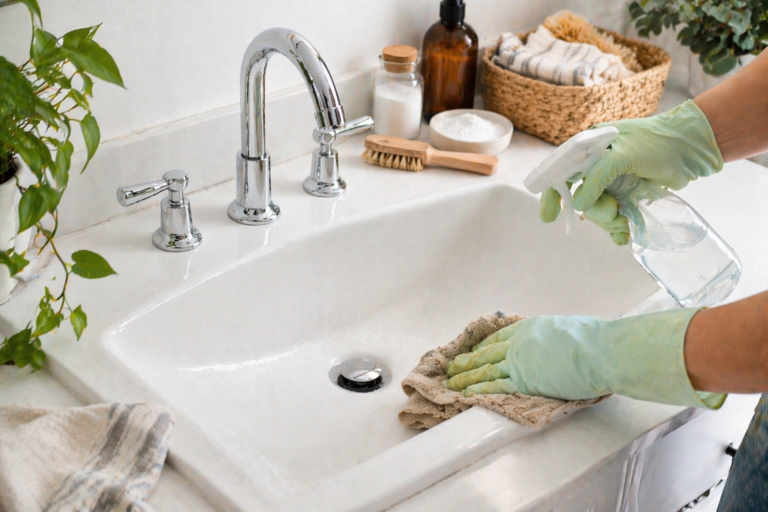
Ceramic sinks are beautiful when clean and frustrating when they are not.
The same smooth, glossy glaze that makes them so attractive also means every mark, stain, and water spot is visible against the white surface.
The challenge with ceramic sinks is that the wrong cleaning approach can make things worse. Abrasive scrubbers scratch the glaze permanently.
Harsh chemicals can dull the finish or leave it more prone to staining. But if you match the cleaning method to the type of stain, ceramic sinks are actually straightforward to maintain.
This guide covers every common ceramic sink problem with the correct solution for each.
What Makes Ceramic Sinks Different
Ceramic sinks are made from clay fired at high temperatures and coated with a hard, glossy vitreous enamel glaze. This glaze is what gives them their characteristic white shine. The glaze is:
- Non-porous: Does not absorb bacteria or water, making it hygienic and easy to wipe clean
- Acid-resistant: Handles mild acids like lemon juice without damage
- Scratch-susceptible: The glaze, while hard, can be scratched or dulled by abrasive cleaners or metal scourers
- Chip-susceptible: Heavy impacts can chip the glaze and the underlying ceramic
The rule of thumb: use soft cloths and non-abrasive cleaners. The glaze does all the work of keeping things clean if you maintain it properly.
Daily Maintenance: 2 Minutes, Big Difference
The single most effective thing you can do for a ceramic sink is wipe it dry after each use. Water left to air-dry on ceramic leaves mineral deposits and creates the dull film that builds up over time. A quick wipe with a soft microfiber cloth takes 10 seconds and prevents most staining.
For daily cleaning beyond drying, a small amount of dish soap on a damp soft sponge, wiped around the bowl and rinsed, is all most ceramic sinks need day to day.
Avoid These Always: Steel wool, abrasive scouring pads, and powders with large grit particles will permanently scratch the glaze on a ceramic sink. Once scratched, the sink is more prone to staining and the damage cannot be reversed. If you only remember one rule for ceramic sink cleaning, it is this.
Method 1: Everyday Cleaning (Soap and Water)
- Rinse the sink with warm water.
- Apply a small amount of dish soap to a soft sponge or microfiber cloth.
- Wipe the entire bowl, the sides, around the drain, and under the rim.
- Rinse thoroughly with warm water.
- Dry with a clean microfiber cloth to prevent water spots.
This is all that is needed for day-to-day maintenance. The key step that most people skip is the drying. Hard water leaves visible deposits on ceramic even after just one day of air drying.
Method 2: Removing Limescale and Hard Water Deposits
White or cream-colored crusty buildup around the faucet, drain, and along the waterline is limescale. It is calcium carbonate deposited by hard water and requires an acid-based treatment to dissolve it.
- Soak a paper towel or cloth in undiluted white vinegar.
- Lay it over the limescale-affected areas and leave for 20 to 30 minutes.
- Wipe away and scrub gently with a soft sponge.
- For stubborn deposits, apply undiluted lemon juice or a small amount of Bar Keepers Friend powder (made into a paste with water) and scrub gently with a soft cloth.
- Rinse thoroughly and dry.
Around Faucets: For limescale at the base of faucets, wrap a vinegar-soaked cloth around the fitting and leave for 30 to 60 minutes. The acetic acid slowly dissolves the deposit without any scrubbing needed.
Method 3: Removing Metal Marks (Grey Scratches from Pans and Utensils)
Ceramic kitchen sinks often develop grey marks from metal pans, utensils, or cutlery scraping against the surface. These are not actually scratches in the ceramic itself; they are deposits of metal left on the surface of the glaze.
- Make a paste from baking soda and a small amount of water.
- Apply it to the grey mark with a soft cloth.
- Rub gently in circular motions. The mild abrasion lifts the metal deposit without scratching the glaze.
- Rinse and dry.
For stubborn metal marks that baking soda does not shift, Bar Keepers Friend powder is the next step. Apply a small amount with water on a soft cloth, rub gently, and rinse. It contains oxalic acid which dissolves metal oxides without damaging the glaze when used correctly.
Method 4: Removing Tea, Coffee, and Food Stains
Pigmented liquids like tea, coffee, red wine, and tomato-based foods can leave visible discoloration on ceramic sinks if not rinsed away quickly.
- For fresh stains: rinse immediately with hot water and a squirt of dish soap. Most fresh stains come off immediately.
- For dried stains: make a paste from baking soda and hydrogen peroxide (3 percent). Apply to the stain, let sit 10 to 15 minutes, then scrub gently with a soft sponge and rinse.
- For very persistent discoloration: a small amount of diluted household bleach (1 tablespoon in 1 cup of water) applied with a cloth for 5 minutes then rinsed can lift organic staining. Use sparingly.
Act Fast: Ceramic glaze is non-porous but the surface texture can trap pigmented liquids if they are left to dry and harden. The faster you rinse food and drink spills, the easier the cleanup.
Method 5: Removing Rust Stains
Rust stains on ceramic sinks usually come from metal objects left in the sink (shaving foam cans, bobby pins, metal pan lids) that react with water and leave orange or brown deposits on the glaze.
- Apply lemon juice directly to the rust stain and leave for 30 minutes.
- Scrub gently with a soft sponge.
- If the stain persists, apply Bar Keepers Friend as a paste and leave for 5 minutes before scrubbing gently.
- Rinse thoroughly.
Avoid Bleach for Rust: Bleach oxidizes iron, which can make rust stains set more deeply into the surface rather than removing them. Always use an acid-based or oxalic acid product for rust.
Restoring the Shine on a Dull Ceramic Sink
If your ceramic sink looks clean but dull, it may have a light mineral film from hard water even after cleaning. After a thorough clean and dry, buff the surface with a dry microfiber cloth. For a deeper polish, apply a small amount of car wax or a ceramic polishing product to a soft cloth, buff in circular motions, and wipe off the excess. This restores the gloss and leaves a protective layer that makes the next cleaning easier.
Frequently Asked Questions
Q: Can I use bleach to clean a ceramic sink?
Diluted bleach (1 tablespoon per cup of water) can be used sparingly on white ceramic sinks to remove organic staining and disinfect. Do not use undiluted bleach and do not leave it on the surface for extended periods, as it can gradually dull the glaze with repeated use. Never use bleach on colored ceramic. For most cleaning tasks, baking soda and hydrogen peroxide is gentler and equally effective.
Q: Why does my ceramic sink have a yellow tinge?
Yellow discoloration on ceramic sinks is usually caused by a buildup of iron in the water supply combined with hard water deposits, or by prolonged contact with bleach. For iron-based yellowing, use a citric acid treatment or Bar Keepers Friend. For bleach-induced yellowing, the discoloration may be permanent, but hydrogen peroxide applied with baking soda can sometimes restore brightness.
Q: Can I use Bar Keepers Friend on a ceramic sink?
Yes, Bar Keepers Friend (the powder form, made into a paste) is one of the best products for ceramic sinks. It contains oxalic acid which dissolves mineral deposits and rust, combined with mild abrasives. Use it with a soft cloth (not a scouring pad), apply gently, and rinse thoroughly. It removes metal marks, limescale, and rust stains that other products cannot touch.
Q: How do I remove the plastic washing-up bowl marks from my ceramic kitchen sink?
Using a plastic washing up bowl on a ceramic sink allows grit to accumulate underneath and grind against the glaze, leaving surface scratches and grey marks. The grey marks themselves (metal transfer) can be removed with baking soda paste or Bar Keepers Friend. To prevent it happening again, choose a washing up bowl with a soft base, or switch to doing dishes directly in the sink.
Q: How often should I do a deep clean of my ceramic sink?
A thorough clean with limescale treatment, stain removal, and polishing once a week is ideal. Day-to-day wiping and drying takes care of most issues between sessions. In hard water areas, the limescale treatment may need to be done twice a week around faucets and the drain area.
Related Articles: