
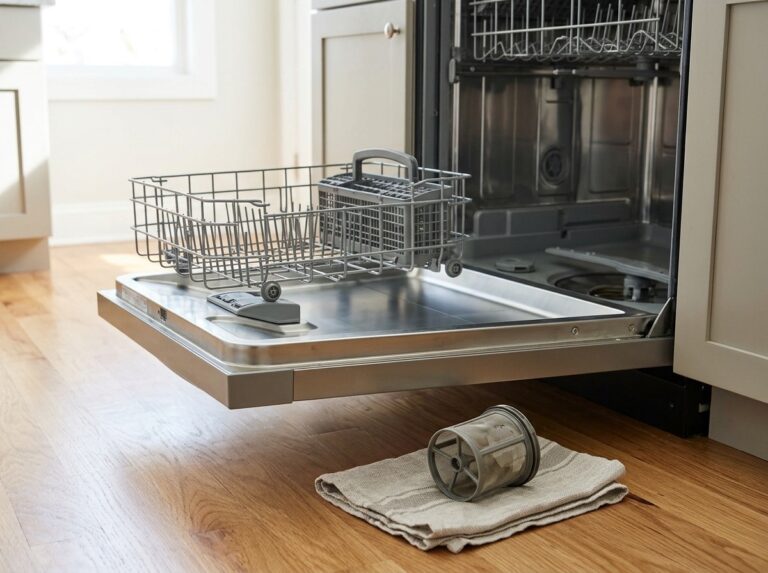
The dishwasher filter catches food particles, grease, and debris from every wash cycle to stop them clogging the pump and drain. When the filter is dirty, water flow is restricted, dirty water recirculates, and dishes come out covered in residue or smelling bad. Cleaning it takes less than 10 minutes and should be done every month.
This guide covers how to locate, remove, clean, and reinstall the filter for all major dishwasher brands, plus what to do if dishes still come out dirty after cleaning.
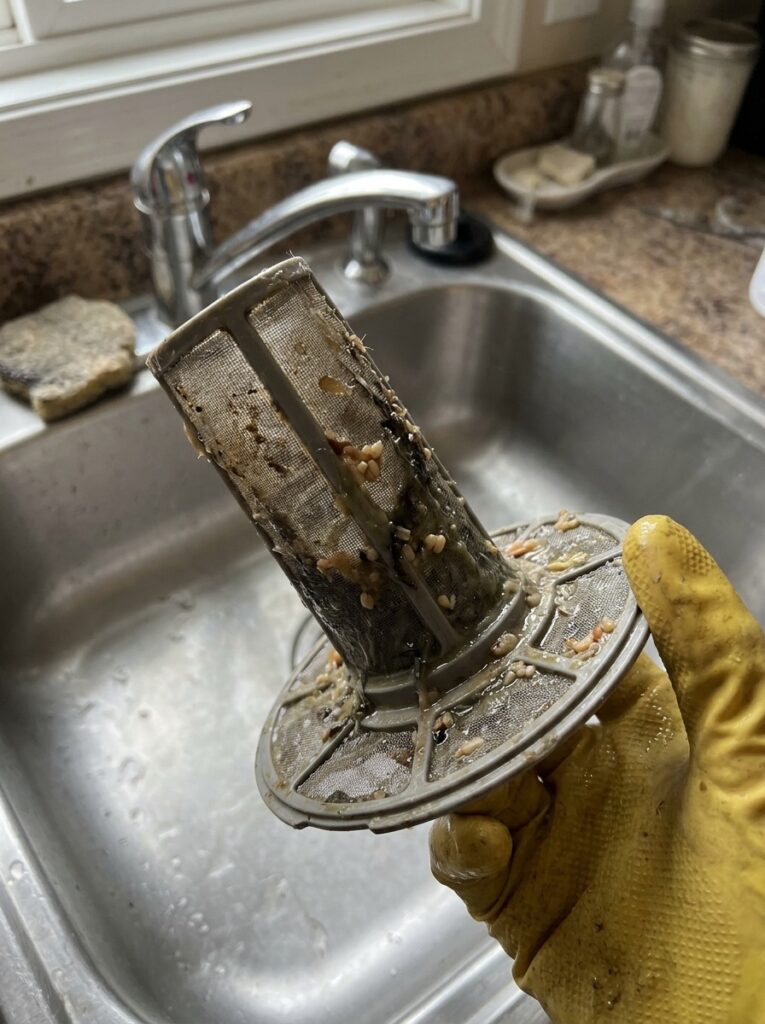
Table of Contents
Do You Have a Manual Filter or a Self-Cleaning Filter?
Before looking for your filter, you need to know which type your dishwasher has.
Manual filter (most dishwashers made after 2010)
Manual filters are quiet and efficient. They trap food particles in a mesh cylinder that you need to remove and clean by hand. Most modern dishwashers from Bosch, Samsung, GE, LG, KitchenAid, Whirlpool, and Frigidaire have manual filters.
Self-cleaning filter (most dishwashers made before 2010)
Self-cleaning filters grind food particles during the wash cycle using a built-in food disposer. These are louder during operation but rarely need manual cleaning. You can identify a self-cleaning filter dishwasher by the grinding or churning noise it makes during the wash cycle.
If you are unsure which type you have, look at the base of the dishwasher with the lower rack removed. A cylindrical mesh filter that twists out is a manual filter. A flat plastic screen with no removable piece is likely self-cleaning.
Where Is the Dishwasher Filter?
In almost all dishwashers with a manual filter, the filter is located at the center base of the dishwasher floor, directly under or near the lower spray arm. Remove the lower rack to access it.
The filter typically has two parts: a cylindrical inner filter (fine mesh tube) and a flat outer coarse filter (a wider mesh plate surrounding the cylinder). Both need to be cleaned.
How to Remove the Filter
Most brands (Bosch, Samsung, LG, KitchenAid, Frigidaire)
- Pull out the lower dish rack completely.
- Locate the cylindrical filter at the center or back of the dishwasher base.
- Grip the cylindrical filter and turn it counterclockwise (usually a quarter to half turn) until it unlocks.
- Lift the cylinder straight up and out.
- Lift the flat mesh plate out as well. On most models it lifts straight out once the cylinder is removed.
Whirlpool and Maytag
The filter on most Whirlpool and Maytag dishwashers is located in the back left corner of the tub floor rather than the center. Remove the lower rack, look in the back left corner, and twist the cylindrical filter counterclockwise to remove it.
GE and GE Profile
GE dishwasher filters are at the center of the base. The cylindrical filter twists out counterclockwise. On some older GE models the filter is a flat plastic screen that lifts straight out without twisting.
Bosch
Bosch filters sit at the center base and have a mesh cylinder with an arrow indicating the direction to twist for removal. The outer mesh plate on Bosch filters is called the micro-filter. Both pieces need to be removed and cleaned separately.
Tip: If the filter is stuck and will not turn, the locking tabs may have debris on them. Rinse the base area with a cup of hot water to loosen any sticky residue, then try again.
How to Clean the Filter
The cleaning process is the same for all brands once the filter is removed.
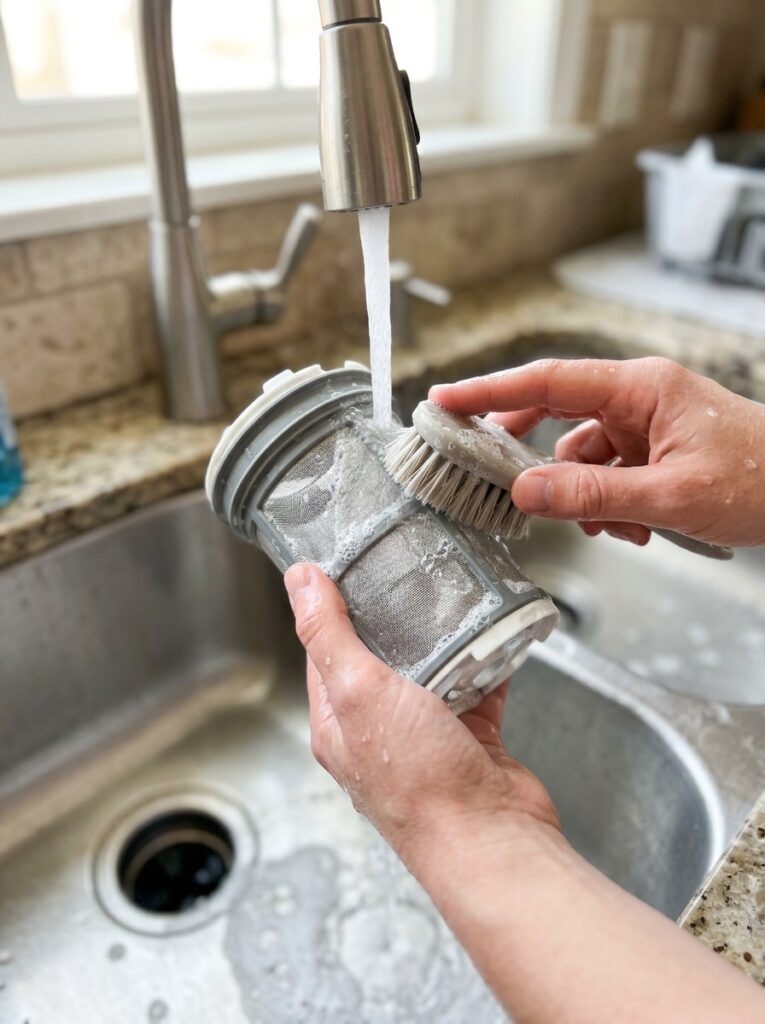
- Hold both filter pieces under warm running water to rinse off loose food particles. Most of what is in the filter will rinse away immediately.
- Add a few drops of dish soap to an old toothbrush.
- Scrub the inside and outside of the cylindrical mesh with the toothbrush. Pay attention to the bottom of the cylinder and the edges of the mesh where grease accumulates.
- Scrub both sides of the flat mesh plate in the same way.
- For grease that the toothbrush does not remove: soak both pieces in a bowl of hot water with 1/4 cup of white vinegar for 15 minutes, then scrub again.
- For heavy mineral buildup that appears as white or gray scale on the mesh: soak in undiluted white vinegar for 20 minutes. The acid dissolves calcium deposits.
- Rinse both pieces thoroughly under running water until all soap and residue is gone.
- Hold the filter mesh up to a light to confirm the holes are clear. Blocked holes reduce water flow.
WARNING: Do not use a harsh abrasive sponge or steel wool on the filter mesh. This stretches or tears the mesh, creating gaps that allow food particles to bypass the filter and reach the pump.
How to Reinstall the Filter
- Place the flat mesh plate back in position in the base of the dishwasher first.
- Insert the cylindrical filter through the center of the flat plate into its socket.
- Rotate the cylinder clockwise until it locks into place. You should feel or hear it click.
- Give the filter a gentle tug to confirm it is locked. A loose filter will rattle during the wash cycle and may allow debris to reach the pump.
- Replace the lower rack.
What to Clean Around the Filter While You Have the Rack Out
The filter housing
While the filter is out, use the toothbrush to clean inside the circular housing in the base of the dishwasher. Food particles and grease collect here and are not removed by cleaning the filter alone.
The lower spray arm
While the lower rack is out, spin the lower spray arm to check it rotates freely. Use a toothpick to clear any clogged holes you can see. If the spray arm is cracked or badly clogged, it can be removed by pulling it straight up from its post and soaked in white vinegar for 20 minutes before clearing the holes and reinstalling.
The door base lip
The inner base of the dishwasher door collects grease and food debris. Wipe it with a damp cloth and a few drops of dish soap while you have the lower rack out.
How Often to Clean the Dishwasher Filter
- Once a month for average household use.
- Every 2 weeks if you rarely pre-rinse dishes, cook heavy greasy meals frequently, or have a large household running the dishwasher daily.
- Every 6 to 8 weeks if you always pre-rinse dishes before loading and run light cycles.
The easiest habit is to clean the filter on the same day you do a full dishwasher cleaning cycle each month.
Signs Your Filter Needs Cleaning
- Dishes come out with small food particles on them after a full cycle.
- Dishes smell unpleasant after washing.
- Water is pooling in the base of the dishwasher after a cycle instead of draining fully.
- The dishwasher makes unusual sounds during the wash cycle.
- Glasses come out looking spotted or hazy when they previously came out clean.
For more on washing dishes, see the dishwashing tips from the American Cleaning Institute.
Related Guides
- How to Clean a Dishwasher (Every Part, Step-by-Step)
- 15 Dishwasher Tablet Cleaning Hacks That Actually Work (With Instructions)
- Cleaning Your Shower with Dishwasher Tablets (Does the Hack Actually Work?)
Frequently Asked Questions
How do I know if my dishwasher filter needs replacing rather than just cleaning?
If the mesh on the filter is torn, stretched, or has visible holes that were not there before, the filter needs to be replaced. A damaged filter allows food particles to bypass it and reach the pump, which can cause blockages and expensive repairs. Replacement filters for most brands are available on Amazon. Search your dishwasher brand and model number followed by the word filter to find the correct part.
I cleaned the filter but my dishes still come out dirty. What else should I check?
If cleaning the filter did not resolve the issue, check the spray arms next. Remove them and use a toothpick to clear every hole. Clogged spray arm holes reduce water pressure significantly and are the second most common cause of dishes coming out dirty. Also check that you are not overloading the dishwasher, which blocks water from reaching all dishes, and that the detergent dispenser door is opening correctly during the cycle.
My dishwasher does not seem to have a removable filter. What should I do?
Your dishwasher likely has a self-cleaning filter. These are built into the pump and grind food particles automatically. They do not require manual cleaning in most cases. If your dishwasher is making an unusually loud grinding noise, the self-cleaning filter mechanism may be worn or partially blocked. Contact the manufacturer or a repair technician.
Can I put my dishwasher filter in the dishwasher to clean it?
Technically yes, but it is not the best approach. Running the filter through a dishwasher cycle may not remove grease that is embedded in the mesh, and it may not clean the inside of the cylindrical section effectively. Manual cleaning with a toothbrush and dish soap takes 5 minutes and does a more thorough job.
How do I find my dishwasher’s model number?
The model number sticker is usually on the inner door frame, visible when you open the dishwasher door and look at the edge. It may also be on the side of the door or at the top of the door opening. The model number lets you find the correct replacement filter, spray arms, and other parts for your specific machine.
