
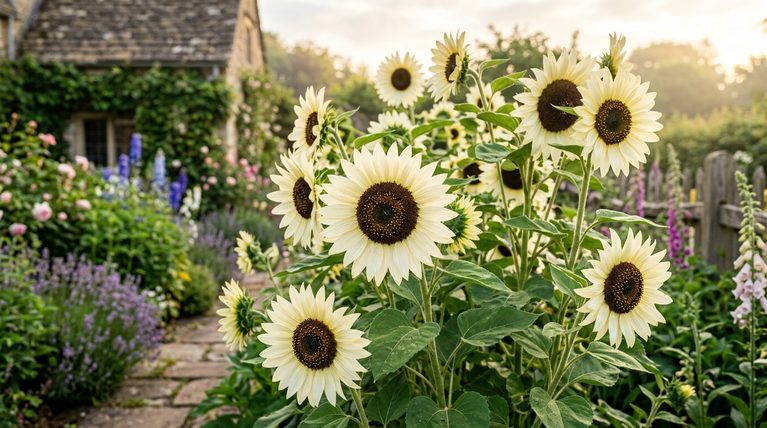
In 2011, Burpee Gardening introduced a sunflower they called Coconut Ice and labeled it “the world’s first white sunflower.”
The claim was accurate enough to stick: while pale and cream-toned sunflower varieties had existed before, Coconut Ice produced a reliably white-to-cream effect with a velvety dark chocolate center, a combination that created a visual contrast entirely unlike standard yellow sunflowers.
If you have grown yellow sunflowers and are looking for something that photographs beautifully, works in elegant cut flower arrangements, and surprises every visitor to your garden, Coconut Ice is worth growing.
Here is everything you need to know.
What Is a Coconut Ice Sunflower?
Coconut Ice is a cultivar of the annual sunflower Helianthus annuus. It is a standard annual — planted from seed each year, not a perennial.
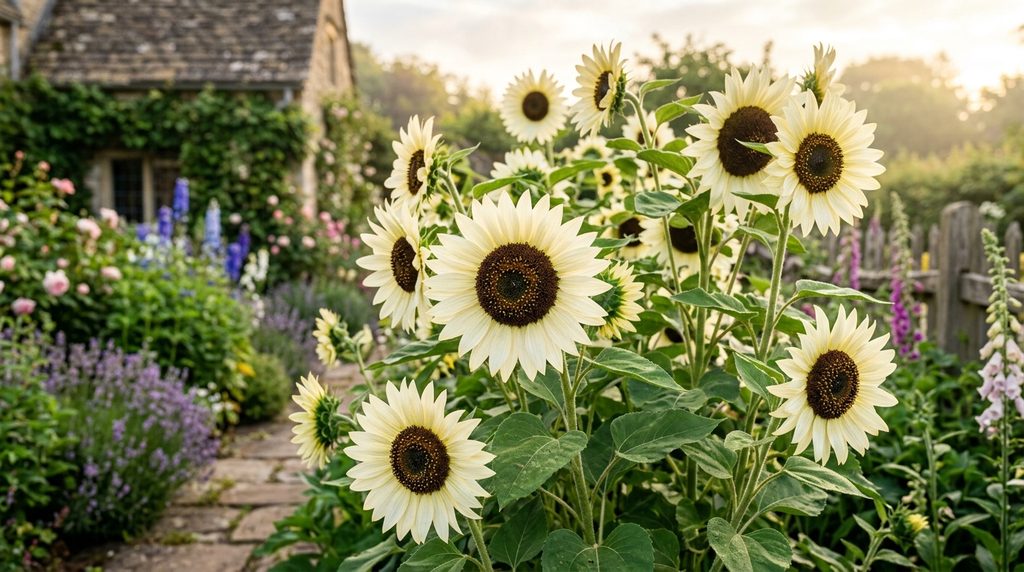
The flowers open as creamy vanilla-white with petals that fade to brighter white as the bloom matures. The center disc is a deep chocolate-brown to near-black, creating a striking contrast against the pale petals. Unlike many novelty flowers, the dark center-light petal combination looks intentional and refined rather than unusual for its own sake.
- Height: 48 to 60 inches (4 to 5 feet) — compact compared to some giant varieties
- Spread: 20 to 24 inches between plants
- Bloom diameter: 4 to 8 inches
- Maturity: 60 to 65 days from direct sowing to first bloom
- Flower habit: Primarily single-headed per main stem, with branching secondary stems
Seed company Smart Gardener lists the bloom duration at approximately 6 weeks per plant, though successive plantings extend the season significantly.
What Other Cream and White Sunflowers Exist?
The success of Coconut Ice created a market for white and cream sunflower varieties. These are the best-known alternatives:
- Italian White Sunflower: Multiple smaller blooms per plant, similar creamy white color, slightly shorter at 3 to 4 feet. A reliable choice.
- Moonshine Sunflower: Pale yellow fading to near-white, large heads, 4 to 5 feet tall. Good for cutting.
- Vanilla Ice Sunflower: Soft cream with a dark center; similar to Coconut Ice in coloring but a slightly different cultivar.
- Swiss Alps Sunflower: Pure white petals with dark center; taller at 5 to 6 feet.
- Strawberry Blonde: Warm pink-cream with dark center — more pink than white, but a beautiful companion to Coconut Ice in arrangements.
How to Grow Coconut Ice Sunflowers
Planting Time
Sow seeds directly outdoors after the last frost date for your area. Do not start indoors — sunflowers have long taproots that transplant poorly.
In most US regions: plant outdoors from mid-April through early June. For a succession of blooms, sow every 2 to 3 weeks from your last frost date through midsummer.
Soil and Location
Sunflowers are remarkably forgiving of soil quality, but they require two non-negotiables:
- Full sun: At least 6 hours of direct sun, and more is better. Sunflowers planted in partial shade become leggy, weak-stemmed, and produce significantly smaller blooms.
- Excellent drainage: Sunflowers tolerate poor, even infertile soil. What they do not tolerate is waterlogged roots. Avoid low-lying areas that collect standing water after rain.
Sunflowers are one of the few plants that actually perform better in lean, low-fertility soil. High nitrogen causes excessive leafy growth at the expense of flowers.
Sowing Seeds
- Prepare the bed by loosening soil to 12 inches with a garden fork. Remove rocks and large clumps.
- Sow seeds 1 inch deep directly in the ground.
- Space plants 20 to 24 inches apart — Coconut Ice does not grow as tall as giant varieties but still needs airflow.
- Water in after planting, then allow the soil to dry out between waterings during germination.
- Seeds germinate in 7 to 14 days in warm soil (65°F or above).
Watering
Once established (about 4 weeks after germination), sunflowers are remarkably drought-tolerant. Water deeply once or twice per week rather than shallow daily watering — this encourages deeper root development.
During the flowering period, consistent moisture improves bloom quality and longevity.
Fertilizing
Generally not necessary if soil is moderately fertile. If your soil is very poor (sandy or rocky), apply a balanced slow-release fertilizer (10-10-10) at planting time. Avoid high-nitrogen fertilizers, which reduce flowering.
Pest and Disease Management
Sunflowers face relatively few serious pests but watch for:
- Cutworms: Young seedlings cut off at soil level overnight. Protect with cardboard collars around stems at planting, or apply diatomaceous earth around plant bases.
- Powdery mildew: White powder on leaves in humid conditions. Improve airflow by maintaining recommended spacing. Remove affected leaves.
- Aphids: Small clusters on new growth. Knock off with water spray or apply insecticidal soap (Safer Brand, $10 at garden centers).
Coconut Ice as Cut Flowers
This is where Coconut Ice truly shines. The cream-white petals work in arrangements that yellow sunflowers do not — particularly with roses, garden peonies, ranunculus, and other soft-toned wedding and cottage garden flowers.
How to harvest and condition for maximum vase life:
- Cut early in the morning when stems are fully hydrated.
- Choose flowers where petals have just opened — not fully mature blooms.
- Cut stems at a 45-degree angle with clean, sharp scissors or pruners.
- Immediately place in a bucket of room-temperature water.
- Remove all leaves that would be below the waterline in your vase.
- Allow to condition in a cool, dark location for 2 to 4 hours before arranging.
Vase life: 5 to 10 days with water changed every 2 days and a floral preservative packet added.
Garden Design with Coconut Ice Sunflowers
Coconut Ice’s pale coloring gives it unusual versatility in garden design:
- Pastel cottage garden: Pair with lavender, pink cosmos, pale pink zinnias, and dusty miller (silver foliage). The cream tones tie the palette together without competing with softer colors.
- Cool-tone modern border: Combine with white echinacea, Russian sage (blue-gray), and silver Artemisia for a sophisticated monochromatic effect.
- Cutting garden: Plant alongside Strawberry Blonde sunflowers and yellow Sunrich Orange for a warm-to-neutral sunflower palette that works in diverse arrangement styles.
- Pollinator garden: Despite their modified coloring, Coconut Ice sunflowers are still excellent nectar and pollen sources. Their dark centers attract bees, and their seeds feed goldfinches and other small birds in fall.
Where to Buy Coconut Ice Sunflower Seeds
Coconut Ice has become widely available since its 2011 introduction:
- Burpee.com: The original source
- Baker Creek Heirloom Seeds (rareseeds.com)
- Johnny’s Selected Seeds (johnnyseeds.com)
- Etsy specialty seed sellers: Often offer small packets for trial quantities
- Local garden centers in spring: Increasingly stocked as interest in unusual varieties has grown
Seed costs: $3 to $6 for a packet of 15 to 25 seeds.
|
✅ Tip Succession plant Coconut Ice every 2 to 3 weeks from your last frost date through late June for continuous bloom from July through September rather than one concentrated flush. Leave spent flower heads standing through fall rather than deadheading. The seed heads attract goldfinches, chickadees, and other small birds who need the high-fat seeds for winter energy reserves. |
|
▶ YouTube Search Recommendation Search: “Coconut Ice sunflower growing harvest cut flowers” Watch a video walkthrough to see this in action. |
Frequently Asked Questions
Are Coconut Ice sunflowers perennial?
No. All Helianthus annuus varieties, including Coconut Ice, are true annuals — they complete their full life cycle in one growing season. They must be replanted from seed each year. In very warm climates (zone 10+), they may self-seed and return voluntarily.
How tall do Coconut Ice sunflowers grow?
Typically 4 to 5 feet (48 to 60 inches), making them a compact to mid-height sunflower. They are suitable for most garden settings without staking, though they may need support in very windy locations.
Do Coconut Ice sunflowers produce multiple blooms per plant?
The main stem typically produces one primary flower, but branching lateral stems produce additional, smaller secondary blooms throughout the season. This branching habit makes Coconut Ice more suitable for cut flower production than single-headed giant varieties.
Why did my Coconut Ice flowers come out yellow?
There can be natural variation within seed packets of hybrid sunflowers. If you see yellow or off-white flowers rather than the expected cream, it is likely normal genetic variation within the cultivar rather than a disease or error. Save seeds from the palest individuals for next year to strengthen the trait in your garden.
The Bottom Line
Coconut Ice sunflowers are one of the simplest high-impact additions you can make to a garden.
Direct sow after last frost. Give them full sun and decent drainage. Harvest early for cut flowers or leave for birds in fall.
The reward is a flower that makes people pause, look twice, and ask: “I’ve never seen a white sunflower before — what is that?”
