
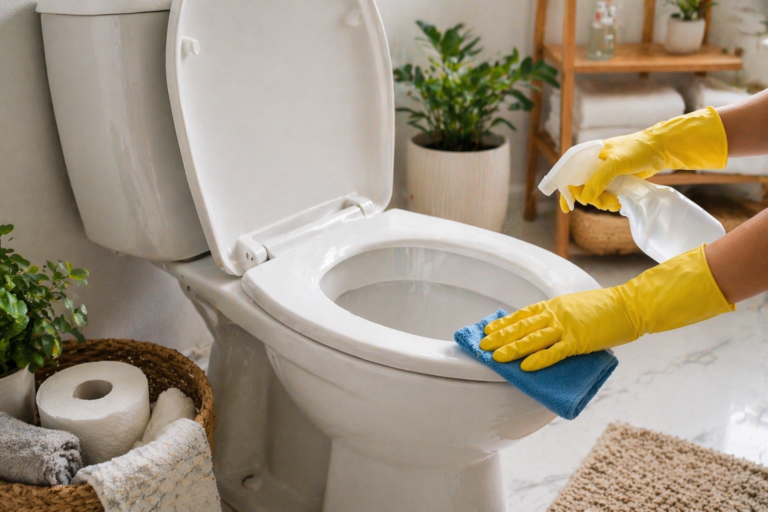
Most bathroom cleaning guides tell you to clean the toilet once a week without explaining what that actually means. Does it mean a full scrub of every surface? A quick wipe? And what about the tank, the base, the hinges?
The answer depends on what part of the toilet you are talking about.
Different areas accumulate bacteria, grime, and mineral buildup at very different rates. This complete schedule breaks it all down so you know exactly what needs attention, how often, and why.
Why Toilet Cleaning Frequency Actually Matters
The toilet is the single highest-risk surface in the bathroom for bacterial contamination. Flushing creates an aerosol effect where bacteria can be launched up to 6 feet into the surrounding air, landing on surfaces including the toilet seat, lid, handle, and nearby countertops.
Research has documented the presence of E. coli and other pathogens on toilet surfaces even in relatively clean bathrooms.
The practical implication is not to panic but to be consistent. A toilet that is cleaned regularly prevents bacterial accumulation from reaching levels that pose real health risk. Regular cleaning also means each session is faster because buildup never gets out of hand.
The Complete Toilet Cleaning Schedule
Daily: Quick Handle and Seat Wipe (30 Seconds)
The flush handle and toilet seat are the two highest-touch surfaces in the bathroom and the most likely to spread germs in a multi-person household. A 30-second daily wipe with a disinfectant wipe or a spray of bathroom cleaner on a paper towel is the simplest thing you can do to keep bacterial load low between full cleans.
Keep a pack of flushable disinfecting wipes or a spray bottle on top of the tank to make this genuinely automatic. If it takes more than 30 seconds, you are overthinking it.
Do Not Flush: Even wipes labeled “flushable” can clog drains over time. Dispose of cleaning wipes in the trash, not the toilet.
Weekly: Full Bowl, Seat, and Exterior Clean
Once a week is the minimum standard for a complete toilet cleaning for most households. This is the full clean:
- Apply toilet bowl cleaner inside the bowl and under the rim. Let it sit 5 to 10 minutes.
- While the cleaner soaks, spray the entire exterior of the toilet (tank, lid, seat top and bottom, base, and floor around the base) with a disinfectant cleaner.
- Wipe all exterior surfaces with paper towels or a dedicated cloth, working top to bottom. Seat first, then lid, then tank, then base. Use a fresh section of cloth or fresh paper towel for each area.
- Pay specific attention to the seat hinges and the area under the toilet seat where it attaches to the bowl. Bacteria and urine residue accumulate here.
- Scrub the bowl with a toilet brush, focusing on under the rim where buildup concentrates.
- Flush to rinse.
Work Top to Bottom: Always clean the toilet from the cleanest areas to the dirtiest. Tank first, then lid, then seat, then bowl. This prevents spreading bowl bacteria to surfaces that people touch.
Monthly: Under the Rim and the Base
The underside of the toilet rim contains siphon jets, the small holes through which water enters during flushing. These accumulate mineral deposits and organic buildup that significantly reduce flushing efficiency over time and harbor bacteria that standard brushing misses.
Once a month, use a denture tablet, a dedicated rim gel cleaner, or an old toothbrush with baking soda to scrub under the rim. Turn off the water supply to the toilet, flush to empty the tank, and this gives you better access for scrubbing without the bowl refilling.
The floor around the base of the toilet is another monthly focus area. Urine spray and water from flushing accumulates at the base bolts and caulking. Clean with a bathroom cleaner and a scrubbing brush, paying attention to the gap between the toilet base and the floor.
Every Three to Six Months: The Toilet Tank
The inside of the toilet tank is forgotten by most people and can be a source of persistent musty smells and eventually mold, algae, or mineral buildup that affects flushing performance.
Cleaning it is straightforward: turn off the water supply valve at the wall, flush to drain the tank, and spray the inside walls with white vinegar. Let it sit for 30 minutes, scrub with a long-handled brush, and then flush several times after turning the water back on to rinse completely.
If you find black or dark staining inside the tank, that is mold or algae and requires a diluted bleach treatment before the vinegar step.
Immediately: When Someone Is Sick
Do not wait for the weekly schedule when someone in the household has a stomach illness, norovirus, or anything contagious. Disinfect the toilet after every use during the illness using bleach or a hospital-grade disinfectant, including the seat, handle, and lid every time. This is the most effective way to prevent other household members from getting sick.
How Household Size Changes the Schedule
The schedule above is based on average single-bathroom household use. Adjust based on your situation:
- 1 to 2 people, one bathroom: Weekly full clean is sufficient
- 3 to 4 people, one bathroom: Clean the bowl every 3 to 4 days, full clean weekly
- Households with young children: Bowl every 2 to 3 days, daily seat wipe essential
- Shared bathrooms with multiple adults: Bowl every other day, full clean twice a week
- Guest bathroom used rarely: Full clean before guests arrive, then once a month to prevent mineral buildup
Signs Your Toilet Needs Cleaning Right Now
- A visible ring in the bowl: This is mineral buildup and/or bacteria film and will not go away by flushing alone
- Persistent smell even after flushing: Usually means bacteria in the rim jets, under the seat hinges, or at the base
- Yellow staining on the seat or around the base bolts: Urine residue needs cleaning before it sets further
- Pink or orange streaks in the bowl: Serratia marcescens bacteria, which thrives in bathrooms and can cause UTIs in susceptible individuals
Frequently Asked Questions
Q: Is cleaning the toilet once a week enough?
For a 1 to 2 person household, weekly is the standard minimum. For larger families or shared bathrooms, every 3 to 4 days for the bowl and daily wipe-downs of the handle and seat is more appropriate. The key is consistency: light cleaning done frequently is better for hygiene than intensive cleaning done rarely.
Q: What is the most germ-ridden part of the toilet?
Research consistently finds that the flush handle and toilet seat are the highest-contamination surfaces because of direct hand and body contact combined with aerosol spray from flushing. The bowl itself has high bacterial concentrations but less contact. The base of the toilet near the floor is often the most overlooked area for urine and bacterial accumulation.
Q: Do I really need to clean the toilet tank?
Yes, but not as frequently as the bowl. The tank should be checked and cleaned every 3 to 6 months. Uncleaned tanks develop algae, mold, and mineral scaling that can affect flushing performance, cause a persistent musty smell in the bathroom, and shorten the lifespan of internal tank components. The cleaning itself takes about 15 minutes.
Q: What is the pink/orange stuff in my toilet bowl?
Pink or orange tinge in the bowl, especially around the waterline, is usually Serratia marcescens, an airborne bacterium that thrives in damp bathroom environments. It is more common in bathrooms with poor ventilation. It can cause urinary tract infections in susceptible individuals. Clean with bleach to kill it, and improve bathroom ventilation to reduce recurrence.
Q: Should I close the lid before flushing?
Closing the toilet lid before flushing reduces the aerosol spray that carries bacteria into the room, which means less contamination landing on the toilet seat, handle, and nearby surfaces. Research on exactly how much this helps is mixed, but it costs nothing to do and the logic is sound. Make it a household habit.
Related Articles: