
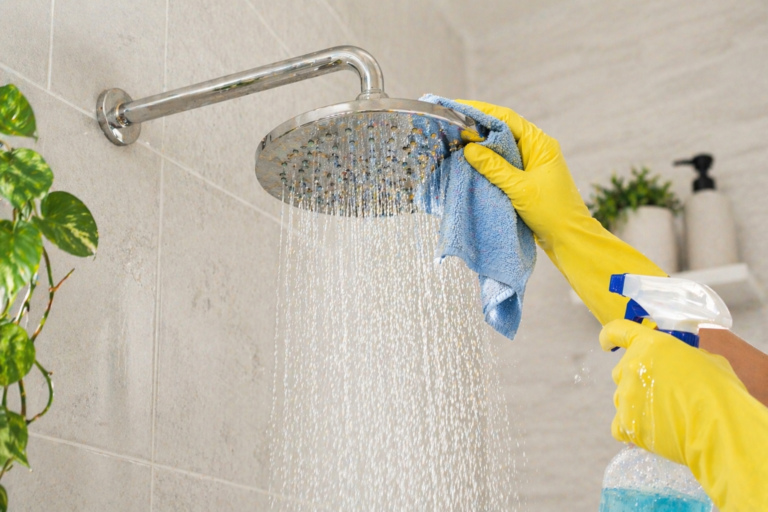
Fixed shower heads, whether wall-mounted, ceiling-mounted, or the large rainfall-style heads that cannot be detached, present a specific cleaning challenge.
You cannot drop them in a bowl of vinegar overnight the way you can with a handheld head.
But with the right approach and a few household supplies, fixed shower heads can be fully descaled and cleaned without removing them.
This guide covers every method from the basic bag soak to handling a badly clogged head that has years of mineral buildup.
Why Shower Heads Need Regular Cleaning
The small spray nozzles in a shower head are very prone to clogging with limescale, which is calcium carbonate deposited by hard water as it evaporates. Over time, blocked nozzles cause:
- Uneven spray patterns with jets going sideways instead of straight
- Reduced water pressure even when the supply pressure is fine
- Water dribbling rather than spraying from some nozzles
- Increased bacteria buildup inside the nozzles where water sits between showers
The American Society for Microbiology has documented that uncleaned shower heads can harbor Mycobacterium avium and other bacteria in the biofilm inside the nozzle holes.
While this poses no significant risk to healthy individuals, it is worth knowing that cleaning your shower head is not just cosmetic.
For homes in hard water areas (most of the US Midwest, Southwest, and South), monthly cleaning is worth doing. For soft water areas, every three months is sufficient.
What You Will Need
- White vinegar (distilled) or citric acid solution
- A plastic bag large enough to fit over the shower head
- Rubber bands, zip ties, or duct tape to secure the bag
- An old toothbrush
- A toothpick or safety pin for stubborn nozzle holes
- Microfiber cloth for polishing
- Optional: commercial limescale remover like CLR or Lime-A-Way for severe buildup
Method 1: The Plastic Bag Soak (Recommended for Most Cases)
This is the standard professional recommendation for cleaning fixed shower heads. It is simple, effective, and uses only white vinegar.
- Fill a plastic bag with enough undiluted white vinegar to fully submerge the face of the shower head when the bag is placed over it. Do not fill the bag all the way to the top.
- Place the bag over the shower head so the entire nozzle face is submerged in the vinegar.
- Secure the bag in place with rubber bands, zip ties, or a few wraps of duct tape around the shower arm or fitting.
- Leave to soak for at least 1 hour. For moderate limescale, 3 to 4 hours. For heavily clogged heads, leave overnight.
- Remove the bag and run the shower on hot for 2 minutes to flush out loosened deposits.
- Scrub the nozzle face with a toothbrush, working around each spray hole.
- Use a toothpick or safety pin to poke through any nozzles that are still partially blocked.
- Run the shower for another minute and check the spray pattern. Repeat the soak if needed.
Secure It Well: The biggest issue with this method is the bag slipping during the soak. Use two rubber bands twisted tightly or a zip tie for a secure hold, especially on ceiling-mounted rainfall heads where gravity works against you.
Brass and Gold Fixtures: Do not leave vinegar on brass, gold, or nickel-plated shower heads for more than 30 minutes. These finishes are vulnerable to acid damage. For these materials, use a 50/50 water and vinegar solution rather than undiluted vinegar and limit soak time.
Method 2: Baking Soda Paste for Surface Cleaning
If the nozzle face has soap scum and mineral deposits on the outer surface but the nozzles are not badly blocked, a baking soda paste works well for surface cleaning without the need for a full soak.
- Mix baking soda with just enough water to form a thick paste.
- Apply the paste to the face of the shower head using your fingers or a cloth.
- Work the paste into the nozzle holes with an old toothbrush.
- Leave for 15 minutes.
- Spray undiluted white vinegar over the paste. It will fizz.
- Scrub with the toothbrush while it is fizzing.
- Run the shower to rinse thoroughly.
Method 3: Spray Vinegar for Quick Maintenance
For monthly maintenance cleaning on a head that is not heavily blocked, a quick vinegar spray is faster than the full bag soak.
- Fill a spray bottle with undiluted white vinegar.
- Spray generously over the entire nozzle face. Let it run into the nozzle holes.
- Leave for 15 to 30 minutes.
- Scrub with a toothbrush and run the shower to rinse.
This method is not as thorough as the bag soak but is good for regular maintenance between deep descaling sessions.
Method 4: Commercial Limescale Remover for Severe Buildup
If the shower head has years of accumulated limescale that has not responded to vinegar soaking, a commercial limescale remover like CLR or Lime-A-Way is the next step. These products are significantly more acidic than vinegar and dissolve calcium deposits faster.
- Apply the product to the nozzle face according to the bottle directions.
- Leave for the specified dwell time (usually 2 to 5 minutes, not longer).
- Scrub with a toothbrush.
- Rinse very thoroughly with running water.
Follow Directions: Commercial limescale removers are more corrosive than vinegar. Follow label directions for dwell time exactly, wear gloves, and do not use on brass, nickel, or gold-plated fixtures unless the label specifies it is safe to do so.
Cleaning the Rainfall Shower Head Face
Large flat rainfall-style ceiling heads have much larger surface areas and often have more nozzle holes than standard shower heads. The bag soak method works well for these if your bag is large enough, but you may need to use a large zip-lock bag or even a small bucket positioned below a ceiling head with the head submerged face-down.
For ceiling-mounted heads, a thick paste of baking soda and vinegar applied to the face and left to work for 30 to 60 minutes is often more practical than trying to engineer a bag soak on the ceiling. Have someone hold a towel under the fitting to catch drips.
Preventing Limescale Buildup
- After every shower, run the cold water for 30 seconds to flush mineral-rich water from the nozzles before turning off
- Wipe the face of the shower head with a dry cloth after each use to prevent mineral deposits from drying on the surface
- In hard water areas, a monthly quick vinegar spray prevents buildup from ever becoming severe
- Install a shower head filter if your water is extremely hard. These reduce mineral content in the water entering the head and dramatically extend the time between descaling sessions
Frequently Asked Questions
Q: How long should I leave vinegar on a shower head?
For a standard bag soak on a metal or chrome shower head, 1 to 4 hours covers most limescale buildup. For severe clogging, an overnight soak of 8 to 12 hours is the most effective. For brass, gold, or nickel finishes, limit to 30 minutes with a diluted solution (50/50 vinegar and water) to avoid finish damage.
Q: Can I use CLR or Lime-A-Way on a shower head?
Yes, these commercial limescale removers are effective on chrome and metal shower heads with severe buildup that vinegar has not resolved. Apply, leave for the time stated on the label (usually 2 to 5 minutes), scrub, and rinse very thoroughly. Do not use on brass, gold, or nickel plated fixtures unless the product label explicitly says it is safe.
Q: My shower head is still clogged after a vinegar soak. What next?
For stubborn buildup, repeat the vinegar soak for a longer period (overnight). After soaking, use a toothpick or safety pin to manually poke through each blocked nozzle hole. If the head has flexible rubber nozzles, pinch and flex each one to break up deposits. If none of this works, a commercial limescale remover is the next step.
Q: How often should I clean my shower head?
In hard water areas, monthly cleaning is ideal. In moderate water hardness, every 2 to 3 months. In soft water areas, every 3 to 6 months. If you notice uneven spray or reduced pressure, that is a sign to clean regardless of the schedule.
Q: Can I clean a shower head with baking soda only (no vinegar)?
Baking soda alone works for surface soap scum and mild deposits but is not acidic enough to dissolve hard limescale. For descaling, you need something acidic: white vinegar, citric acid, or a commercial limescale remover. The baking soda adds scrubbing power when combined with vinegar but is not effective for limescale on its own.
Related Articles: