
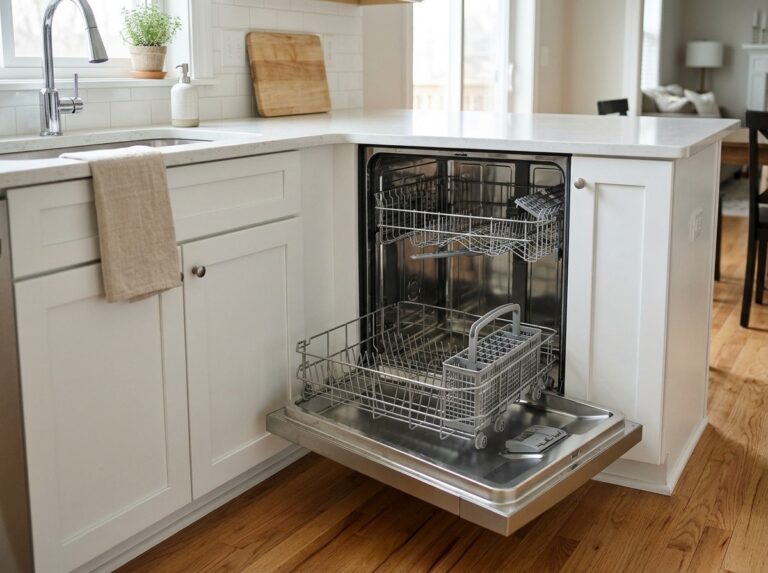
A dishwasher that is not cleaned regularly stops working properly. Grease and food particles build up in the filter, blocking water flow. Mineral deposits clog the spray arm holes, reducing water pressure. Mildew forms on the door seal. The result is dishes that come out with residue, spots, or an unpleasant smell.
This guide covers how to clean every part of a dishwasher completely, in the right order, using products you already have at home or can pick up at any grocery store.
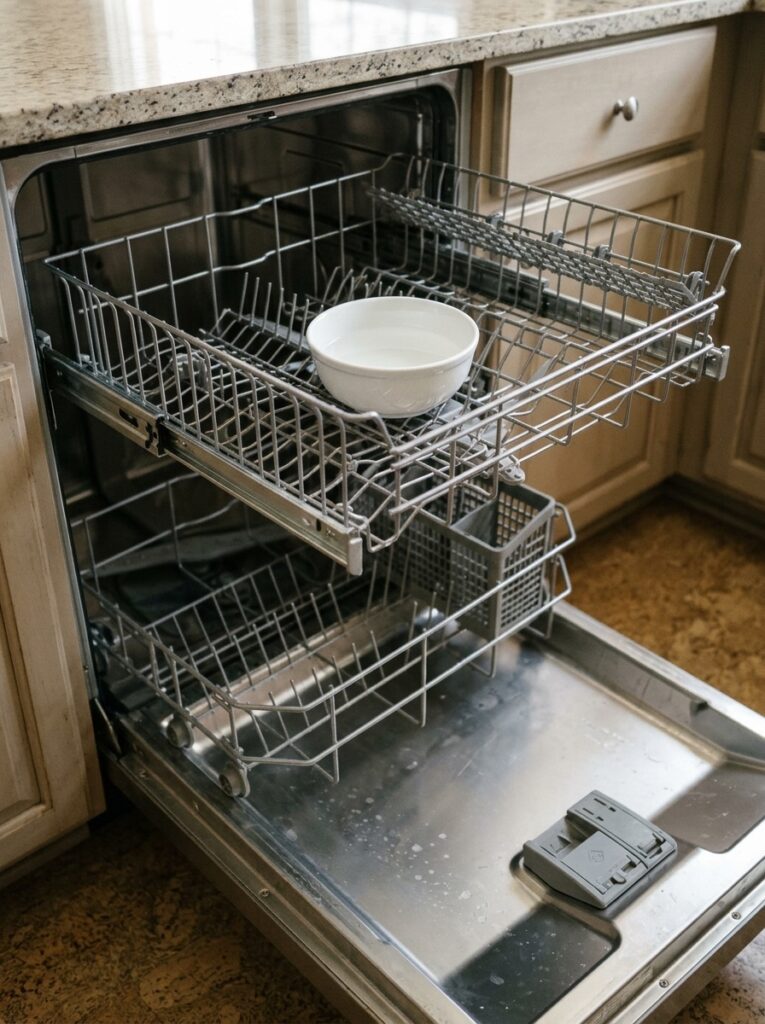
Table of Contents
What You Need
- White distilled vinegar
- Baking soda
- Dish soap
- Old toothbrush
- Toothpicks or a fine wire
- Microfiber cloths
- Rubber gloves
- Optional: Affresh Dishwasher Cleaner tablets (available at Target or Walmart) or Cascade Dishwasher Cleaner
Step 1: Clean the Filter
The filter is the most important part to clean and the most neglected. It is located at the base of the dishwasher under the lower spray arm. Most dishwashers made after 2010 have a manual filter that needs to be removed and cleaned by hand. Older machines may have a self-cleaning filter that grinds food particles, which is noisier but does not need manual cleaning.
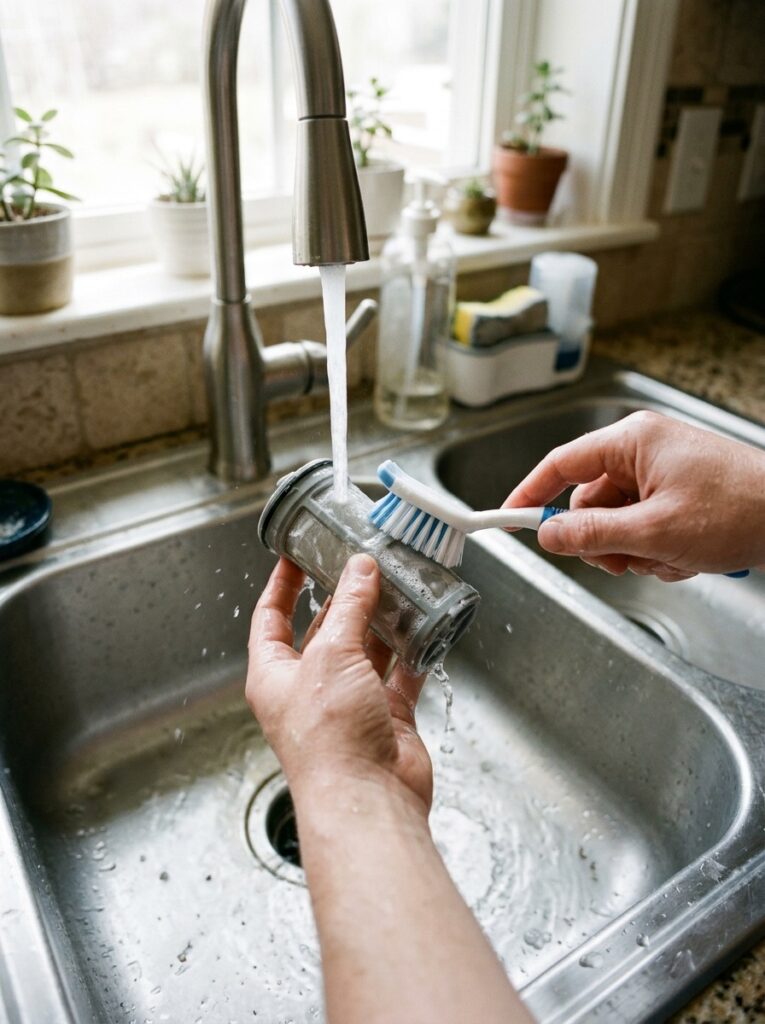
To find your filter: remove the bottom rack and look at the base of the dishwasher. The filter is usually a cylindrical tube surrounded by a flat mesh plate. Twist the cylinder counterclockwise to unlock it, then lift both pieces out together.
- Hold the filter under warm running water and rinse off loose food particles.
- Use an old toothbrush with a few drops of dish soap to scrub the mesh of both filter pieces. Pay attention to the outer edges and the mesh on the flat plate, where grease tends to collect.
- For heavy grease buildup that soap alone does not remove, soak the filter in a bowl of hot water with 1/4 cup of white vinegar for 15 minutes before scrubbing.
- Rinse both filter pieces under running water until clean.
- While the filter is out, use the toothbrush to clean inside the filter housing in the base of the dishwasher. Food debris collects here too.
- Lock the filter back into place by inserting it and twisting clockwise until it clicks.
Tip: Clean the dishwasher filter monthly. A clogged filter is the single most common cause of dishes coming out with food residue, spots, and bad odors. Cleaning takes about 5 minutes.
Step 2: Clean the Spray Arms
The spray arms rotate during the wash cycle and spray water through small holes to clean the dishes. These holes clog with mineral deposits, food particles, and grease over time. Clogged spray arm holes reduce water pressure and leave dishes dirty or spotted.
- Remove the lower spray arm by pulling it straight up from the center post or unscrewing the central nut if it has one. Check your dishwasher manual if it does not come off easily.
- Remove the upper spray arm by unscrewing the retaining nut inside the top rack or pulling it from its attachment point.
- Hold each arm under warm running water and look through each hole to check for blockages.
- Use a toothpick, a fine wire, or an unfolded paper clip to poke through each hole and dislodge any mineral deposit or food particle blocking it. Work around the entire arm.
- Rinse the arms under running water while rotating them so water flows through all the holes.
- For heavy mineral buildup inside the arms, soak them in a bowl of white vinegar for 20 minutes before clearing the holes.
- Reinstall both spray arms before the next step.
Step 3: Clean the Door Seal and Gasket
The rubber gasket around the door opening collects food particles, soap scum, and mold in its folds. This is a common source of bad odors and is frequently overlooked during dishwasher cleaning.
- Mix 1 cup of white vinegar with 1 cup of warm water.
- Dip an old toothbrush into the solution and scrub along all the folds and ridges of the rubber gasket around the door opening. Work all the way around.
- Use a damp cloth to wipe the flat parts of the seal.
- For visible black mold on the gasket: dampen a cloth with undiluted white vinegar and press it against the moldy area for 5 minutes. Scrub with the toothbrush and wipe clean. Do not use bleach on the gasket in stainless steel dishwashers as it will damage the interior.
Step 4: Clean the Interior Door and Detergent Dispenser
The inside of the door, including the lower lip that faces the interior of the machine during operation, collects grease and soap residue. The detergent dispenser builds up old tablet coating and residue that can prevent new tablets from releasing properly.
- Open the door fully. Use a damp cloth with a few drops of dish soap to wipe the inside of the door from top to bottom.
- Scrub the detergent dispenser compartment with the toothbrush. Remove any dried residue from the dispenser drawer and the slot it fits into.
- Wipe the bottom lip of the door, which faces inside the machine. This area collects the most grease and is often completely missed.
Step 5: Run a Vinegar Cycle
With all the components cleaned and reinstalled, run an empty hot cycle with white vinegar to clean the interior walls, remove mineral deposits from the pump and internal plumbing, and deodorize.
- Remove all dishes and ensure the racks are empty.
- Place a dishwasher-safe bowl or mug filled with 2 cups of white distilled vinegar on the top rack.
- Run the dishwasher on the hottest and longest cycle available. Hot water and Normal cycles work well. Do not add any detergent.
- The vinegar will be dispersed throughout the cycle, dissolving mineral buildup, grease residue, and soap scum on the walls, racks, and internal plumbing.
Step 6: Run a Baking Soda Cycle
Immediately after the vinegar cycle, run a short hot cycle with baking soda to deodorize and whiten the interior.
- Sprinkle 1 cup of baking soda across the floor of the dishwasher.
- Run a short hot cycle. No detergent needed.
The combination of the vinegar cycle followed by the baking soda cycle leaves the dishwasher interior clean, bright, and odor-free.
WARNING: Do not add vinegar and baking soda to the dishwasher at the same time. They react immediately and cancel each other’s cleaning effect. Always run them as two separate cycles.
Step 7: Clean the Exterior
The exterior of the dishwasher collects fingerprints, splashes, and grease. Clean the finish based on the material.
Plastic exterior
Wipe with a damp microfiber cloth and a small amount of dish soap. Rinse with a clean damp cloth and dry.
Stainless steel exterior
Wipe with a damp microfiber cloth in the direction of the grain to remove fingerprints and smears. For a streak-free finish, spray a small amount of Weiman Stainless Steel Cleaner (available at Walmart or Home Depot) onto a cloth and wipe in the direction of the grain. Do not spray cleaners directly onto the control panel as moisture can damage electronics.
Using a Commercial Dishwasher Cleaner
If you prefer a single-product approach instead of the vinegar and baking soda method, Affresh Dishwasher Machine Cleaner tablets (available at Target or Walmart) are the most widely used and recommended option. Place one tablet in the base of the dishwasher or in the detergent dispenser and run the hottest cycle available. Affresh contains citric acid and surfactants that break down mineral deposits, grease, and food residue in one cycle.
Cascade Dishwasher Cleaner and Finish In-Wash Dishwasher Cleaner are also effective. All three are safe for the dishwasher plumbing and gaskets.
How Often to Clean Each Part
- Filter: Monthly, or every 2 weeks if you cook heavily or rarely pre-rinse dishes.
- Spray arms: Every 2 to 3 months, or when you notice dishes coming out spotted.
- Door seal: Monthly.
- Interior vinegar and baking soda cycle: Monthly.
- Exterior: Weekly wipe-down.
For more on washing dishes, see the dishwashing tips from the American Cleaning Institute.
Related Guides
- 15 Dishwasher Tablet Cleaning Hacks That Actually Work (With Instructions)
- Cleaning Your Shower with Dishwasher Tablets (Does the Hack Actually Work?)
- Can You Clean an Oven with Dishwasher Tablets? (What Works and What to Skip)
Frequently Asked Questions
My dishwasher smells bad even though I run it every day. What is causing it?
Daily use without regular filter cleaning is the most common cause of a smelly dishwasher. Food particles accumulate in the filter and begin to decompose in the warm, moist environment. Clean the filter first. If the smell persists after cleaning the filter, check the door gasket for mold and run a vinegar cycle. Leaving the door open for an hour after each cycle significantly reduces odor by allowing the interior to dry.
My dishes come out with a white film on them. Is this a dishwasher problem?
White film on dishes is usually caused by hard water mineral deposits and is not a sign of a dirty dishwasher. The solution is to add a rinse aid like Finish Jet-Dry to the rinse aid dispenser. This prevents water droplets from drying and leaving mineral spots. Also check that the dishwasher salt dispenser is filled if your machine has one. If the white film is greasy rather than chalky, the filter may be clogged.
Can I use bleach to clean my dishwasher?
Only if your dishwasher has a plastic interior. Bleach damages stainless steel by causing pitting and discoloration. Check the inside of your dishwasher door: if it is silver-gray metallic, it is stainless steel and bleach should not be used. If it is white or light gray plastic, bleach at a dilution of 1 tablespoon per gallon of water is safe. For stainless steel dishwashers, use white vinegar, baking soda, or Affresh instead.
How do I know if my dishwasher has a manual or self-cleaning filter?
Dishwashers made before around 2010 typically have self-cleaning filters that grind food particles. These are louder during operation and do not need manual cleaning. Most dishwashers made after 2010 have quiet manual filters that need to be cleaned monthly. To check: open the dishwasher, remove the lower rack, and look at the center of the base. If you see a cylindrical mesh filter you can twist out, it is a manual filter that needs cleaning. If the base has a flat plastic screen with no removable piece, it is likely a self-cleaning system.
Why do my glasses come out of the dishwasher looking cloudy?
Cloudy or milky-looking glassware is caused by etching, which is microscopic surface damage from repeated dishwasher use, or by hard water mineral deposits. Hard water deposits are a hazy white film that can be removed with white vinegar: soak a cloth in undiluted white vinegar and wrap it around the glass for a few minutes, then rinse. True etching from repeated washing is permanent and cannot be reversed. Etching is accelerated by using too much detergent and too-hot wash temperatures. Use less detergent and lower the temperature setting for glassware.
