
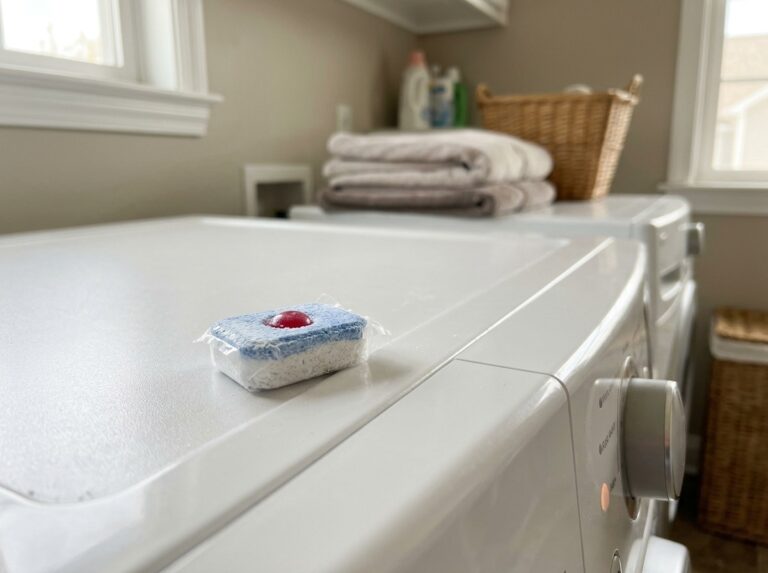
You will find plenty of social media posts claiming that dropping dishwasher tablets into a washing machine drum produces amazing cleaning results. The short answer is: it works to some extent, but it is not the best method and has real risks you should know about before trying it.
This guide explains what dishwasher tablets actually do in a washing machine, what the risks are, what the safe alternatives are, and how to get your washing machine properly clean.
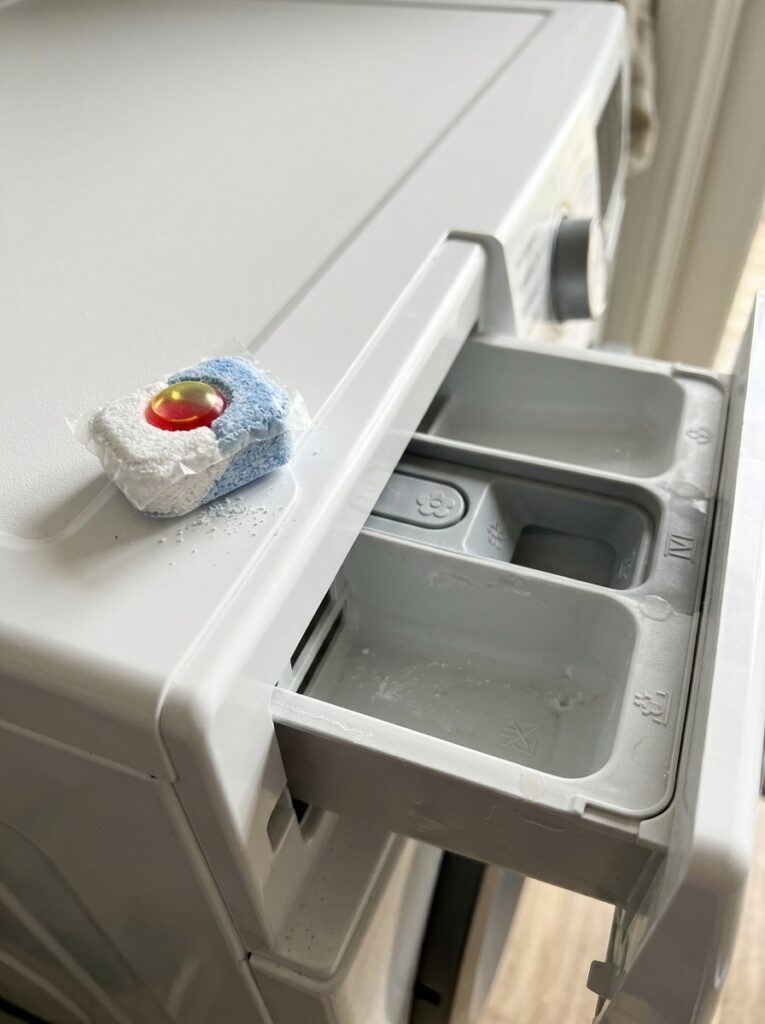
Table of Contents
What Happens When You Put a Dishwasher Tablet in a Washing Machine?
Dishwasher tablets are concentrated alkaline cleaning compounds designed to work in a dishwasher, which uses very hot water (typically 130 to 160 degrees Fahrenheit) and a pressurized spray system. Washing machines operate at much lower water temperatures for most cycles, typically 60 to 104 degrees Fahrenheit.
At washing machine temperatures, dishwasher tablets may not fully dissolve. This can leave residue inside the drum, on the door seal, and in the drain hose. The partially dissolved tablet compounds can then transfer to the next load of laundry.
When a dishwasher tablet does dissolve reasonably well at a high temperature cycle (140 degrees Fahrenheit or above), it can deodorize the drum, remove some mildew buildup, and leave the inside looking cleaner. This is why the hack appears to work when people share results.
The Risks of Using Dishwasher Tablets in a Washing Machine
Warranty voiding
Most washing machine manufacturers explicitly state in their user manuals that only products designed for washing machines should be used to clean the appliance. Using dishwasher tablets is not an approved method and will void your warranty if the machine is damaged as a result. This is the most important practical risk for anyone with a machine under warranty.
Seal damage
Dishwasher tablets contain highly alkaline compounds and enzymes at concentrations much higher than laundry detergent. Repeated use of these compounds can degrade the rubber door seal (gasket) and the rubber seals on internal components over time. A damaged door seal leads to leaks. Replacement door seals are available for most models.
Residue problems
If the tablet does not fully dissolve at the cycle temperature you use, the residue coats the inside of the drum and the rubber seal. When you wash clothes in the next cycle, those clothes absorb the dishwasher tablet residue. Dishwasher tablet compounds are not skin-safe at concentration and can cause skin irritation, especially for people with sensitive skin or children.
Excessive foam
Dishwasher tablets can produce more foam than a washing machine is designed to handle at certain temperatures. Excessive foam can force its way through the door seal and create a mess. In some machines it can trigger fault codes or overflow protection shutdowns.
Should You Try It?
One occasional use at the hottest cycle your machine offers (usually a sanitize cycle or a 140 degree Fahrenheit cotton cycle) with a single tablet in the drum is unlikely to cause damage. The risk increases significantly with repeated use over months.
However, given that purpose-made washing machine cleaners cost the same as a pack of dishwasher tablets and are specifically formulated for safe and effective use in washing machines, there is very little reason to use dishwasher tablets at all.
The Right Way to Clean a Washing Machine
What you are actually cleaning
A washing machine accumulates mildew, soap scum, limescale, and bacteria in the following areas: the drum interior, the rubber door seal, the detergent dispenser drawer, and the pump filter. Each area needs slightly different treatment. Running a hot cycle alone does not address all of them.
Step 1: Clean the drum with a washing machine cleaner
Affresh Washing Machine Cleaner tablets (available at Walmart, Target, or Amazon) are the most widely recommended purpose-made machine cleaner in the US. They are approved by major washing machine manufacturers including Whirlpool, Maytag, and Samsung. Drop one tablet directly into the empty drum and run the hottest cycle available, or your machine’s Clean Washer cycle if it has one.
Other good options: OxiClean Washing Machine Cleaner (available at Target), Lemi Shine Washing Machine Cleaner (available at Walmart), and Tide Washing Machine Cleaner.
Step 2: Clean the rubber door seal
- Pull back the rubber gasket around the door opening and check the inner fold. This area collects lint, hair, detergent residue, and mildew.
- Spray undiluted white vinegar onto a cloth and wipe the full inner surface of the gasket, including the inner fold. Work around the entire gasket.
- For visible mildew or black spots, mix a solution of 1 tablespoon of bleach in 1 cup of water. Apply to the affected areas on the gasket with a cloth and leave for 5 minutes before wiping off. Do not leave bleach on the rubber for longer than this.
- Dry the gasket with a clean cloth after cleaning.
Step 3: Clean the detergent dispenser drawer
- Pull the drawer out completely. Most front-loading washing machines have a release tab inside the drawer that you press while pulling. Top-loading machines vary by brand.
- Rinse the drawer under warm running water to remove loose detergent and softener residue.
- Soak the drawer in a bowl of warm water with 2 tablespoons of white vinegar for 15 minutes.
- Use an old toothbrush to scrub all the compartments and the siphon tube at the back.
- Rinse, dry, and replace the drawer.
- While the drawer is out, use the toothbrush to clean inside the drawer cavity on the machine, especially the dispenser jets at the back that spray water into the compartments. These clog with detergent residue and are a common cause of mold.
Step 4: Clean the pump filter
The pump filter traps lint, coins, and debris from laundry before it reaches the drain pump. A clogged filter causes poor draining, bad smells, and error codes. On front-loading washing machines, the filter is usually located behind a small panel at the bottom front of the machine.
- Place a shallow tray or old towels on the floor in front of the machine.
- Open the small access panel at the bottom front of the machine.
- There will be a small drain hose with a cap. Pull it out and let the water drain into the tray.
- Unscrew the filter cap slowly. More water will drain out. Remove the filter completely.
- Rinse the filter under the tap and remove any lint, coins, or debris caught in it.
- Wipe inside the filter housing with a cloth.
- Screw the filter back in firmly, replace the drain hose cap, and close the access panel.
Clean the pump filter every 2 to 3 months, or whenever you notice the machine draining slowly or smelling bad.
How Often to Clean Your Washing Machine
- Drum and gasket wipe-down: Monthly.
- Full Affresh or machine cleaner cycle: Once a month or every 30 washes.
- Detergent drawer: Once a month.
- Pump filter: Every 2 to 3 months.
How to Keep Your Washing Machine From Getting Smelly
- Leave the door open for several hours after every wash to let the drum and gasket dry out. Mildew grows in the trapped moisture when the door is kept closed.
- Remove laundry promptly after the cycle ends. Wet laundry sitting in a sealed drum encourages mildew.
- Use the correct amount of detergent. Too much detergent leaves residue that feeds mildew and bacteria.
- Run a hot cycle (140 degrees Fahrenheit or above) at least once a month. This kills bacteria and mildew that accumulate during cooler cycles.
- Use High-Efficiency (HE) detergent in HE washing machines. Standard detergent produces too much foam in HE machines and leaves residue.
If you are thinking about a new machine, compare efficient models in the ENERGY STAR clothes washer guide.
Related Guides
- The Best Washing Machine Descaler: [5 Top picks 2025]
- How to Get Mold Off Your Washing Machine Rubber Seal (Step-by-Step)
- Can You Clean an Oven with Dishwasher Tablets? (What Works and What to Skip)
Frequently Asked Questions
I used dishwasher tablets to clean my machine and it looks great. Did I cause any damage?
One or two uses on a hot cycle is unlikely to cause immediate visible damage. The risk is cumulative: repeated use over months can slowly degrade the rubber gasket and seals, and leaves residue that transfers to laundry. If your machine is under warranty, stop using dishwasher tablets and switch to Affresh or an approved washing machine cleaner. If the machine is older and out of warranty, the occasional use is low risk but still not necessary when proper alternatives are available.
Can dishwasher tablets clean the washing machine drum?
They can clean the drum to some extent when used on a very hot cycle. However, they are not formulated to treat the main problems that accumulate in washing machine drums: mildew spores, HE detergent residue, and limescale. Affresh tablets are formulated with citric acid and surfactants specifically designed to address all three.
My washing machine smells even after I ran a hot cycle. What is wrong?
If a hot cycle alone does not remove the smell, the mildew is likely concentrated in the door gasket fold or the detergent drawer, not just the drum. Clean the gasket with diluted bleach as described above, clean the drawer and its cavity, and clean the pump filter. If the smell persists after all four areas have been cleaned, check whether the drain hose has a U-bend loop above the machine. This can trap water and become a source of odor if it is not positioned correctly.
What is the best washing machine cleaner in the US?
Affresh Washing Machine Cleaner is the most widely recommended and is endorsed by major washing machine brands. It is effective at removing mildew, detergent residue, and limescale without damaging seals or voiding warranties. OxiClean Washing Machine Cleaner is a strong second option, particularly for machines with heavy mildew problems, because the oxygen bleach is effective at killing mold spores.
How do I stop black mold from growing on my washing machine door seal?
Black mold on the door seal is caused by moisture being trapped in the gasket after each wash. Leave the door open after every wash to allow the drum and gasket to dry completely. Wipe the inner fold of the gasket dry with a cloth after each wash. Run a hot cycle with an Affresh tablet or diluted bleach every month. If mold keeps returning despite these measures, the gasket may need to be replaced, as mold can penetrate deep into degraded rubber.
