
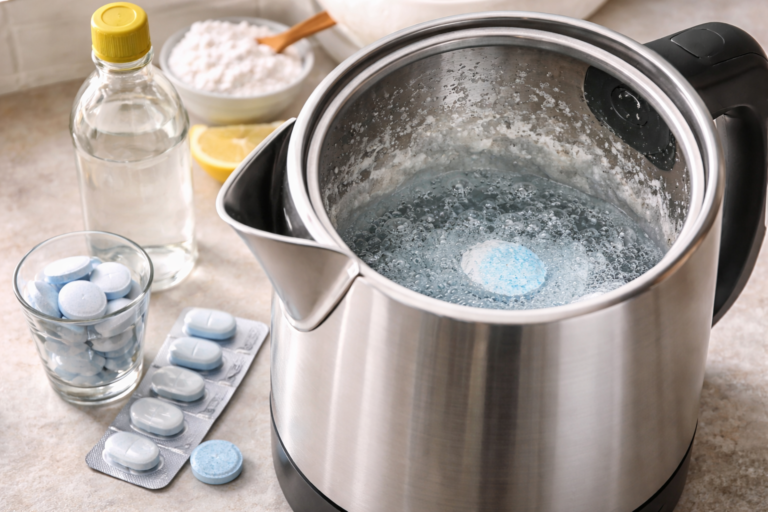
You have a box of denture tablets in the cabinet and a kettle caked in white mineral buildup. Someone online said to just drop one in and watch the magic happen. But does it actually work?
The short answer: yes, in some situations. But denture tablets are not a universal limescale remover, and knowing where they work versus where they fail can save you a lot of wasted effort.
This guide breaks down the science, the real-world results, and exactly how to use denture tablets for limescale removal in your home.
What Are Denture Tablets Made Of?
To understand whether denture tablets can remove limescale, you first need to know what is actually in them. Most brands like Efferdent or Polident contain a combination of:
- Sodium bicarbonate (baking soda) – a mild abrasive and deodorizer
- Citric acid or sodium perborate – provides the fizzing reaction and mild bleaching
- Sodium carbonate – helps lift stains and break down deposits
- Sometimes a mild bleach component – for sanitizing and whitening
When you drop a tablet into water, these ingredients dissolve and release an effervescent fizzing action. That fizzing is what loosens deposits and stains from surfaces. The mild acidity from citric acid is what attacks limescale, which is calcium carbonate — the same mineral that builds up inside kettles, showerheads, and toilet bowls.
What Is Limescale and Why Is It Hard to Remove?
Limescale forms when hard water — water high in dissolved calcium and magnesium — evaporates and leaves behind a chalky white residue. If you live in a hard water area (most of the Midwest, Southwest, or Southeast in the US), you will see it constantly on:
- The inside of your kettle or coffee maker
- Showerheads and faucet aerators
- Toilet bowls, especially below the waterline
- Shower screens and glass doors
- Bathroom and kitchen tiles
The problem with limescale is that it bonds tightly to surfaces over time. Fresh buildup dissolves easily with mild acids. Old, calcified limescale requires stronger intervention.
Where Denture Tablets Work Well
1. Electric Kettles
This is where denture tablets genuinely shine. The method is simple and effective for light to moderate buildup:
- Fill your kettle with water to the max line.
- Drop in 1 to 2 denture tablets and let them fully dissolve.
- Turn the kettle on and let it boil.
- Let the solution sit for 20 to 30 minutes once boiled.
- Pour it out and rinse 2 to 3 times with clean water before using.
Pro Tip: For overnight descaling without boiling, just fill the kettle with cold water, drop in a tablet, and leave it overnight. The fizzing reaction works slowly but still dissolves light deposits.
2. Showerheads
Mineral deposits clog showerhead nozzles and reduce water pressure over time. Denture tablets work well here because the soak method keeps the solution in contact with the buildup for long enough to dissolve it.
- Fill a large zip-top bag or bowl with warm water.
- Drop in 2 to 3 denture tablets and let them dissolve.
- Submerge the showerhead fully in the solution. Use a rubber band to secure the bag to a wall-mounted showerhead if needed.
- Leave for 2 to 4 hours, or overnight for heavy buildup.
- Remove and scrub lightly with a soft brush, then rinse.
3. Toilet Bowls (Light Staining)
For hard water rings and general staining in the toilet bowl, denture tablets can work. They are not as powerful as a dedicated limescale remover, but they are a good low-effort maintenance option.
- Drop 1 to 2 tablets directly into the toilet bowl.
- Let them fully fizz and dissolve — about 15 to 30 minutes.
- Scrub with your toilet brush, focusing on the waterline and under the rim.
- Flush to rinse.
Best Results: For heavy toilet limescale, do this before bed and let the tablets sit overnight without flushing. Scrub and flush in the morning.
4. Coffee Mugs and Teapots
Tannin stains and mineral residue inside mugs and glass carafes are no match for a denture tablet. Fill the mug with warm water, drop in one tablet, let it fizz for 10 to 20 minutes, then rinse. Your mugs will come out dramatically cleaner.
5. Coffee Makers
Run a denture tablet dissolved in a full reservoir of water through a brew cycle to descale the internal components. Follow up with two full cycles of clean water before brewing coffee again.
6. Flower Vases
Cloudy mineral deposits inside glass vases can be stubborn to remove. One denture tablet in water, left for 30 to 60 minutes, clears the cloudiness and sanitizes the glass.
Where Denture Tablets Do NOT Work Well
Heavy-Duty Toilet Limescale
Here is where expectations often get crushed. Independent testing has shown that denture tablets frequently fail to remove severe, calcified limescale from toilet bowls. A test by Which? UK had a tester apply multiple tablets — up to four at a time — with no appreciable difference. The same toilet was then treated with a dedicated limescale remover, which cleared the buildup within two doses.
If your toilet has thick, long-standing limescale deposits, skip the denture tablets and go straight to a proper limescale remover like CLR or Lime-A-Way.
Shower Tiles and Grout
The abrasive and cleaning compounds in denture tablets work better on smooth, non-porous surfaces. Tile and grout have texture and porosity that prevents the dissolved tablet solution from penetrating deeply enough to lift built-up mineral deposits.
Severe Kettle Buildup
If the element in your kettle is encrusted with thick, hardened limescale that has been accumulating for months or years, a denture tablet will not cut through it. A dedicated descaling product with citric acid or acetic acid will be far more effective.
Denture Tablets vs. Other Limescale Removers
Here is how denture tablets stack up against common alternatives:
- White vinegar: Stronger acid than most denture tablets, works on most limescale, very cheap, safe for most surfaces. The smell is the main downside.
- Citric acid powder: Highly effective, food-safe, inexpensive in bulk. Mix 1 to 2 tablespoons in a cup of warm water. Works on kettles, showerheads, coffee makers.
- CLR (Calcium, Lime & Rust Remover): The strongest DIY option for severe buildup. Works on everything but requires careful rinsing before the surface contacts food or skin.
- Baking soda alone: Mild abrasive only — no acid to dissolve minerals. Good for scrubbing, not dissolving limescale.
- Denture tablets: Best for light buildup, maintenance cleaning, and surfaces that benefit from the sanitizing and bleaching properties.
The Honest Verdict
Denture tablets are a genuinely useful multi-purpose cleaner. They are effective for light limescale in kettles, coffee makers, showerheads, and toilet bowls used as regular maintenance. They sanitize, deodorize, and leave surfaces looking brighter.
Where they fall short is on heavy, calcified limescale — particularly in toilets — where the mild acidity simply cannot break through years of mineral deposits. For those situations, a dedicated product with stronger acid is the right tool.
Think of denture tablets as a good monthly maintenance cleaner, not an emergency limescale-removal solution.
Frequently Asked Questions
How many denture tablets should I use for descaling a kettle?
1 to 2 tablets for a full kettle of water is usually enough for light to moderate buildup. For heavier deposits, use 2 tablets and let the solution sit overnight in cold water.
Are denture tablets safe to use in a kettle?
Yes, as long as you rinse the kettle thoroughly — at least 2 to 3 times with fresh water — before boiling water for drinking or cooking. The cleaning compounds are safe in small residual amounts, but you do not want to taste them.
Can denture tablets remove rust stains?
They can lighten light rust stains due to the mild bleach component, but they are not designed for rust removal. For rust, use a product containing oxalic acid or a rust-specific cleaner.
Do denture tablets work on colored surfaces?
Use caution. Some denture tablets contain bleaching agents that can fade colored grout, fabric, or plastic. Test on a small, hidden area first.
How often should I use denture tablets to clean my toilet?
Once a week as maintenance is a good routine to prevent mineral buildup from getting out of hand. For heavy existing buildup, start with a dedicated limescale remover and then switch to weekly denture tablet maintenance.
Related Articles: