
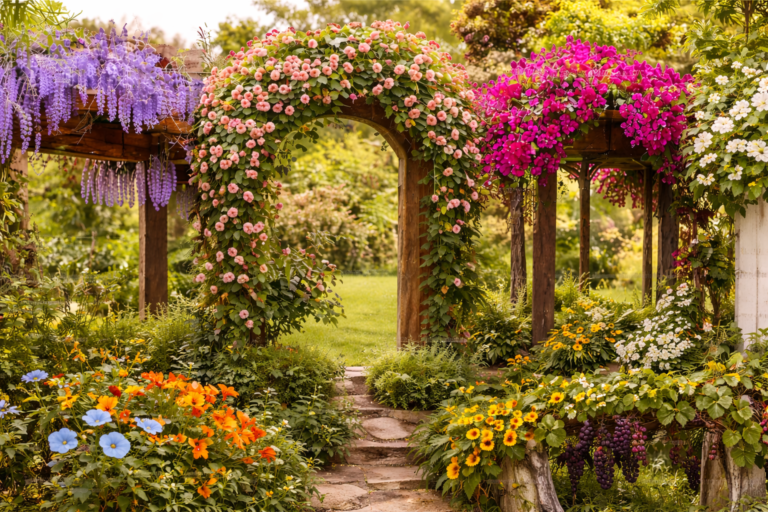
A pergola without climbing plants is just lumber. The structure exists to support living growth, to create the transition from architecture into something that breathes, blooms, and changes with the seasons.
Choosing the right climber matters more than most people realize. The wrong plant, one that is too aggressive, incompatible with your climate, or requires more structural support than your pergola can provide, causes years of problems. The right plant transforms a pergola into a garden destination.
These 15 plants are the best available across different climates, aesthetic preferences, and maintenance tolerances. Each entry includes the honest care requirements the competitor’s article glosses over.
Before You Plant: Matching Plant to Structure
Three questions determine which plant belongs on your pergola:
- How strong is the structure? Wisteria can add hundreds of pounds to a pergola over decades. A lightweight aluminum pergola cannot support it. Solid timber or steel pergolas handle any plant on this list.
- How patient are you? Some plants (climbing hydrangea, wisteria) take 3 to 7 years to establish and bloom properly. Others (morning glory, climbing nasturtium) bloom the first season from seed.
- What is the primary goal? Shade, fragrance, food production, wildlife attraction, and visual drama all have different best-plant answers.
The 15 Best Climbing Plants
1. Wisteria (Wisteria sinensis and W. floribunda)
The most dramatic pergola plant available. Cascading clusters of fragrant purple, white, or pink flowers in May and June, followed by a lush leafy canopy through summer. A mature wisteria covered in bloom is genuinely one of the most beautiful sights in the temperate garden.
- Zone: 5 to 9
- Sun: Full sun — minimum 6 hours for good bloom
- Growth: Can reach 30 feet or more; grows 10 feet per year once established
- Critical warnings: Wisteria is invasive in parts of the southeastern US — check your state’s invasive species list. It requires heavy structural support. It may take 3 to 7 years from planting to first bloom. Purchase grafted plants rather than seedlings to reduce the wait.
- Pruning: Prune twice yearly: once in late winter (cut back all shoots to 2 to 3 buds) and once in midsummer (cut back new growth to 5 to 6 leaves). Failure to prune annually produces a dense, non-blooming mass.
- Best varieties: ‘Amethyst Falls’ (American wisteria, less aggressive, reliable bloomer), ‘Blue Moon’ (reblooms in cold climates), ‘Prolific’ (prolific-blooming Chinese wisteria)
2. Clematis (Clematis — large-flowered hybrids and species)
With over 300 species and hundreds of cultivars, clematis provides color for virtually any season, climate, and aesthetic. From the massive purple plates of ‘Jackmanii’ to the delicate nodding bells of Clematis tangutica, this genus is the single most versatile pergola climber available.
- Zone: 4 to 9 depending on species
- Sun: Head in sun, feet in shade — roots prefer cool, shaded soil while stems and flowers need full sun
- Growth: 6 to 20 feet depending on variety
- Pruning groups: Clematis is grouped by pruning requirements (Group 1, 2, or 3) — always confirm which group before pruning, as incorrect pruning removes next year’s flowers
- Best for pergolas: ‘Jackmanii’ (purple, Group 3, reliable), ‘Nelly Moser’ (pink-striped, Group 2), ‘Sweet Autumn’ clematis (C. terniflora, white-scented, very vigorous, invasive in some states)
3. Climbing Roses
Climbing roses are not natural climbers — they have long, flexible canes that must be trained and tied to supports. But few plants combine fragrance, visual beauty, and structural impact as effectively on a pergola or arbor.
- Zone: Varies by variety, most 5 to 9
- Best varieties for pergolas: ‘New Dawn’ (soft pink, very vigorous, disease resistant, zones 4 to 9), ‘Fourth of July’ (red-striped, fragrant, AARS winner), ‘Zephirine Drouhin’ (thornless — ideal for high-traffic pergola paths), ‘Generous Gardener’ (David Austin, apricot-pink, extraordinary fragrance)
- Maintenance: Train canes horizontally along the pergola beams rather than vertically — horizontal training produces far more blooms per cane
4. Honeysuckle (Lonicera species)
Honeysuckle twines enthusiastically around any support and produces fragrant tubular flowers beloved by hummingbirds and butterflies. The evening fragrance of native coral honeysuckle and the sweet scent of Japanese honeysuckle make these outstanding choices for pergolas near seating areas.
- Zone: 4 to 9 depending on species
- Native recommendation: Lonicera sempervirens (coral honeysuckle) is native to eastern North America, non-invasive, and produces spectacular red-orange flowers that attract hummingbirds
- Avoid: Japanese honeysuckle (L. japonica) is highly invasive in the eastern US; choose native species instead
5. Climbing Hydrangea (Hydrangea anomala petiolaris)
The most shade-tolerant climbing plant on this list. Climbing hydrangea attaches to structures via aerial rootlets (no tying needed) and produces stunning white lacecap flowers in June. The exfoliating cinnamon-brown bark provides winter interest.
- Zone: 4 to 8
- Sun: Partial shade to full sun; exceptional for shaded north-facing pergolas
- Important patience note: Climbing hydrangea is notoriously slow for the first 3 years (“sleep, creep, leap” is the common description). After year 3 or 4, growth becomes vigorous. Do not give up.
- Caution: The aerial rootlets can damage painted or soft masonry surfaces over time. For wooden pergolas, the attachment is harmless.
6. Jasmine (Trachelospermum jasminoides and Jasminum officinale)
Few plants produce fragrance as powerful and universally loved as jasmine. Star jasmine (Trachelospermum jasminoides) is a particularly reliable pergola plant in zones 7 to 11 — evergreen, vigorous, and covered in white flowers with an intoxicating scent in late spring and early summer.
- Star jasmine zone: 7 to 11
- Common jasmine zone: 7 to 10 (dies back in zone 6 but often returns from roots)
- Best placement: Near outdoor seating areas where the evening fragrance can be enjoyed
7. Bougainvillea (Bougainvillea spp.)
The most visually dramatic tropical climber available. The vivid magenta, red, orange, yellow, or white “flowers” (technically bracts — modified leaves surrounding tiny white true flowers) are incomparable for sheer visual impact.
- Zone: 9 to 11 as a perennial; can reach 40 feet in warm climates
- For colder zones: Grow in a large container and overwinter indoors
- Care: Bougainvillea blooms most on slightly stressed plants — drought stress and root-bound conditions actually increase flowering. Over-watering reduces bloom significantly.
- Caution: Thorns are sharp. Use gloves when pruning and do not position near children’s play areas.
8. Passionflower (Passiflora incarnata and P. caerulea)
The most intricate flowers in the temperate garden — each bloom is a complex arrangement of filaments, petals, and reproductive structures that looks like something from a science fiction novel. Native maypop (P. incarnata) is hardy to zone 6 and grows vigorously.
- Zone: P. incarnata zones 6 to 10; P. caerulea zones 7 to 10
- Growth: Extremely fast — can cover a pergola in a single season
- Wildlife: P. incarnata is the host plant for Gulf Fritillary and Zebra Longwing butterflies
- Fruit: P. incarnata produces edible “maypop” fruits with a tropical flavor in late summer
9. Morning Glory (Ipomoea purpurea and I. tricolor)
For immediate results in the first season, morning glory is unmatched. Sow seeds directly at the base of the pergola after last frost and by midsummer the structure is covered in trumpet-shaped flowers of vivid blue, purple, pink, or white. Each flower closes by afternoon but new blooms open every morning.
- Annual: Grows in any zone as an annual; self-seeds prolifically
- Warning: Morning glory self-seeds aggressively and can become weedy. Deadhead promptly if reseeding is a concern.
- Best variety: ‘Heavenly Blue’ (vivid cerulean blue, spectacular)
10. Golden Hops (Humulus lupulus ‘Aureus’)
Golden hops provides the fastest dense coverage of any perennial pergola plant. The brilliant lime-gold leaves create a luminous canopy. Plants die back completely in winter and re-emerge vigorously in spring, reaching 15 to 20 feet by midsummer.
- Zone: 4 to 8
- Sun: Full sun for best golden color; shaded plants revert to green
- Note: The hops cones produced in late summer are the same used in brewing — an added bonus for home brewers
11. Hardy Kiwi (Actinidia arguta)
Hardy kiwi is the most productive food-producing pergola vine for temperate climates. Unlike grocery store kiwi, the fruits of Actinidia arguta are grape-sized, smooth-skinned, and can be eaten without peeling — with a flavor remarkably similar to their larger cousins.
- Zone: 4 to 8
- Pollination: Most varieties require one male plant for every 6 to 8 female plants. ‘Issai’ is self-fertile and suitable for single-plant situations.
- Fruit timing: First fruit typically appears in year 3 to 5
12. Grapevine (Vitis vinifera, V. labrusca)
Grapevines have been trained on pergolas since Roman times — the combination of a lush leafy canopy with hanging fruit clusters is one of the most classically beautiful garden images available. The autumn color of the foliage before leaf drop adds a seasonal finale.
- Zone: 5 to 9 depending on variety
- For cold climates: Concord (V. labrusca), zone 4 to 9, reliably productive
- For wine grapes: Select varieties matched to your specific region and climate — consult your state extension service
13. Mandevilla (Mandevilla spp.)
Mandevilla produces large, trumpet-shaped flowers in deep pink, red, or white throughout summer and into autumn. Extremely easy to establish — the tendrils grab supports independently and the plant needs very little training.
- Zone: 10 to 11 perennial; grown as annual or overwintered indoors elsewhere
- Best for: Hot-summer climates where other flowering climbers struggle; combines beautifully with dark-foliaged plants
14. Crimson Glory Vine (Vitis coignetiae)
Grown primarily for autumn foliage, Vitis coignetiae produces enormous leaves (up to 12 inches across) that turn spectacular crimson and scarlet in fall. Through the growing season it provides a dense, tropical-looking canopy.
- Zone: 5 to 9
- Growth: Very vigorous — 30 to 50 feet. Requires annual pruning to maintain scale on a typical pergola.
- Best use: Large, sturdy pergolas where scale is not a concern
15. Moonflower (Ipomoea alba)
The nocturnal counterpart to morning glory. Moonflower’s large, pure white trumpet flowers open at dusk and remain open through the night, releasing a sweet jasmine-like fragrance that draws night-flying moths. An extraordinary plant for outdoor evening entertaining spaces.
- Annual: Grows in any zone as an annual; start seeds 4 to 6 weeks before last frost
- Companion: Pair with morning glory on the same structure for 24-hour bloom coverage
✅ Tip
For vinyl pergolas, which have smooth surfaces that vines cannot grip, use soft garden twine wrapped around columns or adhesive hooks to give tendrils and climbing stems something to grasp. Even natural climbers need a little help on slippery surfaces.
Plant the base of any pergola climber at least 18 inches away from the post or column it will ascend. Root competition with the structural footing is less of a concern than the soil drainage problem created by planting directly against a concrete base.
Frequently Asked Questions
What is the fastest growing vine for a pergola?
For immediate results in a single season: morning glory and climbing nasturtium from seed, or mandevilla from a nursery transplant. For the fastest perennial coverage: golden hops can reach 15 to 20 feet in a single growing season once established. Passionflower is similarly vigorous.
Can wisteria damage a pergola?
Yes — a mature wisteria is extraordinarily heavy and strong. Its woody stems have been documented splitting wooden beams and dismantling poorly constructed structures over decades of growth. Install wisteria only on heavy timber, steel, or masonry pergolas with substantial post footings. Annual pruning keeps it from reaching destructive size.
The Bottom Line
Match the plant to your structure’s strength, your climate, and your patience level. Wisteria and climbing hydrangea are investments that deliver decades of beauty. Morning glory and moonflower deliver beauty the first season from a $3 seed packet. Both approaches are valid — choose the one that fits your situation, and plant it at the base of the pergola this season.