
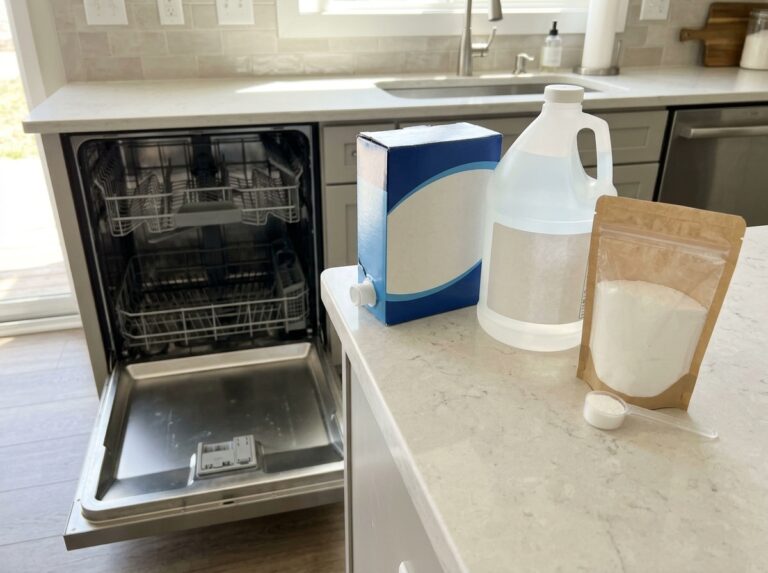
Dishwasher salt is not like most other cleaning supplies. You cannot swap it out freely for something else sitting in your kitchen cabinet. Most alternatives either fail to do the job or can cause actual damage to your machine over time. But if you have run out and need to run the dishwasher right now, there are a couple of short-term options that work well enough to get through a few loads.
This guide explains what dishwasher salt actually does, which alternatives genuinely work (and why), which ones are commonly suggested but should be avoided, and what happens if you skip salt altogether.
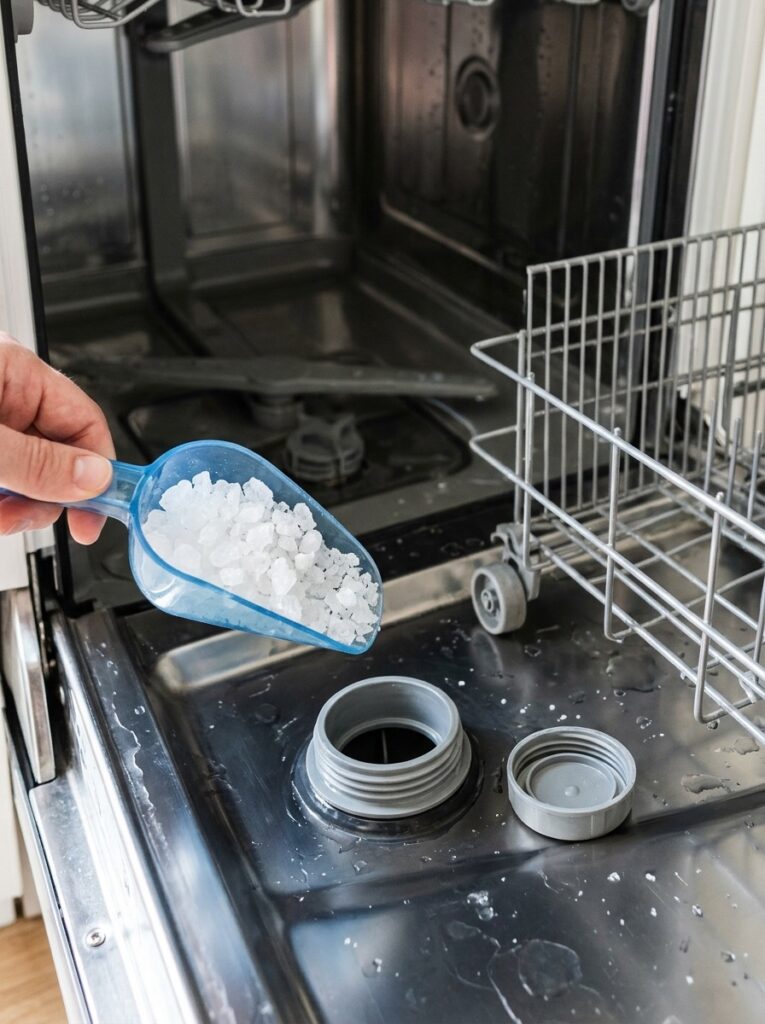
Table of Contents
What Dishwasher Salt Does and Why It Matters
Dishwasher salt is pure, coarse-grained sodium chloride. It does not wash your dishes. Instead, it regenerates the resin beads inside your dishwasher’s built-in water softener unit. These resin beads pull calcium and magnesium ions out of the incoming water before it reaches your dishes. Calcium and magnesium are what make water hard, and hard water causes two problems in a dishwasher: it leaves white mineral deposits on glassware and dishes, and it causes limescale to build up inside the machine’s pipes, heating element, and spray arms over time.
The resin beads become saturated with calcium and magnesium after a while and stop working. Dishwasher salt flushes them clean by supplying sodium ions that displace the calcium and magnesium and restore the resin so it can keep softening water. Nothing else does this specific job in the same way.
Whether you actually need salt depends entirely on how hard your water is. In soft water areas, some people skip dishwasher salt entirely with no visible problems. In hard water areas, skipping salt for more than a few cycles leads to cloudy glasses and gradual limescale accumulation inside the machine.
TIP: To check your water hardness, visit the US Geological Survey water hardness map at water.usgs.gov, or contact your water utility directly. Most water utilities publish hardness data online. You can also buy a water hardness test strip kit on Amazon that gives an immediate result from a tap sample.
The US Context: Do American Dishwashers Use Salt?
Most dishwashers sold in the US do not have a dedicated salt reservoir. American dishwashers are typically built without a separate water softener unit. This is because US dishwasher detergents have historically included water softening agents (phosphates and now their replacements) built into the formula, and because American consumers generally handle hard water issues through whole-house water softeners plumbed into the home rather than appliance-level softeners.
If your dishwasher does not have a salt compartment, the alternatives and workarounds in this guide are relevant to you. If you have a European-made dishwasher such as a Bosch, Miele, or Siemens imported model, it very likely does have a salt reservoir, and this guide applies fully.
Alternative 1: White Distilled Vinegar (Best Short-Term Option)
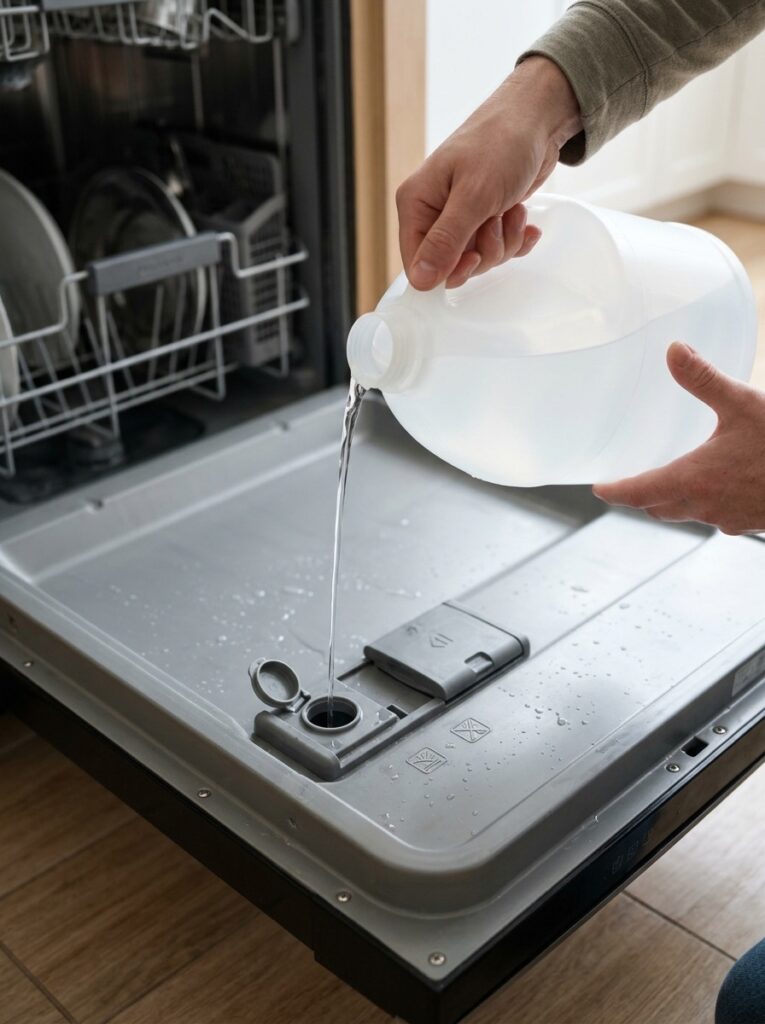
White vinegar is the most practical short-term substitute when you have run out of dishwasher salt. It does not regenerate the resin beads the way salt does, but it addresses the symptom that most people notice first: white mineral film on dishes and glasses.
Vinegar is a mild acid (acetic acid, typically 5% concentration). It dissolves calcium carbonate, which is the mineral compound that forms the white residue on glassware. Running a cycle with vinegar prevents that film from forming in the current wash, but it does not protect the machine’s internal components from limescale the way proper salt does.
How to use white vinegar as a short-term salt substitute
- Pour 1 cup of plain white distilled vinegar into a bowl or cup.
- Place the bowl on the top rack of your dishwasher before starting a cycle.
- Do not add vinegar directly to the salt reservoir. The reservoir is designed for coarse solid salt, not liquid.
- Run the cycle as normal.
The vinegar disperses into the wash water during the cycle and prevents mineral deposits from forming on dishes for that wash. It also helps clean the interior walls and spray arms slightly.
WARNING: Do not add vinegar to the rinse aid dispenser on a regular basis. Vinegar with an acidity above 5% can degrade rubber seals and gaskets inside the dishwasher over time. Use it only as an occasional substitute, not as a permanent replacement for salt or rinse aid.
Alternative 2: All-in-One Dishwasher Pods with Built-In Softener
If you are out of dishwasher salt and want a more complete solution than vinegar, switching to an all-in-one detergent pod that includes a water softening agent is the best long-term workaround for dishwashers without a salt reservoir.
Cascade Platinum ActionPacs (available at Walmart, Target, and Amazon) include built-in rinse aid and water softening chemistry. They are formulated specifically for US water conditions and handle moderate hard water well without requiring separate salt. For very hard water areas (above 200 ppm or 12 grains per gallon), results may still fall short compared to a dedicated water softener.
Finish Quantum Ultimate is another strong option with built-in protection against hard water deposits. It performs well in moderately hard water.
TIP: If you live in a hard water area and your dishwasher does not have a salt compartment, Cascade Platinum ActionPacs or Finish Quantum pods combined with Finish Jet-Dry Rinse Aid is the most effective combination available to you as a US consumer without a built-in water softener unit.
Alternative 3: Citric Acid (Effective for Descaling, Not a True Substitute)
Citric acid dissolves limescale and mineral deposits more aggressively than vinegar. It is sold in powder form as a cleaning agent and is available at most grocery stores and on Amazon.
Adding 2 tablespoons of citric acid powder to the bottom of your dishwasher (not the salt compartment) before a hot cycle will descale the interior of the machine and help prevent mineral buildup on dishes. This is useful if you have skipped salt for several weeks and notice limescale accumulating inside the machine.
Citric acid is not a substitute for the water softening regeneration process that dishwasher salt performs. It removes existing deposits rather than preventing hard minerals from depositing in the first place.
WARNING: Do not put citric acid powder directly into the salt reservoir. Powders can foam in the water softener unit and cause blockages. Use citric acid only in the main tub.
What Not to Use as Dishwasher Salt Substitutes
Table salt
Table salt is too fine-grained. The salt reservoir in a dishwasher is designed to dissolve coarse salt granules slowly over many cycles. Fine table salt dissolves almost instantly, flooding the water softener unit with a concentrated salt solution all at once. It also contains anti-caking agents such as sodium ferrocyanide or silicon dioxide, which can leave residue inside the machine. Table salt in the salt reservoir risks clogging the water softener unit.
Sea salt
Sea salt, including kosher salt and rock salt, is often suggested online as a substitute. It is not safe for the same reasons as table salt. While it is coarser than table salt, it still contains trace minerals that can build up inside the water softener unit. It also lacks the consistent grain size of dishwasher salt and may partially block the reservoir.
Baking soda in the salt compartment
Baking soda added to the main tub or dispenser as a cleaning booster is fine. Adding baking soda to the salt reservoir is not. The powder dissolves instantly, foams in the water softener, and provides no ion-exchange benefit.
Water softener pellets for home water softeners
These are a completely different product from dishwasher salt, even though both are sodium-based. Water softener pellets are designed for large whole-house units and are not compatible with dishwasher salt reservoirs.
What Happens If You Skip Salt Entirely
In soft water areas (below 60 ppm or 3.5 grains per gallon)
Very little. Dishes and glasses may come out slightly less sparkling over time, but no significant damage occurs. Many people in soft water areas use their dishwashers for years without ever adding salt and see no problems. If the machine has a salt indicator light, it will stay on, but this is just a reminder rather than an emergency warning.
In moderate hard water areas (60 to 180 ppm or 3.5 to 10.5 grains per gallon)
After several weeks without salt, a white haze starts to appear on glasses. The inside of the dishwasher may develop a white powdery film. The spray arm holes can gradually narrow from limescale deposits. Run a citric acid descaling cycle to clear existing deposits, then top up the salt or switch to a hard-water formulated all-in-one pod.
In hard water areas (above 180 ppm or 10.5 grains per gallon)
Skipping salt for more than a few weeks leads to noticeable cloudiness on glasses that does not come off. The heating element at the bottom of the dishwasher accumulates limescale, which reduces heating efficiency, increases energy use, and can shorten the life of the element. This is the situation where using the best available alternative matters most.
To understand what makes tap water hard, see the USGS explanation of water hardness.
Related Guides
- Can Denture Tablets Remove Limescale? (What Actually Works)
- How to Clean a Dishwasher (Every Part, Step-by-Step)
- 15 Dishwasher Tablet Cleaning Hacks That Actually Work (With Instructions)
Frequently Asked Questions
My dishwasher has no salt compartment. Does that mean I never need to add salt?
Yes, for most US dishwashers without a salt compartment, you do not add separate dishwasher salt. The water softening function is either absent (the machine relies on detergent chemistry alone), or it is handled by a whole-house water softener already installed in your home. Use Cascade Platinum or Finish Quantum pods for the best hard water protection if you live in a hard water area and have no salt compartment.
Can I use the white vinegar method every cycle as a permanent salt replacement?
No. Vinegar helps with the visible symptom of white film on dishes, but does not regenerate the resin beads in a machine that has a salt reservoir. If your machine has a reservoir, the resin will gradually saturate and stop softening water regardless of how much vinegar you use. Use vinegar only as a temporary workaround while you get more salt. For machines without a salt reservoir, vinegar once a month as a maintenance rinse is fine.
My dishwasher salt light came on but I just refilled the salt. Is something wrong?
The light may stay on for one or two cycles after a refill while the new salt dissolves into the water softener and the sensor registers the change. If the light stays on after three or more full cycles, check that the cap is screwed on tightly, that the salt reservoir is actually full, and that water is visible in the reservoir (a filled reservoir always has water mixed with the salt). If the light stays on and the reservoir appears full, the sensor or the water inlet valve may have a fault.
Does dishwasher salt expire?
Dishwasher salt does not expire in the way that food does. Pure sodium chloride is stable indefinitely if stored in a sealed, dry container. However, if stored in a damp environment, it can clump and harden, making it difficult to pour. Store it in a sealed bag or container in a dry cabinet. If clumped, break it up with a wooden spoon before pouring.
Is Finish dishwasher salt the same as store-brand dishwasher salt?
Yes, chemically they are identical. Dishwasher salt is 99.9% pure sodium chloride with no additives. The only meaningful difference between brands is grain size, and even that is standardized. Finish and store-brand dishwasher salts perform equally well. Buy whichever is cheapest. In US stores, Morton Water Softener Salt Fine Crystals (sold in larger bags for water softener systems) is sometimes used in dishwasher salt reservoirs with good results, though it is worth checking the grain size matches your machine’s specifications first.
