
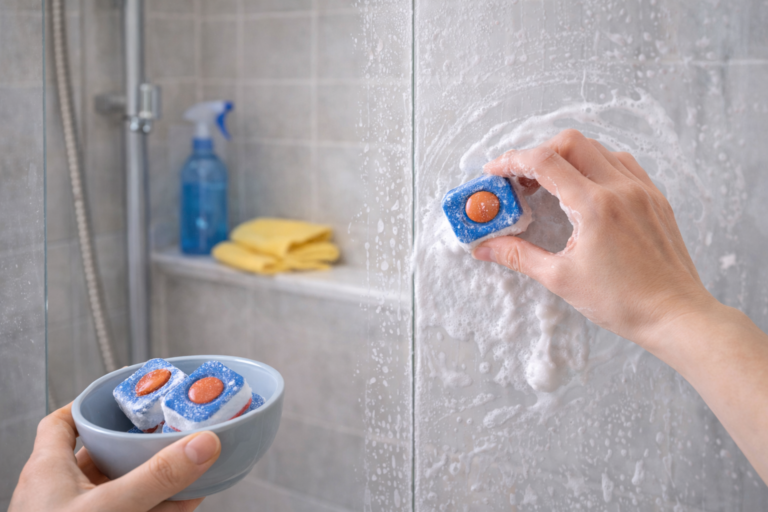
The cleaning hack spread fast.
Someone posts a video wiping their shower walls with a soaked dishwasher tablet, and suddenly every corner of the internet is calling it life-changing.
Thousands of people comment to say they tried it and got a sparkling result. But is it actually worth doing, or is there a better and cheaper way to get the same result?
We have looked at the real-world evidence — including an independent test where the hack flat-out failed — and put together an honest guide to what dishwasher tablets can and cannot do in your shower.
Why People Think Dishwasher Tablets Work on Showers
Dishwasher tablets are designed to tackle dried-on food, grease, and hard water spots on ceramic dishes and glass. Your shower has the same combination of soap scum (a grease-adjacent substance), hard water mineral deposits, and glass surfaces. On paper, the chemistry matches up.
Most dishwasher tablets contain:
- Surfactants that cut through grease and soap residue
- Sodium carbonate and sodium bicarbonate that lift stains
- Enzymes in some brands that break down organic residue
- Mild bleaching agents for whitening
Used on shower surfaces, these compounds can tackle soap scum reasonably well. The catch is in the application — a tiny tablet has to cover a large surface, it is abrasive on your hands, and it becomes slippery quickly.
What Works Well: The Honest Assessment
Shower Fixtures and Metal Hardware
This is where dishwasher tablets shine in shower cleaning. Chrome fixtures, showerheads, faucets, and handles accumulate soap and mineral deposits that the tablet works through quickly with some scrubbing. The abrasive texture combined with the cleaning compounds get faucets looking polished and new.
Glazed Ceramic Tile Walls
The smooth, non-porous surface of glazed tiles is similar to the ceramic plates a dishwasher tablet is designed for. For soap scum and light buildup on tile walls, the tablet scrubs them clean effectively. The fizzing action as it dissolves helps loosen deposits.
Glass Shower Doors (Light Soap Scum)
For recent, light soap scum on shower glass, the method works. The key is to work in small sections with a well-moistened tablet and rinse frequently. Use circular scrubbing motions and do not let the tablet dry out.
Where the Hack Fails
Heavy Limescale and Mineral Deposits
Independent testing by Real Homes found that dishwasher tablets made no appreciable difference on limescale in the shower. The reason: dishwasher tablets are mostly composed of water-soluble salts and baking soda — effective at cleaning food and grease off ceramic, but not formulated with the strong acids needed to dissolve calcium carbonate mineral deposits. CLR, white vinegar, or a dedicated limescale remover will be dramatically more effective.
Grout Lines
Grout is porous and textured. The dishwasher tablet rides over the surface without penetrating the grout, so it has little effect on discolored or stained grout lines. Use a baking soda and hydrogen peroxide paste with a grout brush instead.
Natural Stone Surfaces
The abrasive nature of dishwasher tablets makes them unsuitable for marble, travertine, or slate shower surfaces. Scratching these materials is easy and expensive to repair.
Gold-Plated or Specialty Fixtures
Never use a dishwasher tablet on gold-plated taps, brushed brass, or specialty-finish hardware. The abrasive compounds will strip the finish.
How to Do It Properly (If You Want to Try It)
If you decide to try the hack for soap scum on tiles or fixtures, here is the right technique:
- Use a pressed-powder dishwasher tablet — brands like Finish Powerball or Cascade. Avoid gel or liquid packs.
- Wear rubber gloves. The tablet is abrasive and the cleaning compounds can irritate your hands.
- Wet the surface you are cleaning and wet the tablet.
- Rub the tablet directly on the surface in circular motions, working in small sections. Dip in water as needed to keep it from drying out.
- Rinse each section thoroughly as you go.
- Give the entire shower a final rinse and squeegee dry.
Alternative Approach: Instead of scrubbing with the whole tablet, dissolve a tablet in a cup of warm water, pour it into a spray bottle, and spray the shower walls. Let it sit for 10 minutes and scrub with a sponge. This uses the cleaning power more efficiently and saves your wrists.
Is It Cost-Effective?
Here is where the hack loses some of its appeal. A quality dishwasher tablet costs roughly 25 cents to 50 cents per tablet. A full shower cleaning using tablets means 2 to 4 tablets, putting the cost at $1 or more per clean — plus the effort of scrubbing every surface manually with a tiny tablet.
A bottle of white vinegar costs about $2 for a gallon. It is more effective on mineral deposits, covers far more surface area, and takes much less physical effort. For most shower cleaning jobs, vinegar and baking soda will outperform dishwasher tablets while costing a fraction of the price.
When Dishwasher Tablets Are Worth Using in the Bathroom
- Toilet bowl: Drop one in at night before bed, scrub and flush in the morning. Effective for hard water rings and general staining.
- Showerhead: Soak it in a bowl of hot water with a dissolved tablet for 30 minutes. Works well for removing limescale from the nozzle holes.
- Washing machine cleaning: Two tablets in an empty drum run on a hot cycle cleans internal residue.
- Shower fixtures and chrome hardware: Where they genuinely outperform vinegar in ease and polish.
Frequently Asked Questions
Q: Can I use a gel dishwasher pod instead of a solid tablet?
No — gel pods are not abrasive and will not have the same scrubbing effect. The solid, pressed-powder tablets are what the hack uses. Avoid the film-wrapped liquid pods.
Q: Is using a dishwasher tablet safe on all shower surfaces?
No. Avoid natural stone (marble, slate, travertine), gold-plated fixtures, and specialty hardware finishes. It is safe on glazed ceramic tile, acrylic, standard chrome, and glass.
Q: Does the dishwasher tablet hack work on bath tubs?
It can work for soap scum on acrylic or fiberglass tubs. Dissolve 2 to 3 tablets in a bathtub with warm water, let sit for 30 minutes, drain, and scrub. But again, it will not remove heavy limescale — use CLR or vinegar for that.
Q: What is better than dishwasher tablets for cleaning the shower?
For soap scum: vinegar and dish soap spray. For mineral deposits: white vinegar, citric acid solution, or CLR. For grout: baking soda and hydrogen peroxide paste. Each of these is cheaper and more targeted than dishwasher tablets.
Q: Will dishwasher tablets damage my shower grout?
They are unlikely to damage sealed grout, but they also will not clean it effectively. The abrasive tablet rides over the grout texture rather than penetrating it. For grout, use a brush-applied paste.
Related Articles: